What is the stance of the candidates in the upcoming presidential elections in Argentina on scientific and environmental matters?
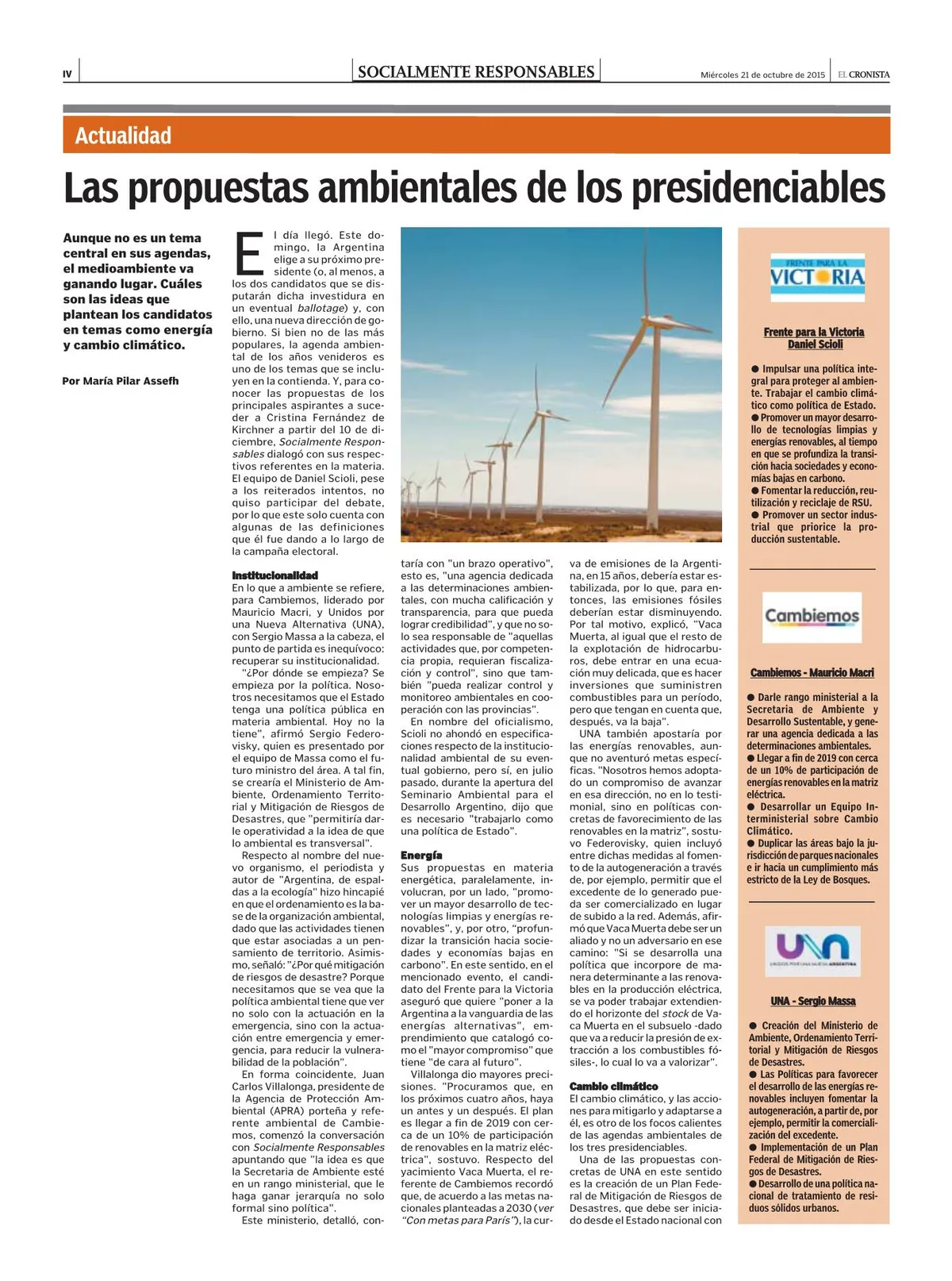
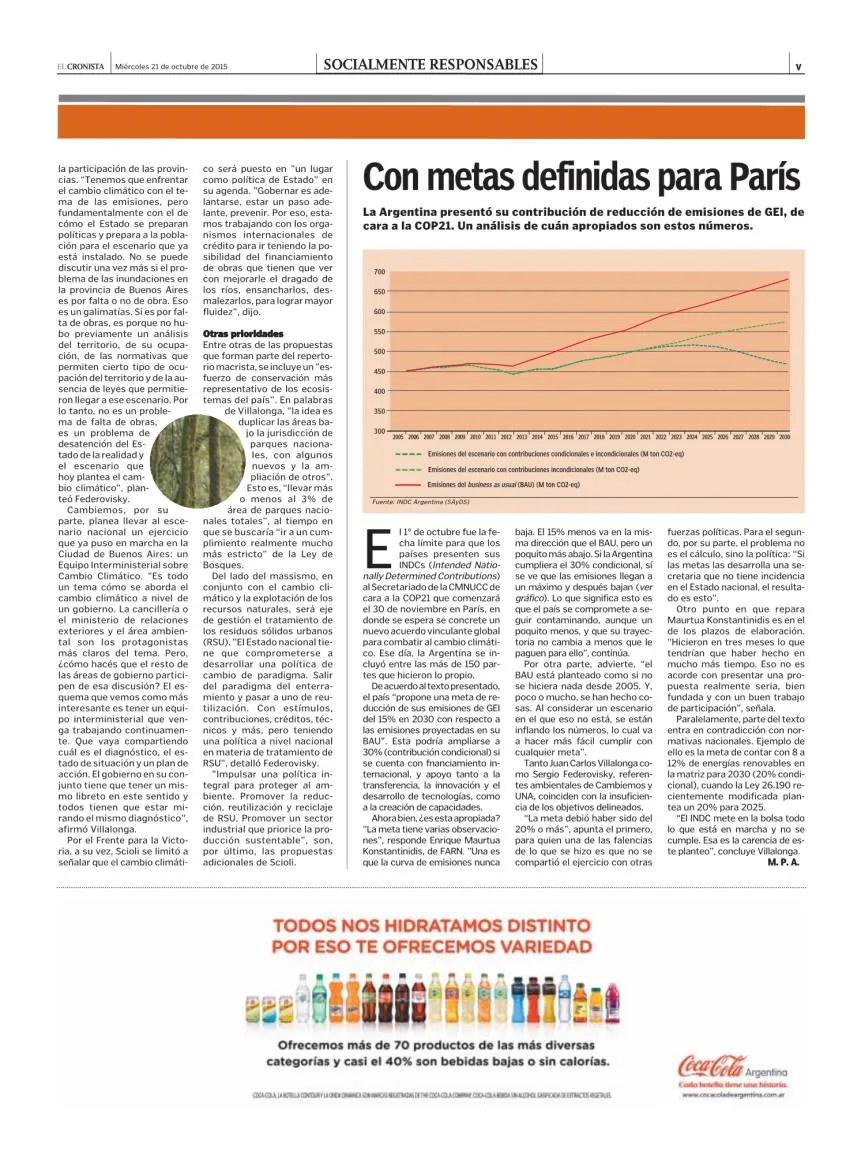
Some media outlets have interviewed the candidates of the parties that this Sunday will compete for the Rivadavia seat on their ecological stance, among them, the Vida Silvestre Foundation and the newspaper El Cronista in the supplement Socialmente Responsables.
Here I reproduce both publications which have a not insignificant difference: in the second one, the three candidates with the least chances according to the results of the primary elections are omitted. However, even if those three forces do not manage to reach the Executive Power, they will have representatives in the National Congress, so it is well worth knowing the thinking not of the candidates themselves, but of the parties and social sectors they represent.
The latest magazine of the Vida Silvestre Foundation can be downloaded from its website and they themselves also upload it to the site Issuu.com so it can be easily shared:
The supplement of El Cronista was published on 21-10 and can be seen at:
http://edicion.cronista.com:8093/20151021/#24
Furthermore, the article can be read here:
SCIENTIFIC MATTER
Regarding proposals on science matters, the candidates have expressed little on the subject, but it is worth mentioning at least the document presented by a group of scientists: The group, named CYTAR (for Ciencia y Tecnología Argentina), is made up of Eduardo Artz –doctor in Pharmacy and Biochemistry and director of the Instituto de Investigación en Biomedicina de Buenos Aires (CONICET- Max Planck) and of the Red Mercosur de BioMedicina (FOCEM)–, Fernando Goldbaum –doctor in Biochemistry and president of the Agencia Nacional de Promoción Científica y Tecnológica (MINCYT), Diego Hurtado –doctor in Physics, historian of science and president of the Board of Directors of the Autoridad Regulatoria Nuclear (ARN)–, Alberto Kornblihtt –doctor in Chemistry and director of the Instituto de Fisiología, Biología Molecular y Neurociencias (IFIBYNE-UBA-CONICET)–, Agueda Menvielle –Agronomist Engineer and National Director of International Relations of MINCYT–, Fernando Pitossi –doctor in Biological Sciences and head of the group of the Laboratorio de Terapias Regenerativas y Protectoras del Sistema Nervioso Central of the Fundación Instituto Leloir–,Gabriel Rabinovich –doctor in Chemical Sciences and director of the Laboratorio de Inmunopatología of the Instituto de Biología y Medicina Experimental (IBYME-CONICET), and Alejandro Vila –doctor in Chemistry and director of the Instituto de Biología Molecular y Celular de Rosario (IBR-CONICET)–.
The document was shared by UNSAM when publishing on 14-10 an article with the title "Una nueva agenda de ciencia y tecnología".
The document has been uploaded by me to ISSUU to be able to share it here:
I cannot fail to mention that such a document has two characteristics regarding its members: They are prominent Argentine researchers who have aligned themselves with the national policy of the last decade, so the document is not critical and its view of what has been done (and not done) tends to be optimistic.
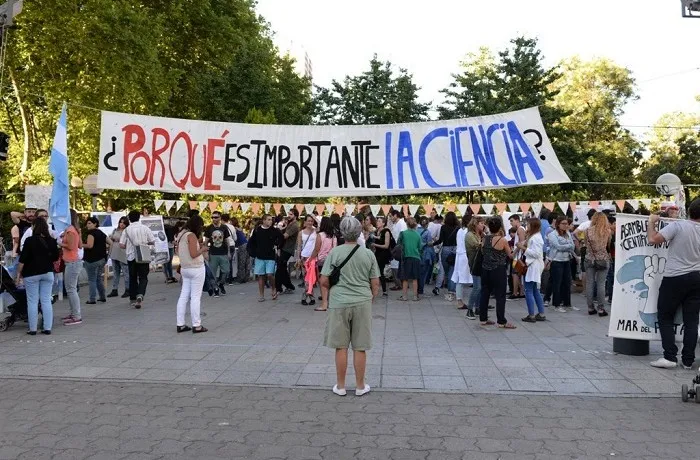
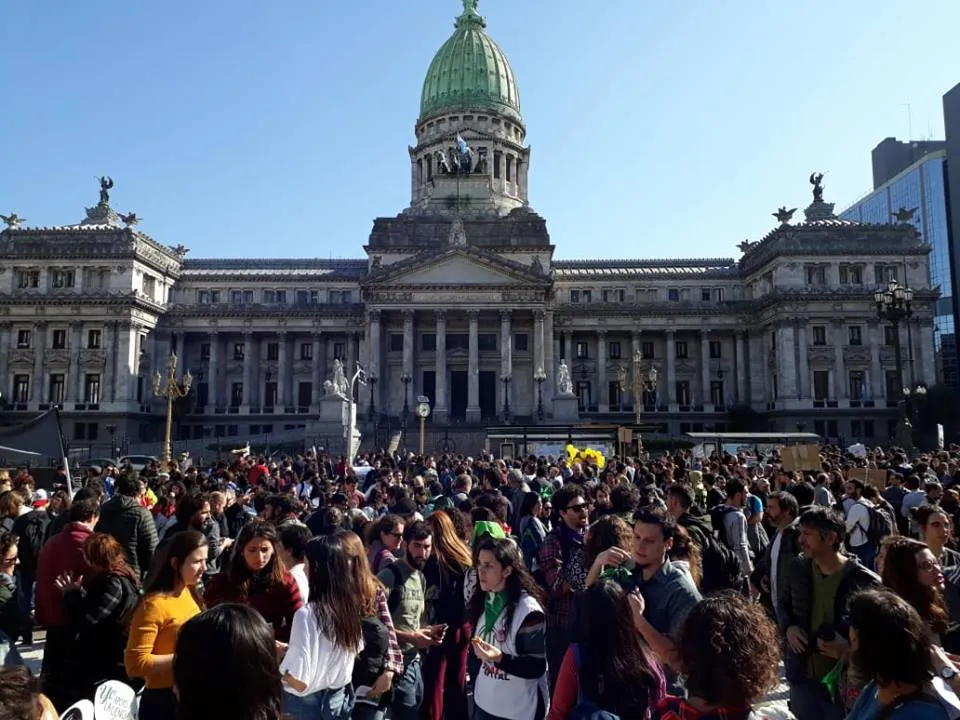
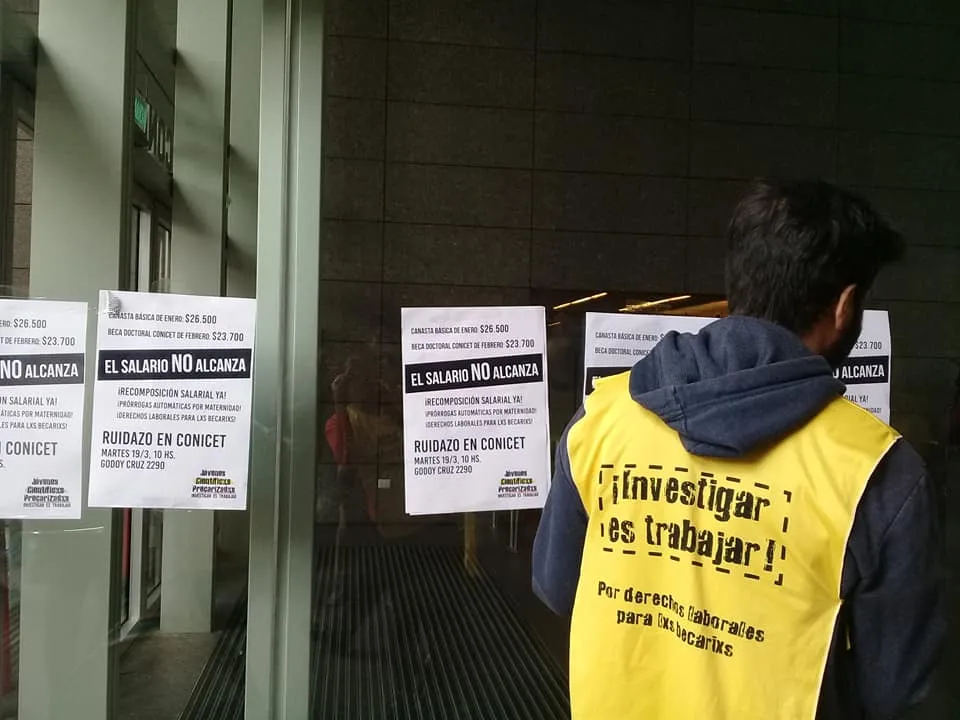
However, situations such as those that lead to today, the staff of Conicet Santa Fe mobilizing, are unknown there: “Years go by and officials and promises go by and remain unfulfilled. In the face of this, with firmness, we will continue to demand from the authorities –present and future–, that workers and current legislation be respected”, the workers expressed in a statement. The staff mobilizing today demands, among other points, job stability for all those who perform tasks in the organization, labor rights for fellows, and recomposition of fellowships and salaries. They also ask that retirees of the organization receive the 82% mobile, the democratization of Conicet, the return of the 7% of the annual report, and the cessation of the income tax which they qualify as a tax on salary. Lastly, they demand the “right to collective bargaining to build a collective labor agreement that replaces the statute in force since the dictatorship”, according to UNO Santa Fe.
Labor precarization in the scientific field is not something new. See article in Infobae (below).
Filmus for Barañao in Scioli's cabinet
It was learned in these hours that the one who will succeed Lino Barañao in the portfolio of Science and Technology, in case Daniel Scioli wins the elections, will be Daniel Filmus, who when consulted on Radio Nacional indicated: "Science and technology have been fundamental tools of a different outlook after the era of 'washing the dishes' and trying to change it only with the internet", Filmus asserted and added: "The creation of the ministry and everything that has been done in these years has been enormous. The challenge is to continue advancing in deepening research and transferring technologies. It is the only possibility of having an autonomous country".
Science and candidates: a survey
On the initiative of Drs. Guillermo Lehmann, Juan Pablo Zanin and Cristian Favre, a Forum of Information on Science, Technology and Innovation (CTI) has been formed.
The first objective of the Forum, within the framework of this year's presidential elections, has been to know the contents of the CTI programs belonging to each political space.
Of the four who expressed their opinion -except Ernesto Sanz-, today they are candidates for the Presidency of the Nation.
They are: Daniel Scioli, Mauricio Macri and Margarita Stolbizer. The opinions of these candidates in relation to the questions posed about CTI can be seen at: http://www.politicascti.org/
It is a shame that not all candidates answered the questionnaire. It is a right of citizens to know in advance the scientific policies of the parties and alliances.
The future
If in the last 12 years advances were achieved in scientific matters, such as the creation of the Ministry, the repatriation of researchers, the satellites, the improvement of salaries, and therefore the scientific policy carried out can be considered "progressive", there is not and never will be a true "progress" if at the same time workers are adjusted, both the intellectual workers of the scientific field, as well as the rest of the working class.
On the other hand, the "scientific question" cannot be analyzed separately from other social, political and economic aspects: for example, floods and energy blackouts are a consequence of the non-application of scientific knowledge to deal with problems that science knows how to solve, some in the medium and long term, but which have no solution for political and economic reasons. That is why science is not on the margins of other spheres of the res publica.
From here I point out that I do not want, as happened during the 1990s - years in which the three candidates with the greatest chances of reaching the Executive Power this Sunday were formed - researchers to be sent to wash the dishes. But I also do not want that mistreatment to be inflicted on the Qom, the majority of retirees receiving the minimum pension, workers laid off from any economic sector. Enough of extractivism and megamining. I do not want femicides or trigger-happy policing. I do not want inflationary adjustment or devaluation. I do not want subsidies for the rich and taxes for the workers.
I do not want to resign myself to the fact that, as Yupanqui sang, "the sorrows are ours, the little cows belong to others".
Sources and related links
- UNSAM: A new science and technology agenda
http://www.unsam.edu.ar/tss/por-una-nueva-agenda-de-ciencia-y-tecnologia/ - UNO Santa Fe: Conicet Santa Fe staff mobilizes for the bridge
http://www.unosantafe.com.ar/santafe/El-personal-de-Conicet-Santa-Fe-se-moviliza-por-el-puente-20151022-0003.html - Infobae.com: UBA scientists marched demanding a salary increase
http://www.infobae.com/2014/08/13/1587365-cientificos-la-uba-marcharon-reclamo-aumento-salarial - Radio Nacional: Daniel Filmus: “We are very confident in the evaluation that the people will make of everything that was built from 2003 onwards”
http://www.radionacional.com.ar/?p=80945 - PO: The "moment of science" and the K's
http://www.po.org.ar/prensaObrera/1300/sociedad/el-momento-de-la-ciencia-y-los-k
PO: Tecnópolis: "great event of cutting-edge science and technology maintained by slave labor"
http://www.po.org.ar/prensaObrera/1189/politicas/tecnopolis-gran-evento-de-ciencia-y-tecnica-de-punta-mantenida-por-mano-de-obra-esclava-1
Grupo de Gestión de Políticas de Estado en Ciencia y Tecnología http://grupogestionpoliticas.blogspot.com.ar/
10 theses on the new progressive extractivism installed in South America
Essay by economist Eduardo Gudynas on the reality of mining and oil exploitation http://plataformaenergetica.org/content/340
About the images
Images from Revista Fundación Vida Silvestre and El Cronista Comercial.