Reflections on what and how we choose.
Choosing is not an action linked exclusively to partisan politics, which takes place every two years, but rather a daily action, necessary in day-to-day life. We cannot not choose. Leaving the house or not leaving is, in both cases, a choice.
We are not now the same as when we were born. For at least 20 years, I have consciously chosen science. But what is science?
First, a fundamental question: what is choosing?
When individuals decide to join a group (be it a soccer club, a group of friends, a political party, an NGO, etc.) we do so based on basic or core coincidences, key ideas that we consider very important. This necessarily implies that with those groups we will have disagreements, but they will not be core, but secondary. And this is so because it is impossible to agree one hundred percent, always, with a group, whatever it may be, unless one falls into dogmatism.
Dogmatism is a form of blind trust that consists of believing, not in thinking critically, and is related to the concept of the Principle of Authority. However, the principle of authority is not always questionable. When I go to the doctor or the dentist, I trust the professional. Otherwise, if I went with distrust, I would have to verify in some way that the doctor really is one, and it is quite difficult to do so. For practical reasons, it is necessary to trust. But it is not a blind trust, but a lucid one. If the dentist, upon receiving me, asks me to undress, I stop trusting. In dogmatism, one never stops trusting, despite there being many indications that the one being trusted does not know or is wrong.
Therefore, I choose science in a lucid way, not in a blind way.
WHAT IS SCIENCE
The original question remains: what is science? Science is like a sharp knife, which is much better than a dull knife if what you want is to cut a hard element. Note that saying a knife "is better" or "is good" is not a moral consideration, but a utilitarian one.
However, a sharp knife could be used to solve a people's problem or to kill. That is where moral issues would come in, meaning that the knife is not morally good or bad "in itself," but in the social use we give it. But, at the same time, we can say that it "is good or better" than other knives for cutting if it is sharp.
The same happens with science. It is a set of methods and techniques that, through the use of formal logic, observations and experiments, is the best way to try to understand reality. Example: Why does it rain?
Pseudoscientific theory: It rains because Zeus punishes us. However, some do well with the rain and others do not. And, in any case, it is impossible to verify the existence of Zeus. Therefore, we either believe or we don't.
Scientific theory: it rains because water in the form of vapor that forms clouds condenses upon contact with cold air. This theory is verifiable, meaning we can take data from reality and see if when it rains this happens or not. There is no need to "believe" blindly.
However, this fabulous tool, which is the best for understanding reality, can then be used to solve people's problems or to kill us.
Blind beliefs have also been used against people, and furthermore, they are false, as is the case with astrology or the flat Earth theory, which are unverifiable and unnecessary and are based on the assumption that reality is as certain supposedly sacred scriptures say. That is, blind trust.
CHOOSING SCIENCE
Choosing science implies being in favor of methodologies that are better than others for trying to understand reality. And it implies knowing that, in many cases, science is questionable: fraud, plagiarism, weapons, pollution, are some of the possible objections to science.
Choosing science means, above all, trying to describe and understand reality, it is not a value judgment, which however, as a consequence of the former, can indeed appear.
The United States reached the Moon six times with crew. These are facts of reality filled with evidence, even if we don't like it. China and Japan have sent unmanned spacecraft to the Moon, which verifies that the technology allows it (despite what some say) and the photographs taken by these countries of the lunar landscape match those taken by NASA 45 years ago.
This in no way implies being in favor of the Government or Governments of the USA. In the same way, it is scientifically proven that Hitler existed, which does not mean that that description is a value judgment.
In a recent article, journalist Roger Cohen, who certainly does not think the Moon is made of cheese (1), is very critical of the current Government of his country:
If this is the United States, with a cabinet of sycophants who bow to the Great Leader, a vice president who pays a compliment every 12 seconds to Mussolini's substitute, and a White House that believes in 'alternative facts,' then it is time to 'keep your head when all about you are losing theirs.'
The reference to 'alternative facts' is to the current denialism of the Shoah or climate change. And the last quoted phrase is a paraphrase of the poem 'If...' by Rudyard Kipling, to which the author will refer again throughout his article. (2)
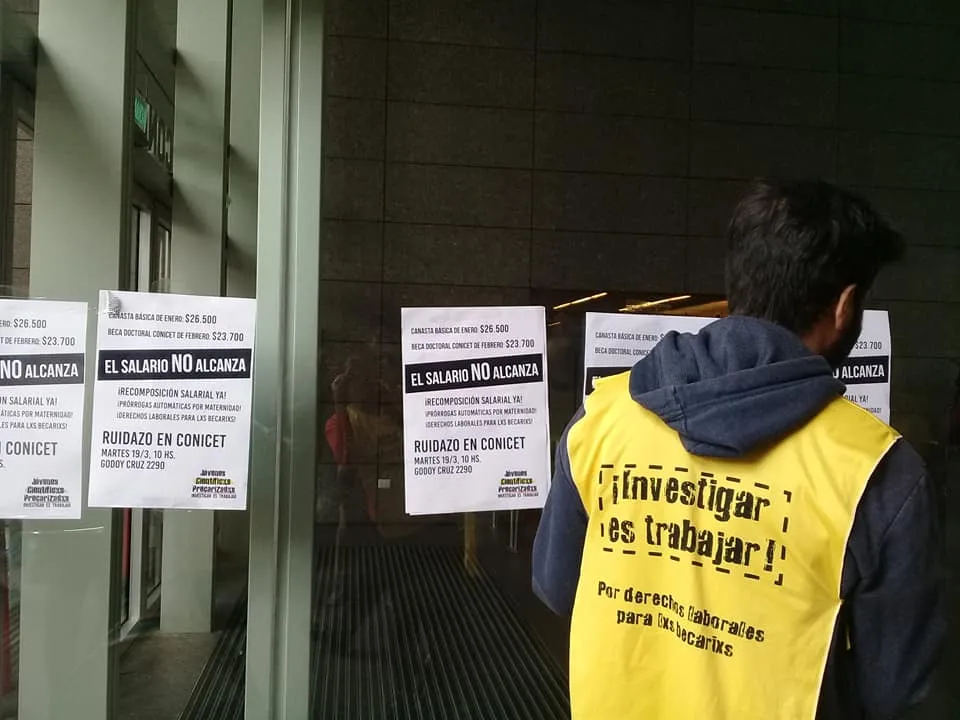
Choosing science is therefore choosing methods that are better than others for understanding reality. And for that to be concrete and not just an abstract idea, it is necessary to fund science. The percentage of the Gross Domestic Product that countries allocate to scientific research is usually scarce, so it is necessary to increase it. However, in many cases, the opposite occurs: austerity cuts research positions, as well as cuts jobs in general in the State, because a large part of basic science is assumed by States more than by companies. Scientists, similarly to retirees, cannot go on strikes, even though the former still produce and the latter do not, because scientific production is not immediate. If astronomers in a country went on strike demanding higher wages, there would be no social impact, as there is when teachers and doctors strike. They can carry out other protest actions, such as occupying ministries, petitions, demonstrations, which generally have little public-political impact.
It is necessary to create more and better jobs in general, there is no doubt about that. A large part of the problem with pension systems would end if the mass of active workers were much larger than it is now. That way, those problems would truly be solved. Cuts to retirement benefits, which are already meager, do not improve anything and are merely a violent patch. We must choose science and point out when "alternative facts" are invoked, like those used to try to change the meaning of a "cut" to a sector as if it were an "improvement" for that sector. That is pseudoscience, sloppiness, sophistry. Reality is, evidently, different.
I choose science not only so that there are more and better scientists, more and better funding, but I choose science for everyone, not just for professional research. More and better science communication; more and better formal science education.
VALUABLE ACTIONS
In this sense, I want to congratulate the initiatives taken by professional researchers to bring science to the general public, in various ways. For example, as reported in the latest Newsletter, the outreach talks given by Andrea Suad and Mariela Corti (3) from the Instituto Argentino de Radioastronomía; the greater inclusion of social science topics in the magazine Ciencia Hoy, the TV programs (broadcast and cable) about science, among other valuable actions.
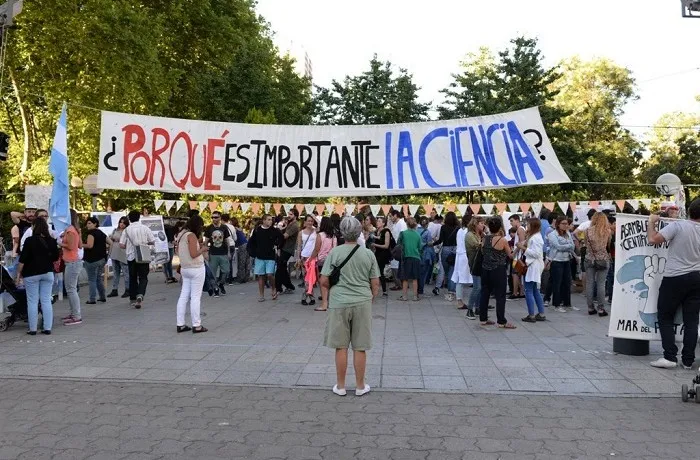
Both last year and in 2017, researchers who received awards like the Houssay were critical of the current scientific policy.(4) A valuable and promising action was a science fair held in Mar del Plata, for example, with the goal of explaining to the general public why it is important to do science.(5)
The stoicism that Roger Cohen appeals to is not enough; creative actions are required that challenge the politicians in power and, particularly, the ordinary citizen.
Those are my wishes for the civil year that is about to begin.
Sources and related links
(1) Roger Cohen: Kiplin' vs. Palin http://www.nytimes.com/2008/10/05/opinion/05iht-edcohen.1.16695732.html
(2) If This Is the United States https://www.clarin.com/new-york-times-international-weekly/?url=/clarin/story/content/view/full/79245
(3) Boletín Informativo del IAR http://www.iar.unlp.edu.ar/boletin/bol-dic17.htm#3f
(4) Letter for Macri http://nexciencia.exactas.uba.ar/carta-para-macri
Harsh Demand from Researchers to Macri at the Houssay Awards Ceremony https://www.eldiario24.com/nota/argentina/390310/duro-reclamo-investigadores-macri-entrega-premios-houssay.html
(5) Conicet: Expo Ciencia on the Pedestrian Street Against the Cuts http://quedigital.com.ar/sociedad/contra-el-recorte-en-el-conicet-se-hizo-una-expo-ciencia-en-la-peatonal/
About the images
Photograph from Quedigital.com.ar