I will hold a contest among the public to celebrate the blog's tenth anniversary.
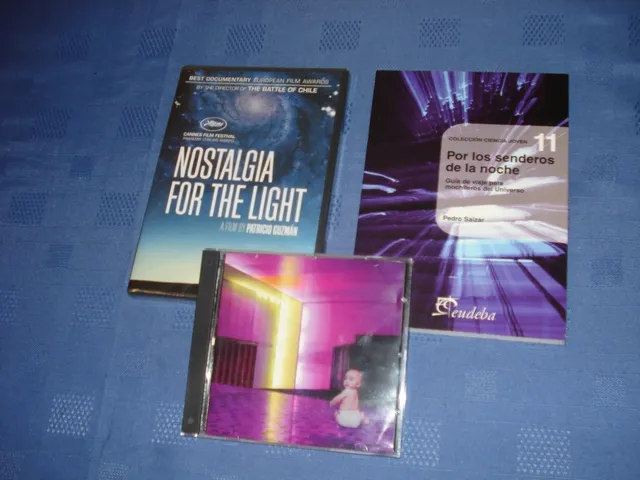
Book+DVD+CD as first prize and a book as second prize. Until June 30.

Borges is credited with a text about our mania for celebrating anniversaries, in a sort of fetishism of the decimal system that would suppose that every 10 years something different happens than every 9 or any other number.
In any case, this celebration is nothing more than an excuse to take stock.
Brief history of the blog
I had certain personal material (stories, poems, etc.) uploaded to the internet hosted on the Yahoo platform Geocities, knowing that it would be discontinued, as finally happened in 2009. So I thought about designing a site from scratch, with fixed sections (maybe "frames" as was customary then) to upload the same material there. But there were already certain content management platforms (CMS, in English) that I wanted to try. These CMS impose certain limitations, but also offer some flexibility. I tried several until a fellow student told me about the Blogspot platform. When I tried it, I told myself it wasn't what I was looking for. A blog's "hallmark" is that what is published last appears first. It is, therefore, a system strongly associated with the current situation, with the news, even if it is of a personal nature. After all, blogs were personal "logs."
Meanwhile, to those already published stories and poems, I began to add comments on astronomy news. A notable site called Astroseti already fulfilled that function, but there weren't many other alternatives. There, the idea began to emerge in me to track news, interviews, and materials already published in different media. At that time, I moved the more personal content to another blog and began to think about giving this blog a specific focus on astronomy. This happened in mid-2006.
Since then, the blog and I have changed. Among other reasons because studying and working take time away from other things and therefore, the frequency of publication decreased drastically. In those moments, however, I maintained a weekly section called "Multimedia Selection." One of the consequences of such a section was that I noticed that several people approached the blog or shared it on social networks, but those same people, on their Facebook walls or in emails they sent me, held a magical discourse. I told myself that I must be doing something wrong. The relationships between science and art open an ambiguity. I value those relationships, but I believed it necessary to be clearer in my position in favor of science and against pseudosciences. That implied, then, fewer "news" items (supposedly neutral) and more "opinion."
I'm sure many people didn't like that. Even those who would agree with me in my position might consider that there is no longer a need to have a discourse "against." Perhaps they consider it "negative or pessimistic."
Because of this change in content, I believed a change in name was also necessary. If I no longer published as much news as opinion pieces, the name "Latest News from the Cosmos" was almost a fraud. I opted, provisionally, as a tribute to Copernicus on an anniversary of his birth date (again the decimal system), to use the name "De revolutionibus." But finally, at the beginning of 2016, I chose a new name, which is the current one.
The blog's title refers to the Kósmos, as the Universe as everything, but it is also a word associated with order, the ordered, and therefore also with beauty. The word "cosmetics" comes from there.
And Logos is a reference to reason and the word. Therefore, their relationship implies the order of discourse and the discourse of order.
Scientific research is part of astronomical discourses, but also TV programs, movies, that is, social discourses that, unfortunately, include pseudosciences.
The blog has been, therefore, a practice and a search. On this journey, I had contact with professional astronomers, artists, and science communicators, some of whom I met personally and with whom a friendship began. I know other people only virtually. From many of them I learned, received criticism and suggestions, and often made changes in relation to those comments.
I was wrong many times. That's also how you learn. I thank those who, with good will, have pointed out those errors to me. And I learned to value the work, the task, of many other bloggers whom, without knowing them personally, I consider valuable.
For all this and because it is difficult to maintain a blog despite having to work and other times also study. There are more widely read blogs, with a greater number of subscribers. I am glad -sincerely- that this is so since I consider that in general they deserve it. Blogs like those of Francisco Villatoro, Kanijo (Manuel Hermán), Verónica Casanovas and many more, especially from Spain. Also the blog of Guillermo Abramson, the Sofista, my friend Alejandro Tropea whom I met through the blog. Enzo Bernardini and company deserve a monument for their splendid work on Sur Astronómico. And so many more. I learn from and admire those named and many others. A blog, therefore, is less "personal" than one might think.
THE CONTEST
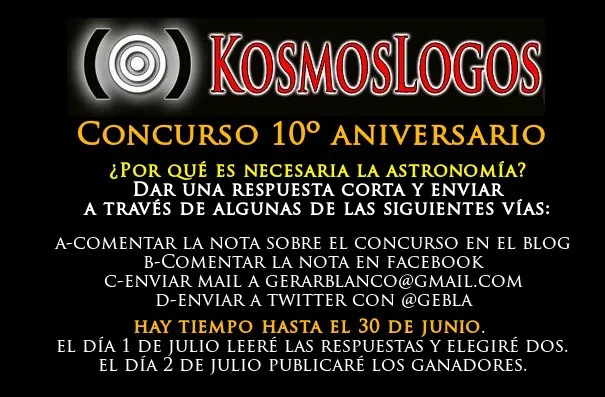
That's why I decided to hold a contest. To participate you must write a brief answer to the question: Why is astronomy necessary?
The answer can be sent as a comment on this post (when it is published on Facebook), or using up to 140 characters on Twitter (indicating @gebla) or by email to the contact address gerarblanco at gmail.com. You can also leave a comment on this entry using the Disqus form below the post.
The prizes
The prizes will be for two people. The first prize consists of a book+dvd+cd.
The book will be "Exótico cielo profundo" by Rodolfo Ferraiuolo and Enzo De Bernardini, fourth edition, 2012, which I recommended in Science Books by Bloggers.
The DVD will be "The Atom smashers," by Clayton Brown and Monica Ross (2008), which I wrote about in The Atom Smashers: The Documentary.
And the CD will be Música Espacial by Ensamble circular, by Ulises Labaronnie, which I wrote about in Multimedia Selection.
The second prize will be a copy of the book Corazones solitarios en el cosmos by Dennis Overbye, a NY Times journalist, which I wrote about in this post.
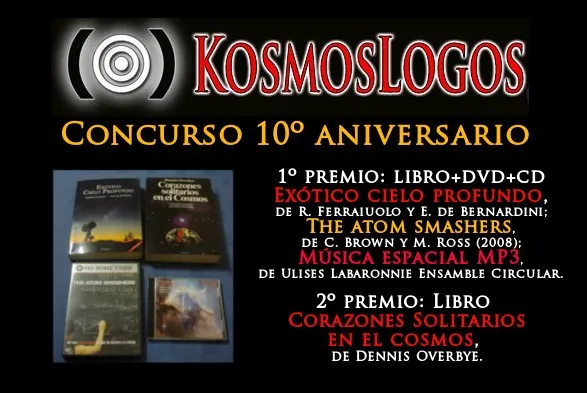
The winners will be chosen subjectively by me, but without any hint of favoritism, and the prize will be mailed to any place in the world.
To participate, there is time until June 30. On Friday, July 1st, I will review all the answers and choose the two winners, who will be announced as text added to this same post, and I will contact the winning people so they can give me a postal address for the relevant shipments.
The future of the blog
It's worth adding a small reflection on the present and future. There are several topics I would like to address in this space-time. Among them, the astronomy-theater relationship and ethno-archaeo-astronomy.
I would like to disseminate more astronomy activities throughout the territory, but due to time constraints, it is sometimes difficult to keep up with everything. That is why I suggested the need for a Nodo de la Astronomía Argentina.
I am open, of course, to suggestions for topics to address, which can be made through the communication channels indicated above.
UPDATE: 07-01-2016
The contest winners are:
1st: Juan Carlos Vallejo Velásquez (Caldas, Colombia)
2nd: Hilda Sierra (Buenos Aires, Argentina).
Both have already been notified by email, and in both cases, the packages were dispatched via Correo Argentino.
I share Juan Carlos's answer to the contest question:
Astronomy is important because it allows us to contextualize, with simplicity, the efforts the human race has made to understand itself and understand the dynamics of the planet we occupy. The evolution of human astronomical thought has followed the route of all sciences, from topocentric approaches to more integral and complex visions, in a universe still to be discovered where the conservation of Planet Earth is one of the priorities to guarantee our subsistence until we can move our home to a nearby and promising system for the development of our culture.
Astronomy is useful because it teaches us the place we occupy in the universe and what we must do to continue transcending in the sea of space-time.
For her part, Hilda Sierra indicated:
Astronomy is useful when it helps us understand climate change and predict solar storms. People need to eat to live, but also music or poetry, which are also useful and necessary. In a similar way, astronomy is also a necessity in understanding what all that we call 'Universe' is.
To conclude, I indicate that participation in the contest has been very low in quantity, but that some answers, like those mentioned above, are enriching. It is worth, however, reflecting on the reasons for the low participation. It is not very encouraging or motivating, certainly. Could it be due, in part, to a low interest in reading?