What do stars, cats, tattooed people and blonde models have in common?
1-Variable stars
Astronomers know about variable stars, that is, stars that vary in brightness in a regular way. They found one, then another, then more. Conclusion: all variable stars change brightness.
2-What are cats like?
I have a cat (or the cat has me...). Do you have a cat? Tell me if I'm wrong: cats are possessive, they climb on our legs and follow us when we go to the bathroom. They love to drink water from the kitchen or bathroom sink even if they have their own bowl next to their food. They spend their time licking themselves and frolicking. And at some point during the day they feel like releasing their energy by running back and forth. They love to knock things off furniture with their little paws... even if they are fragile things!
We know it's like that, even though we only know a handful of cats. That cat is like that; that other cat too; this other one the same. Conclusion: all cats are like that.
3-What are people with tattoos like?
They are evildoers, criminals or weirdos. Many criminals in prison get tattoos, pirates too. I know a person with tattoos who is very strange. I was told about another one who is in prison for murder. And we've all seen movies, right? Conclusion: all people with tattoos are weird.
4-What are blonde models like?
I know several models who are blonde and dumb. Many, let's say, about 30. Conclusion: All blonde models are dumb.
What do stars, cats, tattooed people and blonde models have in common?
Nothing significant. What they have in common is not in those people but in all people: the formation of prejudices and stereotypes. Now let's separate the wheat from the chaff.
DEFINITIONS AND CLASSIFICATIONS
Although all the examples have something in common, namely that from certain particular cases an absolute general conclusion is reached, there are elements that deserve to be differentiated.
A-In the first example there is a fundamental difference with the rest. Variable stars are such by definition. We can understand this with movies and film genres.
Someone once made a movie whose plot is set in the western USA, a century ago, with wagons, rifles, hero and villain.
Then someone made another different movie with many of these elements. Then someone made another. Movies that have several of these elements we call, by definition, westerns.
Something similar happens with variables. But variables are not all the same.
Some change brightness intrinsically (in simple terms, they seek a certain balance between gravity and pressure); others are so extrinsically, or they are not really variable: they seem to vary in brightness in our perception because another star passes in front of the observed one at some point, recurrently, in a binary system. Therefore, the change in brightness is not due to the star in question, but to an eclipse.
This last point should warn us of something we have known for millennia: objective reality is different from subjective perception. If we stop telling ourselves this, then we are lying to ourselves. Since this always happens (always, always), then can we do something about it? We'll see.
B-The description of cats I gave before is "real" insofar as I really own a cat that behaves that way and insofar as I know that many other cats do too. But I also know that not all cats behave the same, always. In fact, the cat I have now was rescued from the street. He was evidently mistreated and when I brought him home he was very withdrawn and lived hidden. That is, his behavior differed enormously from what was described before. A cat that lives threatened (according to what cats consider threats) will not behave the same as other cats that feel safe. So on the one hand the description is adequate for many cases, but not for all.
C-What was said in points 3-4 does not reflect my thinking, of course. It is stupid to say and think that all blonde models or all tattooed people behave the same. It is stupid because it is false.
D-But how do we know if something is true or false?
Note that the method in cases 2 to 4 is the same as point 1 insofar as from particular cases we reach a general conclusion.
But in the first point we do not define something by the cause of a behavior. As soon as we wanted to do that we found that the causes of the same "behavior" were different. That is, the causes for which stars vary in brightness are many (more than those indicated before) and that includes stars that seem to us to change brightness, but in reality do not (in regular periods, since over time all stars change brightness).
In points 2 to 4, on the other hand, the definitions I made on purpose for didactic purposes and which are similar to many discourses we actually make in life, respond to APPARENT causes from which we reach a categorical, biased, false conclusion.
And this type of discourse has several causes and consequences.
One consequence (and perhaps also a cause) is that we separate into groups of belonging and through such separations we favor those who belong to our group and do not favor (even harm) those who SUPPOSEDLY belong to other groups.
This consequence may also be a cause as a social motivation or need to belong and distinguish oneself (therefore to catalog and classify).
Classifying is not bad in itself, but it can be done well or badly. In fact, cataloging and classifying is inevitable.
What I have shown is nothing other than the formation of prejudices, which are inevitable.
But that they are inevitable is not a justification. Understanding is not the same as justifying. To be able to deal with prejudices we must first understand what they are and how they are produced.
If the formation of prejudices is inevitable since in our daily lives we do not act like scientists trying to minimize biases in inductive reasoning, then we should reach non-absolute conclusions.
In fact, even in the scientific field, when using that type of reasoning that starts from several particular premises to reach a general conclusion, there is the logical caution of knowing that the conclusion is PROBABLY true, but not necessarily true.
In everyday life we have more reasons to hold this probability since we do not take controlled samples of the observed universe, but only data from our surrounding reality, in a biased way.
If we learned something from our mistakes, then we know that it is very easy to mistake appearance for reality. Therefore, when forming a prejudice we should take it with a grain of salt, knowing that it is more likely to be wrong than to be right. And since scientific knowledge is shared, we should seek more precise information to know if things are as we think.
ASTROLOGY
If we are already clear about what prejudices are and if we know how to separate what is a prejudice from what is not, then, what is astrology?
Isn't it a sum of prejudices?
It seems that Leos are all the same and different from Virgos. It seems so, but is it? You meet a Leo person and they are impulsive. Then another and another. Will they all be? Why? What does the date of birth have to do with personality? Does the position of the Sun, moon and planets have anything to do with it? What thing, how? Do we know or does it just seem so?
If it only seems so, but it isn't, isn't that a prejudice?
Evidently, to deal with prejudices, science is needed. This does not prevent that within the scientific field itself one also falls into prejudices, as I already pointed out in a previous post.
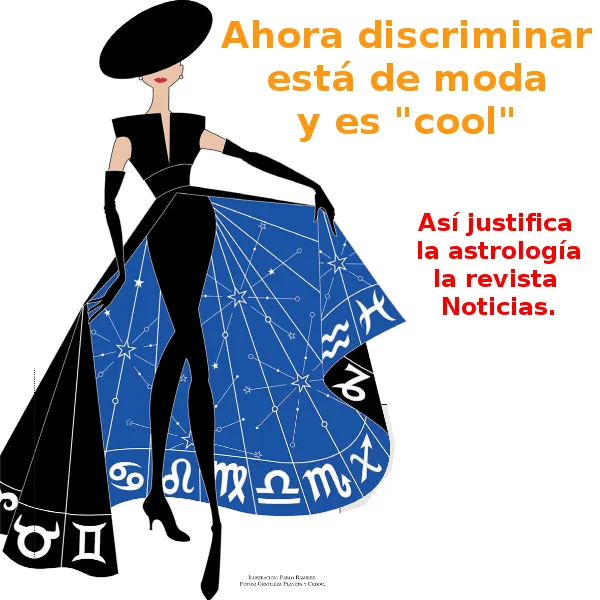
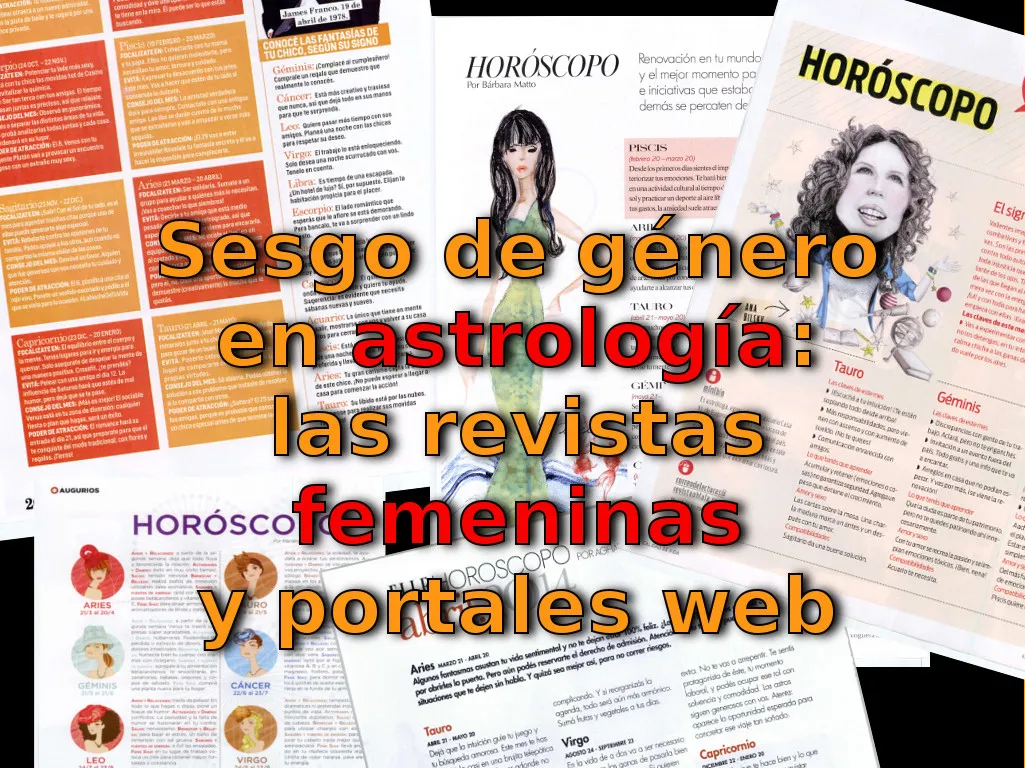
If astrology is a sum of prejudices, why are they validated in horoscopes published by general-interest newspapers and women's magazines?
Certainly these prejudices were not created by the media, but they were massified and validated by newspapers and magazines.
Can the editors of those newspapers respond to this? Do they care about being creators or accentuators of prejudices?
What about journalists? And readers?
Astrology is a symptom that despite having progressed in many ways, in others, not so much.
Prejudices are not only negative preconceptions towards a group. Positive ones are also prejudices. You cannot be against black people without being in favor of white people. Even though in one case it is negative and in the other positive, in both they are false ideas. Neither are black people inferior nor white people superior.
Foreigners are neither worse nor better than natives.
Millennials are neither worse nor better than those of Generation X.
Prejudices unite us, but they also separate us. It is true that we are often right and also that we are often wrong.
That is why astrology is a problem. It is a serious problem. More serious than those who seem to think it is just a "mere entertainment" think. Astrology articles are published almost every day on websites and newspapers and magazines (at least in Spanish). The idea that there are people who behave in one way and different people by virtue of their date of birth due to the supposed "cosmic" influence—never explained nor investigated—of the Sun, moon and planets (including Pluto, but not Ceres or the moons) is reinforced with the horoscope, every day.
CONCLUSION
Astrology is a serious problem because it is still here among us. But it is a symptom of something even greater that runs through global society in terms of the formation of prejudices (ideas) that lead to action. Discourses are not harmless.
And those prejudices are a symptom of a deeper problem: not being clear, after thousands of years of history, that it is difficult to know what objective reality is like and that always, to a greater or lesser extent, our subjective perception is different. To narrow that gap, science is needed.
The problem with astrology is not Ophiuchus nor precession nor the profit of astrologers nor ambiguity. All those characteristics are important to consider, but the core of the problem is another.
I leave below a video of a TED talk about prejudices because I consider it very interesting to address the issue starting from the fact that it is false that those who form prejudices are bad. It happens to all of us. But that cannot be a justification to continue with it, but rather the impulse to understand first and overcome it later.
There are still those who maintain that by saying this I am right, but I am like Don Quixote fighting windmills in a lost battle because it is imaginary, utopian, idealistic. And there are those who consider that I am wrong. Very prestigious people like Liliana López Foresi or Jorge Asís.
It is true that I have my days when I tell myself that it is possible that I am imagining all this. So many people point elsewhere...
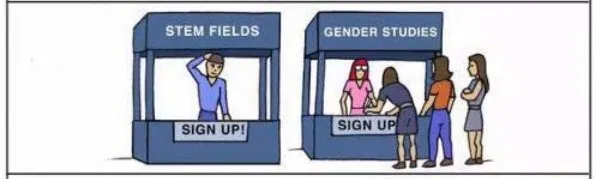
They point to black people, women, foreigners, teachers who want a decent salary. It must be that those groups are "badly aspected".
Can prejudice be good?
https://www.ted.com/talks/paul_bloom_can_prejudice_ever_be_a_good_thing?language=es#t-501916
About the images
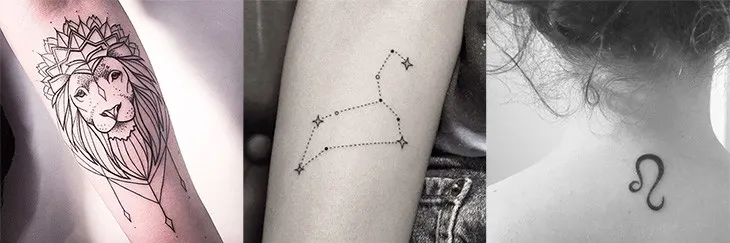
Zodiac Sign Tattoos http://serchickas.blogspot.com.ar/2016/06/tatuajes-de-signos-del-zodiaco.html