How the HETDEX experiment mounted on one of the largest telescopes is changing the way we study the universe.
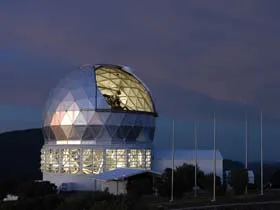
The Hobby-Eberly Telescope has existed since 1996. In recent years the instrument was updated with better equipment so it can carry out the fine tasks required for the HETDEX experiment aimed at investigating dark energy.
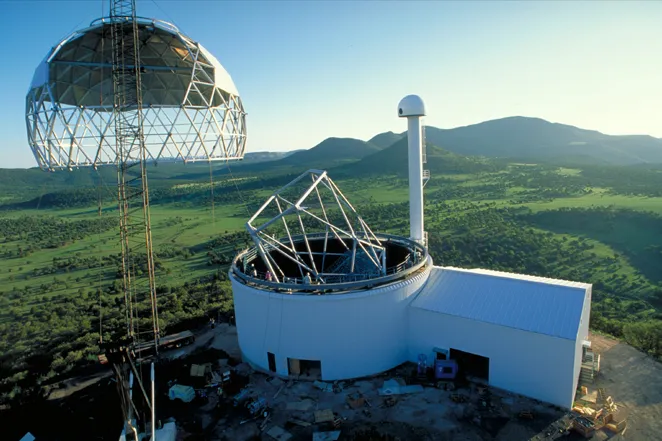
The telescope is already exceptional in itself: it has an effective aperture of 10 meters and 78 m2, an array of 91 hexagonal mirror segments. Its construction cost 20% of other 9-meter telescopes due to its particular design, situated at an elevation angle of 55º. Each segment of the mirror assembly is 1 meter and its alignment is possible by a series of actuators adjustable to 1/3 of the wavelength of light (218 nm). The segments are spherical, like contact lenses, with a radius of curvature of 26 meters with a precision of 0.5mm. A sensor located at the center of the segment's radius of curvature, 26 meters from the mirror, is at the top of the tower next to the HET (the Center for Curvature Alignment Sensor tower, CCAS for its acronym in English).
HETDEX and the paradigm shift
Usually in astronomy and other sciences, one looks for something in particular. For example, if you want to investigate globular clusters, you point the telescope at some of them. The same with other objects. In short, you point at what you want to observe. With the HETDEX experiment, things will be done more the other way around. The instrument will observe the sky and accumulate petabytes of data. Therefore, it does not look for anything in particular, but for everything. This methodology is not completely new: there have long been telescopes that observe the same parts of the sky more than once and then the data stored in computers is processed automatically to compare both images looking for some alteration, for example a change in light.
The objective of the experiment is to investigate dark energy, for which they propose to study one million galaxies at distances of 9 to 11 billion light-years. To achieve this in appropriate times they created VIRUS, an acronym for Visible Integral-Field Replicable Unit Spectrographs, that is, spectrographs. HETDEX will consist of 150 VIRUS units. By splitting a spectrograph into 150 boxes, its assembly is faster and for less money, as indicated on the experiment's website. Each unit contains a bundle of 230 optical fibers.
With such technologies and the current possibilities of storing enormous amounts of data, we are moving from the "wysiwyg" paradigm ("what you see is what you get", in Spanish "lo que ves es lo que obtienes") to another that could be called "you observe everything, you get everything". But it is not as simple as it seems because if you look for rare trees in a huge forest it is like looking for a needle in a haystack. Here then appears the need for human ingenuity again, now to program data processing routines, with which professional astronomers are increasingly programmers of computer codes.
A commentator on the Wired site very aptly recalled a scene from the movie "Zero Effect" (Jake Kasdan, 1998) in which the protagonist Bill Pullman as the eccentric detective Daryl Zero says in voice-over as a lesson:
"A few words on looking for things. When you go looking for something specific, your chances of finding it are very bad, because of all the things in the world, you're only looking for one of them. When you go looking for anything at all, your chances of finding it are very good, because of all the things in the world, you're sure to find some of them".
However, is this really the case? Are they really going to look for literally "anything" as indicated by an article in Wired?
https://youtu.be/LcVph_23VIE
Cited scene from the film, in English.
HOW DARK ENERGY WORKS
Einstein's field equations include the Cosmological Constant with a precise rule for cosmic acceleration: the larger the size of the universe, the greater the acceleration. In other words, the pressure pushing the universe is inversely proportional to the density, P ∝ w ρ, with w = -1, where P is pressure, ρ (rho) is the energy density and w is the constant.
But is it true? An alternative is that the acceleration of the expansion is due to "quintessence", a form of energy whose equation of state is P=w ρ c2 with w variable.
The idea with HETDEX is to measure the amount, but also the evolution over time of dark energy to know if w is constant or variable. For this, they try to trace the fluctuations of the background radiation by observing the large-scale distribution of galaxies that formed from those fluctuations and measuring how the separations between clusters and voids changed with redshift. For this, then, many measurements of distant galaxies are needed.
A calculation made by astronomers at Penn-State University indicates that with HETDEX they will obtain 10,000 galaxies each night, during 140 nights of observation. Yes, it's checked: 10,000 (ten thousand) galaxy spectra with cosmological redshift (z) between 1.9 and 3.5!
The analogy of the Zero Effect
Let's return to the detective. A person disappeared and they try to find out the reason. They go to his office and find 1 million books with annotations. Let's say each book indicates the date it started to be written. If each book is reviewed and the initial date is recorded, by doing this with the whole set, the historical speed of writing such books and how that speed changed can be known. The moment there is a significant change, an acceleration or deceleration, the detective will know at what moment in space-time something important happened.
That's why it's not so true that the telescope will look for "anything". However, it is true that the instrument with its new capabilities can be used to investigate different objects and that the set of observations could contain many "smoking guns", clues to investigate different aspects of the universe.
But we can also think of the film analogy in another way. Without counting the closing of the audiovisual work, I can advance that in the end we must rethink everything we were told. On the other hand, it is also called the "zero effect" when no evidence is found for something that is being sought.
I point this out because, just as indicated in the outreach video from the Institute of Theoretical Physics below these lines, it is quite possible that the universe is NOT expanding in an accelerated manner and that dark energy is not necessary to explain anything. When something is very hard to find, it may be that it is difficult to locate or simply that it does not exist.
It is necessary to remember this so as not to be like that other detective in the film Basic Instinct who falls in love with the suspect. Although I wouldn't blame anyone for getting excited about such a structure. I'm not referring to Sharon Stone (only), but to the techno-architectural marvel of this beautiful telescope!
Sources and related links
- Astronomers Don’t Point This Telescope—The Telescope Points Them
https://www.wired.com/2017/03/astronomers-dont-point-telescope-telescope-points/ - HETDEX
http://hetdex.org - Texas University
http://www.as.utexas.edu/mcdonald/het/het_gen_01.html - Penn State University: Hobby-Eberly Dark Energy Experiment
http://astro.psu.edu/astro-research/facilities/hobby-eberly-dark-energy-experiment - Wikipedia: Quintessence
https://es.wikipedia.org/wiki/Quintaesencia
About the images
University of Texas gallery. Credit: Thomas A. Sebring