Is there a bias in the directionality of astrological discourse? Here I will show why I insist that there is, based on the categorization and review of women's magazines and news portals.
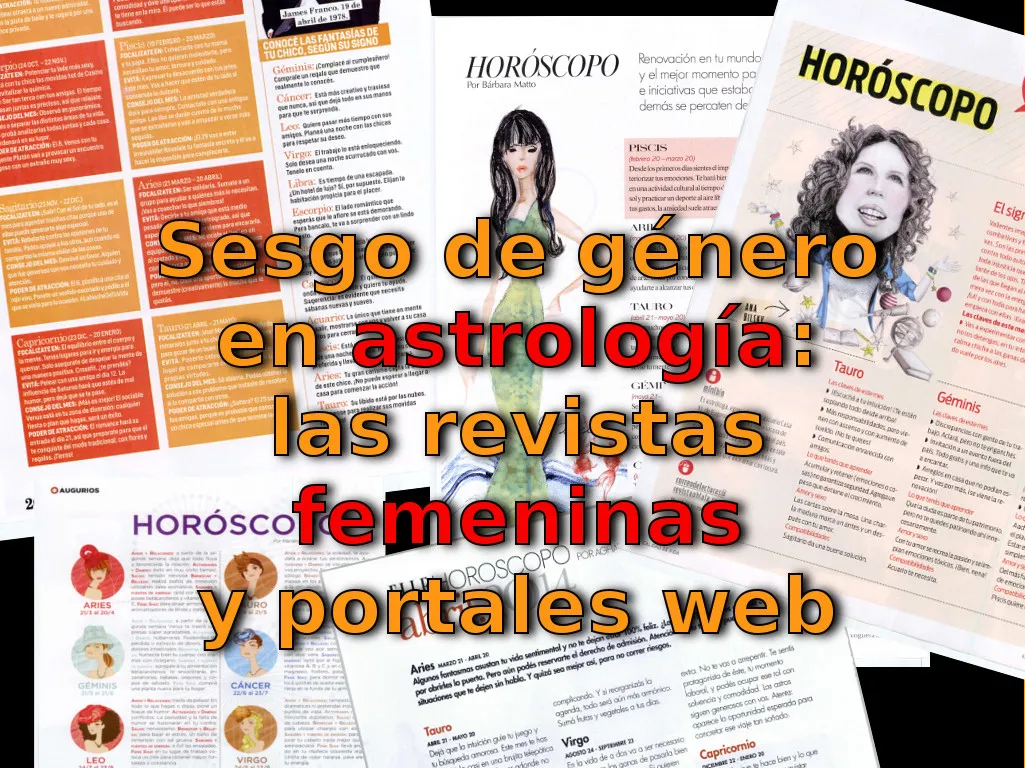
For more than four years I have been collecting data from magazines and since then I have not stopped noticing a bias in the audience to which the horoscope is directed: Women's publications.
In addition to news portals, where astrological articles are published in certain sections aimed at women, paper (or web) magazines aimed at women mostly have the horoscope as a fixed section, published in each issue. In the case of Sophie magazine and Look magazine, I did not find the horoscope as a section, although there were astrological articles. Elle, Cosmopolitan, Vogue, Entrecasa, Susana, Maru, Mia, Harpers, Para ti, Para teens, Utilísima, Vanidades, Ohlala have fixed horoscopes.
Magazines aimed at women are those in which several things are noticeable that allow their classification:
1-Enunciative-grammatical elements: for example, in Cosmo, it reads: "Get to know your guy's fantasies, according to his sign." In Elle, it says "This month you have become almost a telepathic little witch..." And also "A very strange thing for a freedom-loving Aquarian, you are bringing out a certain possessive side..."
2-Visual elements: drawings, photographs, that illustrate the horoscope and the articles.
3-Advertising for certain types of products such as perfumes, shoes, handbags (linked to point 4).
4-Historically feminine themes: cosmetics, fashion shows and women's clothing (skirts, dresses, high heels), DIY, gardening, handbags and shoes, perfumes. Some themes are ceasing to be thought of as feminine, becoming more unisex, such as gastronomy.
5-Media kits: A media kit is a text in which a commercial brand is presented, a cover letter. The intention is to seduce advertisers and therefore, show the reasons why it could be useful for companies to advertise in a magazine. On the websites of some magazines there are media kits that include the target audience data. I started using this criterion more recently, so I am still compiling the data, but as an example, a button from Vogue magazine's MK, downloaded from its website, is enough. Additionally, the mk indicates that 81% of subscribers are women.
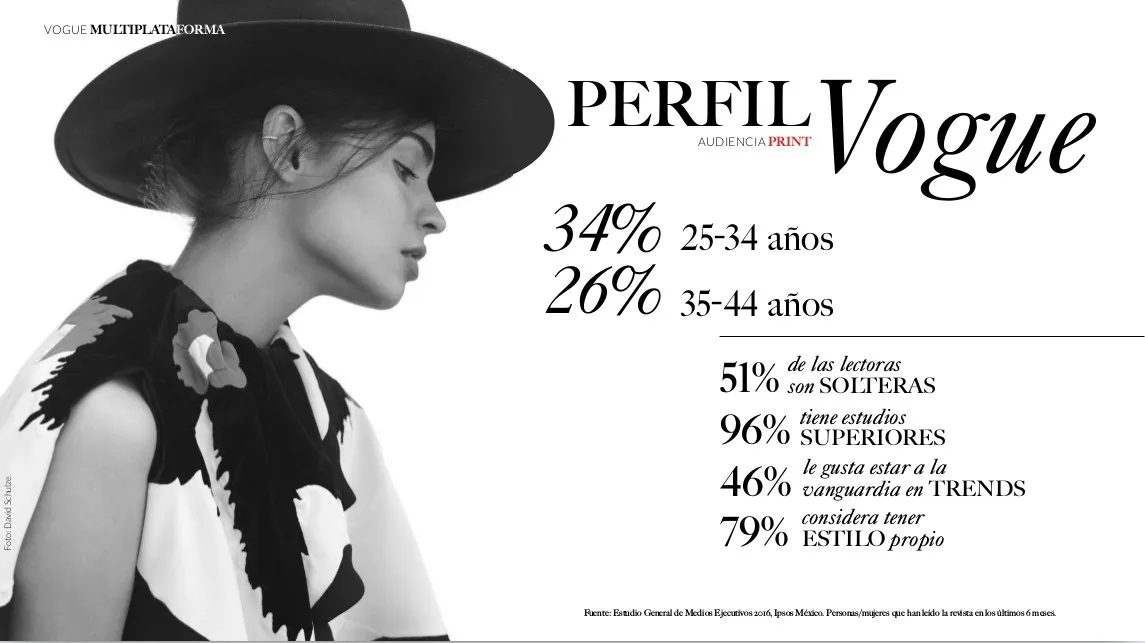
I note that these criteria do not take into account who writes or who reads such magazines, that is, the senders and receivers are not considered, but the potential public, the target. These criteria are not taken into account because it is difficult to know who writes just by the name nor who reads (except through surveys). In some cases -and it is usually private information- it is possible to know who buys, if it is by subscription.
A theme that can still be related to women is showbiz gossip (theme known as "pink press"), in which case magazines like Pronto, Paparazzi and Semanario (which also publish horoscopes) should be included.
The Sunday magazines of newspapers (La Nación, Viva de Clarín, Luz de Perfil) contain articles aimed at women, but also others that are not, in which case, they should not be considered as feminine. Something similar could be said of magazines like Caras and Gente that are often offered for reading in "men's" hair salons. Someone might think that these exceptions are not really exceptions, but given the criteria stated above, they should be considered unisex or neutral magazines.
On the other hand, in magazines like GQ (Gentlemen's Quarterly), Brando, Men's Health, Maxim, Hombre, FHM, among others (from Argentina and abroad) they do not publish the horoscope as a fixed section and rarely have articles about astrology, although they do address some pseudoscientific themes like sports superstitions. Other magazines like business magazines are not considered in this analysis as masculine, despite the gender bias that effectively exists in corporate executives, since they are specialized magazines. Similarly, other magazines with a single or little varied theme are not considered, such as gardening, travel, outdoors, fishing, motorsports magazines.
On the other hand, the (few) astrology magazines have articles aimed at women and men (according to the first enunciative criterion).
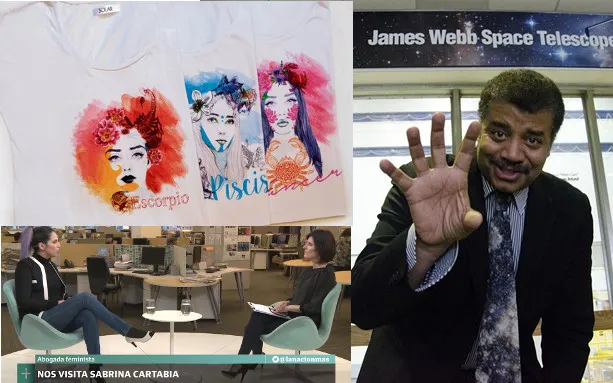
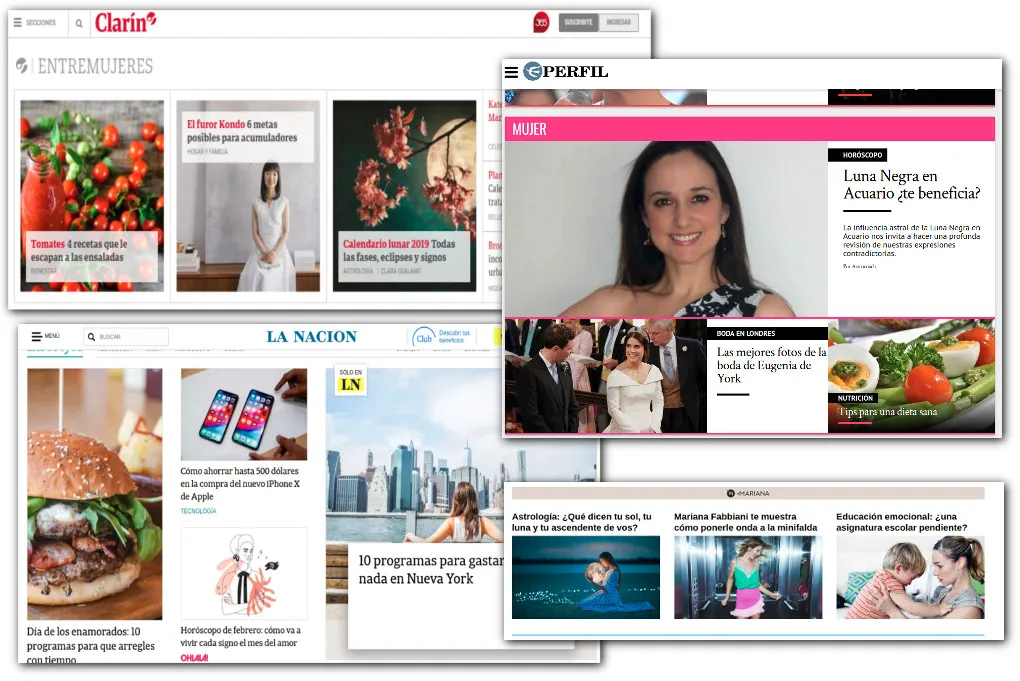
If you review the web portals you will find the same thing, since in many cases the paper magazines have websites, but there are also other publications particularly aimed at women, which we can know by the name, the content and the enunciative-grammatical criterion. In such women's portals the horoscope is published as a section, while the same is not found in men's portals. On general news sites, astrological articles are published in some cases in general information or curiosities or services sections, but on the most important news portals in Argentina, such as Clarin.com, Lanacion.com, Perfil.com and Infobae, astrological articles are published in sections aimed at women, as demonstrated by visiting those sites and illustrated with this composition:
One thing is to find the bias, another is to confirm it. Confirmation made by the same person is not enough. Hence I promote that other people do independent analyses, with their own criteria. The importance of doing so lies in the fact that the elaboration of an anti-astrological discourse must take into account to whom astrology is directed to be more effective.
On the other hand, one thing is that it happens and another the causes. Perhaps it is thought that women are more emotional and less rational than men. All the people who taught me mathematics in school and later were women. It is, clearly, a prejudice, a cultural bias. Astrology is nothing more than a factory of millennial prejudices that claims to describe people without knowing them and without justifying how it reaches its conclusions, based only on myths.
The interesting thing is that if it is a macho prejudice, then why aren't feminist women against astrology? The vast majority of discourses against astrology in the 20th century and until now were written by men. Women, when will you?
Sources and related links
- The horoscope in "women's magazines"
https://sites.google.com/site/gerarblanco/ensayos/lossentidosdelhoroscopoenelsigloxxi/revisfem - Comparative study of women's magazines in Argentina.
The cases of "Sophia" and "Ohlalá", 2010-2013.
Author: María Florencia Vago
Universidad de San Andrés - Licenciatura en Comunicación.
http://hdl.handle.net/10908/11727 - Vogue Magazine Media Kit
https://condenastmexico-latam.com/wp-content/uploads/2018/12/MK-VG-ESP-LT-SITIO.pdf