March for Science is a global initiative, with its epicenter in Washington, that will take place on Earth Day, April 22.
On the official site of the March for Science movement, they indicate who they are and why they march. Here is a translation:
Why
Science and scientists are under attack. Budget cuts, censorship of researchers, disappearance of data and threats to dismantle agencies harm the public in matters of health, climate and put jobs at risk. It is time for people who defend science to take a public stand and be noticed.What
The March for Science is the first step of a global movement to defend the vital role science plays in our health, safety, economies and governments.How
We are building a diverse coalition of organizations and individuals, broad and non-partisan, that defends science. We advocate for evidence-based policies, science education, research funding and inclusive and accessible science.Who
People who value science. Science advocates, educators, scientists and concerned citizens.Where
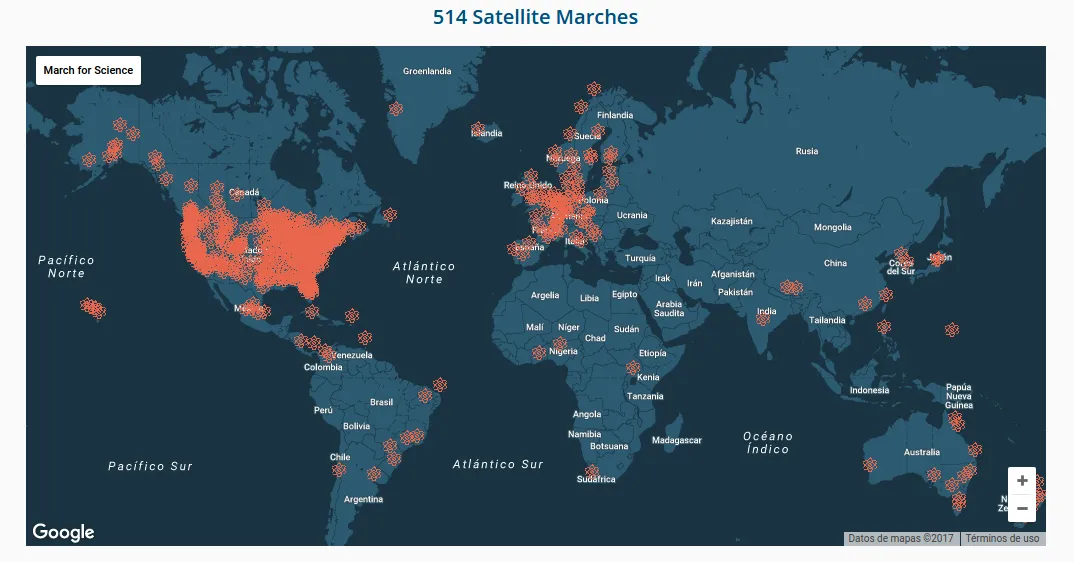
On the National Mall in Washington DC and 425+ satellite marches around the world.When
April 22, 2017. But it's only the beginning...
Background and reasons
To try to understand the origins and motives of this global march, it is worth analyzing certain discourses. On the Sciencenode.org site there are several posts about this march. There it is pointed out, for example:
The March for Science picks up the mantle of resistance against tyranny on April 22, this time against anti-intellectualism and open hostility to the principles of rational discovery upon which our founders built our nation and the modern system of democratic and representative government.
The same text indicates that the March for Science in Boston started spontaneously, through forums and social networks. It also explains that this movement began from objective conditions: budget cuts in the USA (for example the Environmental Protection Agency). Many scientists who until then were reluctant about politics began to express their concern.
It is not far-fetched then to relate these marches to the rise to power of Donald Trump. But it happens that there will be marches in almost all of Western Europe.
In a post about the marches in France, it is indicated that the movement is coordinated by an apolitical collective that considers scientific knowledge not to be an opinion. (Note1)
Some common points linked to this movement are:
1-Funding science: expanding budgets instead of cutting them
2-Diversity of age, gender, ethnicity, religion (or lack thereof), political affiliation or socioeconomic status.
3-Communication: the possibility of communicating science freely and without censorship.
4-Public policies must be informed and guided by evidence-based scientific research, local scientific knowledge and general scientific consensus.
5-Literacy: Initiatives to promote public knowledge of scientific topics, understanding of how scientific research is conducted and how to consume media about scientific studies for all age groups and demographics should be supported.
Based on the above, I insist on considering the relationship between this movement and "Trumpism" not far-fetched, but not as a relationship with a particular government, but with the rise of a certain type of discourse that denies climate change (and favors oil companies); opposed to immigration policies and therefore also anti-global.
Donald Trump is a symptom, but not the only one. In Europe there is also an advance of this type of discourse. And also in other parts, like Latin America.
On the site of the March for Science of Chile it is indicated:
Many researchers see the difficulty of acting and channeling concrete proposals, because they are not considered or heard by the power groups that today make decisions in different instances of the country. This has resulted in a State that has set aside the opinion of its citizens and has prioritized economic criteria for decision-making. Politics cannot become a space of restricted action for a few bureaucrats, but must open up and expand towards citizens in all their expertises.
According to the official site of this Global March for Science, some organizations from Chile, Brazil, Argentina, Colombia, Costa Rica and Mexico are participating.
In the case of Argentina, the only organization that adheres to this march is Jóvenes Ecólogxs en Red.
My opinion
First, I want to make clear my objection to Note1 indicated above. Science IS opinion. Data does not speak for itself, but must be interpreted. The difference between science and something else is the type of opinion. Science rationally argues its opinions not based on particular feelings. An example is worth giving that will later serve us to say something else:
That people opine that they feel the Moon is square, triangular or that it does not rotate is of little importance as long as those feelings do not influence the shape and movement of the Moon.
In those cases, the subjective perception of people does not influence objective reality.
But in social reality, things change.
Suppose a society is objectively safe, but a person feels it is not and therefore buys a gun. Since they do not know how to handle the gun, it goes off by accident causing a death or injury. Then, the subjective perception will have modified objective reality. In these cases, subjective perception is VERY important.
It is most common for our subjective perceptions not to coincide with objective reality. That is why science is needed, because it is difficult to know what reality is like. If we base ourselves on particular sensations, which are usually few and biased, then appearances will deceive us. Here prejudices are born, inevitably. What is not inevitable is staying with them, instead of overcoming them.
However, these relationships between nature and people could be classified as genuine and naive. But it is not all that happens. Those who oppose climate change, for example, are in many cases scientists. I recommend watching the new Cosmos series, in particular the episode about lead in fuels to notice that there are vested interests even WITHIN science.
And those who are right are not always the majority.
But one thing is the debate of scientific ideas (argued based on data and theories) and another is for political and economic power to intervene in favor of what suits them, censoring the others.
If there is debate in science (and there should be), then it is not ONE opinion, but several. In the long run, the one with the greatest evidential weight will prevail, not just the greatest consensus. The Steady State Theory was the one with the greatest consensus from the 1930s to the 1960s, but no longer.
For the reasons stated, I believe it is a mistake to insist that science is not opinion. The ancient debate between doxa and episteme is not the dichotomy between opinion and evidence, but between vulgar opinion and scientific opinion.
That said, I adhere to a global, diverse, inclusive, educational science, one that fosters critical thinking and is always subject to reasoned debates. A science that values local human resources in international collaboration. A science that enables the development of "peripheral" countries with their own agendas arising from the needs of each region.
A science that gets involved in public discussions to develop better arguments on topics addressed in a vulgar way by the mass media.
Finally, science is not exempt from class contradictions: there are scientific workers, scientists who apply budget-cutting policies, and "entrepreneurs" who, as employers, pay insufficient wages.
Will other scientific organizations in Argentina join this mobilization?
I don't think it's necessary to agree on everything with the slogans of this global march, although it is necessary to agree on the main ones. Local marches can have their own slogans and divergences from the original movement.
In my view, that science gets moving is positive and necessary. Someone already said that everything that is static and stagnant vanishes (All that is solid melts into air).
Sources and related links
- March for Science
https://www.marchforscience.com/satellite-marches/ - Science Declares War on Trump
http://elpais.com/elpais/2017/01/26/ciencia/1485424411_820201.html - Let's start our March for Science in Boston
https://sciencenode.org/feature/lets-start-our-science-march-in-boston.php - Les Marches pour les Sciences in France
https://sciencenode.org/feature/les-marches-pour-les-sciences-in-france.php - Marcha de la Ciencia Chile, Manifiesto
https://marchaporlaciencia.cl/#manifiesto - The March for Science on April 22 will be global
http://www.tendencias21.net/La-marcha-por-la-ciencia-del-22-de-abril-sera-global_a43738.html - March for Science - Argentina
https://www.facebook.com/events/122518608283681/
About the images
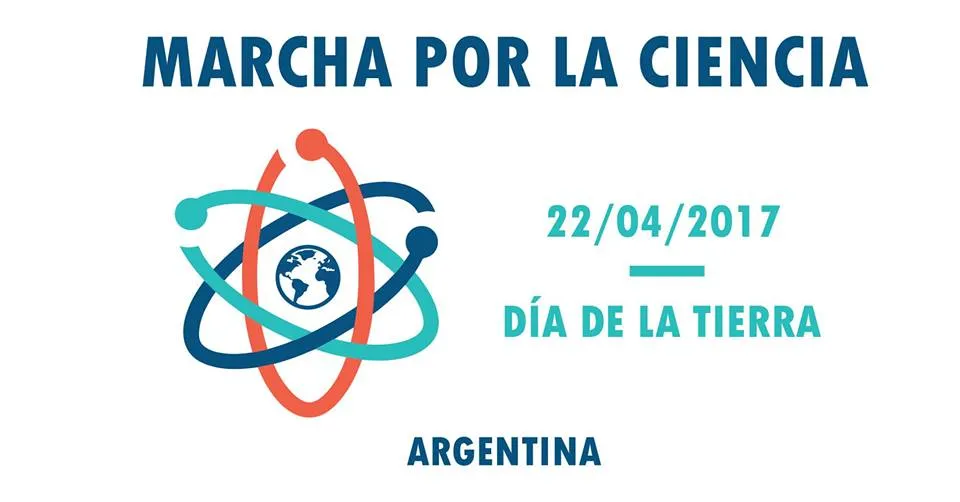
Logo of Marcha de Argentina from the Facebook Event.
Map from Marchforscience.com