A quantitative assessment of citations in scientific papers in astronomy reveals a gender bias against women.

That there is an unjustified gender difference in social reality is blatantly obvious. But to what extent does it occur?
A new study attempted to measure this bias in astronomical publications from 1950 to 2015 (about 200,000 publications).
In science, the first thing that matters is not whether something is true or false, but what the bases or foundations are for making an assertion. So it's not just the "result" that matters, but the means by which that conclusion is reached.
In this case, the study was led by Neven Caplar, a doctoral student at ETH Zurich who works on AGN for his doctoral research and runs a blog on (astronomical and non-astronomical) data called AstroDataIsCool.
In the introduction to his paper, he notes (as usual) the previous research on gender bias. He then states that the authors wished to measure the role of gender in the number of citations that papers receive in astronomy. The first assumption is that authors should receive the same number of citations for papers that have the same properties aside from gender. That is, for similar cases, similar gender treatment. To a large extent, scientific experiments seek to isolate one variable while taking care that the rest of them are similar.
Second consideration: the study is based on the lead authors, the first author of each paper.
Third: Authors are often named with abbreviations, which is why some procedure is needed to know if an author named "J. Surname" is a man or a woman.
To obtain the data that made up the sample, they used the SAO/NASA ADS service for astronomy for five established publications (A&A, APJ, MNRAS, NAT and SCI) between the years indicated above.
The service allows downloading parameters of different variables such as author names, institutions, number of citations, references, year of publication and others. Data acquisition was performed in June 2016.
They also used the arXiv service to complete data such as the length of the paper and research subfield.
For the most important task, i.e., knowing which given name corresponds to the initials, the first thing they did was to search the dataset for a match between abbreviated name and unabbreviated name, so that if at least once an author appears with the given name spelled out, it can be extrapolated to the other cases where the same author is indicated with an abbreviation.
They also used an algorithm called SexMachine (for Python) that contains 40,000 names from different regions classified by their native speakers. Thirdly, they used data from the US Social Security Administration and the UK Office for National Statistics. Finally, they used the Gender API which includes nearly 2 million names.
Another variable to consider was experience ("seniority") based on the number of years since the first publication.
They then cleaned the sample of spurious or incomplete data. From the total ADS data (208 thousand) more than 58 thousand (28%) were removed, leaving almost 150 thousand. From that total, records without citations or references (4,400) were removed, authors who only published in Nature or Science (5,400), entries without specified authors (491), entries without a given name for the first author (7,700, typical of collaboration articles), entries where the first author only uses initials (i.e., could not be disambiguated, 42,400) and entries whose given name could not be determined (2,200). The total number of removals is not the sum of all the above, due to overlaps.
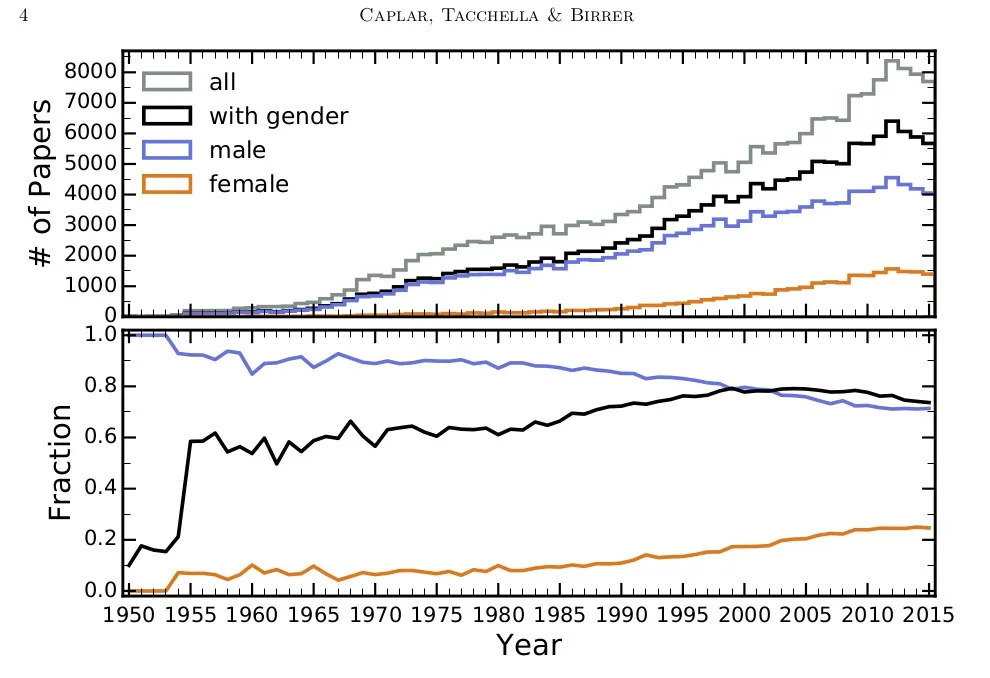
In Figure 1, the top shows the total number of papers with any citation and reference, the total number of papers with gender of the first author determined, the total number of men and total number of women. Bottom: Fraction of all papers for which gender was determined (black), fraction of papers with male gender for the first author (blue) and female (orange). Looking at the black line, gender determination is above 50% from 1960 onwards, reaching 80% in 2000. The fraction of women as first authors has increased consistently over the last 50 years (orange).
CHARACTERISTICS OF PUBLICATIONS IN ASTRONOMY
Figure 2 shows some average global trends of publications and highlights differences between genders. Panel (a) plots the average number of references in papers as a function of publication year. A strong increase in the number of references per paper over time is noted: from 10 per paper in the 1960s to 60 today (500% increase).
What is notable about this graph is the difference between genders: from 1980 onwards there is a clear trend where papers with a woman as first author have 7 +-3% more references than in the male case. In the appendix of the study, they also indicate that women's papers tend to be longer.
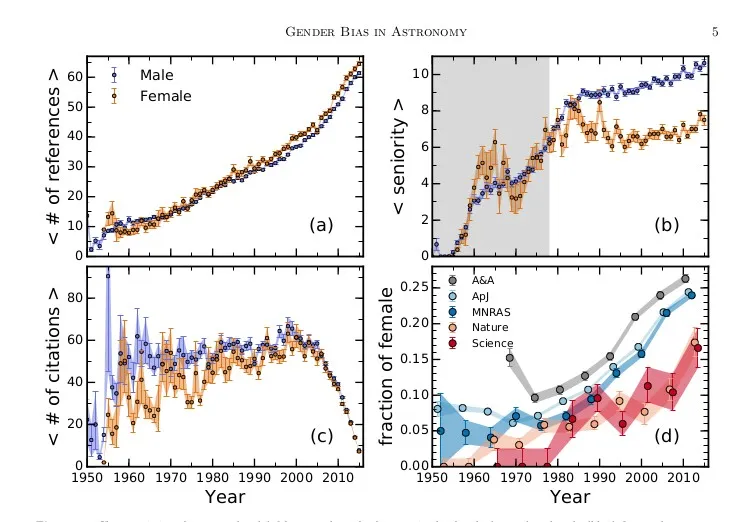
experience or seniority (b), citations received by gender (c) and gender representation by journal (d). Credit: Caplar et al (2017).
Panel (b) illustrates the average experience (seniority) in years: around 1980 the value is an average of 7, but then it increases notably for men.
Panel (c) compares the number of citations received for men and women as a function of publication year. Until 2000, the average increases for both. Then it declines, but probably because not enough time has passed. In general, it is found that papers with a male first author have more citations.
This point is explored further later in the study.
Panel (d) plots gender representation in the selected journals. Women tend to be underrepresented compared to men in the most prestigious journals, which in turn tend to generate more citations. Around 1980 the female fraction of first authors was similar among the journals at about 10%. Until now the fraction has been increasing in all of them, but more in A&A, ApJ and MNRAS (up to 25%) and less in Nature and Science (17%).
GENDER DIFFERENCE
Since the citation count should be correlated with non-gender properties, such as experience and number of references, some precautions were taken when considering the gender difference in relation to citations to avoid spurious variables.
Figure 4 shows the mean number of citations received by men divided by the mean number of citations received by women in a given year.
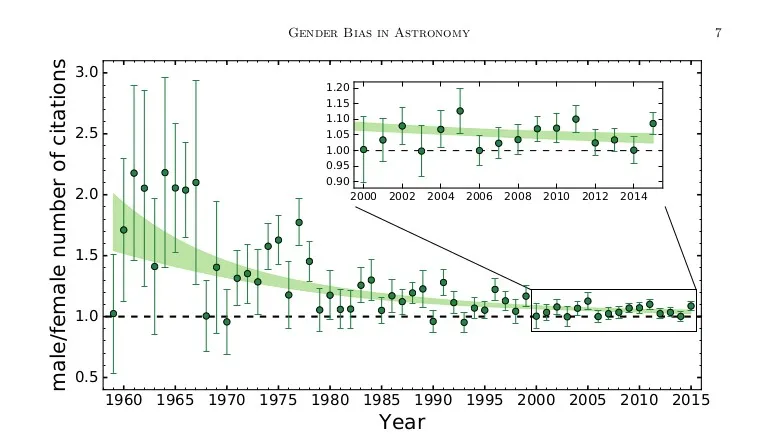
Then they evaluated experience, after which they performed what is known as a "random forest" algorithm (whose code they put online).
In this way they could predict the number of citations for a paper based on non-gender parameters to compare with reality. They found that papers signed by women systematically received fewer citations than expected (in relation to non-gender parameters). The difference is 10%.
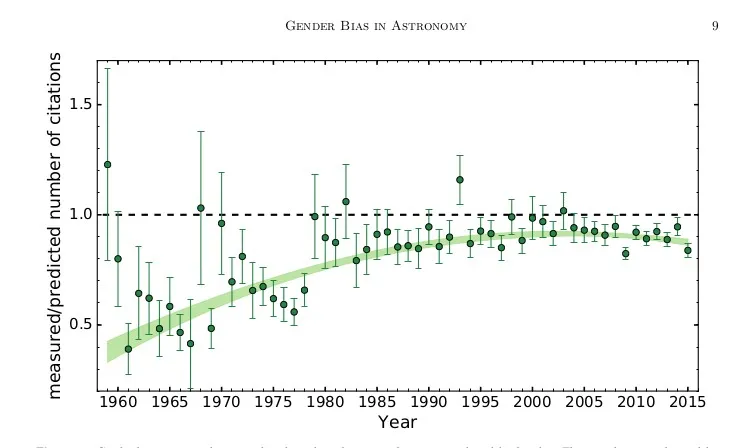
The authors also took self-citations into account (authors citing themselves). They indicate that it is logical to expect that if men publish more, then they cite themselves in greater quantity.
Therefore, what they did was consider papers that are not the first ones to see if they indicated a citation to the immediately previous work of the same author. In that case, they found that women cite themselves more than men. But if the other (non-gender) parameters are considered, such a trend is not found.
CONCLUSIONS
The authors are cautious in their conclusions, first because determining the gender of a first author is difficult and because claiming that a gender bias actually exists would imply being able to remove any other variable, which is also complicated.
They add that the astronomical community, increasingly globalized, makes things more difficult as it implies considering first names from different regions.
That there is concern about this is important. There is no meritocracy if there is no equity. Equity is not egalitarianism. Equity assumes that the possibilities or conditions are the same. And that the recognitions (which are also conditions or possibilities) are also the same. Citations are a form of recognition.
From a semiotic point of view (taking Eliseo Verón as a beacon) the conditions of production are the conditions of recognition and the difference between the two is "circulation."
But, would it be crazy to think that gender bias is not the only one? Might there not also be nationality-institution biases? And if so, wouldn't that also be a principle of authority?
For weeks I have been watching the series Genius about Einstein, of impeccable quality, on NatGeo. The German scientist called himself an "internationalist," even "stateless." Although the series suggests that the (undue) recognition to Mileva Maric should be reviewed. (Let's be fair: it is also possible to say this about some forgotten men. For example, Humason).
So we must not only review the present for the future, but also the past. The need for this is proven by the lack of response to a simple question: Name 5 outstanding female philosophers.
In a society based on permanent competition, however, we men have not wanted to compete with women. To compete is to compete with equity, otherwise it is theft, fraud, trickery. We are afraid of them. It is collaboration, more than competition, that we should do. Instead, everything is business. Business is benefiting at the expense of others. We should think about it better. Sometimes "we" are "the others."
Sources and related links
- Quantitative evaluation of gender bias in astronomical publications from citation counts
Neven Caplar, Sandro Tacchella & Simon Birrer
Nature Astronomy 1, Article number: 0141 (2017)
DOI: 10.1038/s41550-017-0141 - arXiv:1610.08984 [astro-ph.IM]
https://arxiv.org/abs/1610.08984 - Research led by women, discriminated in Astronomy, by Mar de Miguel
http://www.elmundo.es/ciencia-y-salud/ciencia/2017/05/26/59285b59468aeb3d788b45bd.html
About the images
Figures taken from Neven Caplar, Sandro Tacchella & Simon Birrer (2017).
Logo: She is an Astronomer