TV Pública bet on an out-of-the-ordinary program.

Let's start with some description, for example the one provided by the site of TV Pública Argentina (TPA):
“Todo tiene un porqué” is an educational, cultural and scientific magazine with a federal character. The program aims to entertain, motivating curiosity and the desire to know, as well as helping to raise awareness about current issues and fulfilling a social function. We will discover that the desire to learn is something we can preserve in adult life and is not just the domain of childhood.
Hosted by Germán Paoloski with the support of Cristian Domínguez, Carolina Di Nezio and Connie Ballarini and the participation of scientists, researchers and all kinds of invited experts, “Todo tiene un porqué” aims to stimulate in viewers the desire to know more and, why not, generate interests that become future vocations.
Let's complete the program's data sheet:
It airs Monday to Friday between 19 and 20 h.
It is produced by Mandarina TV, producer of several programs such as El Diario de Mariana or Confrontados currently or Sábado Bus in the past.
In its time slot it competes with América Noticias, Tele 9, Cortá por Lozano, A todo o nada.
Vertically, its preceding and following programs are: Documentales de la tarde and Cocineros de noche.
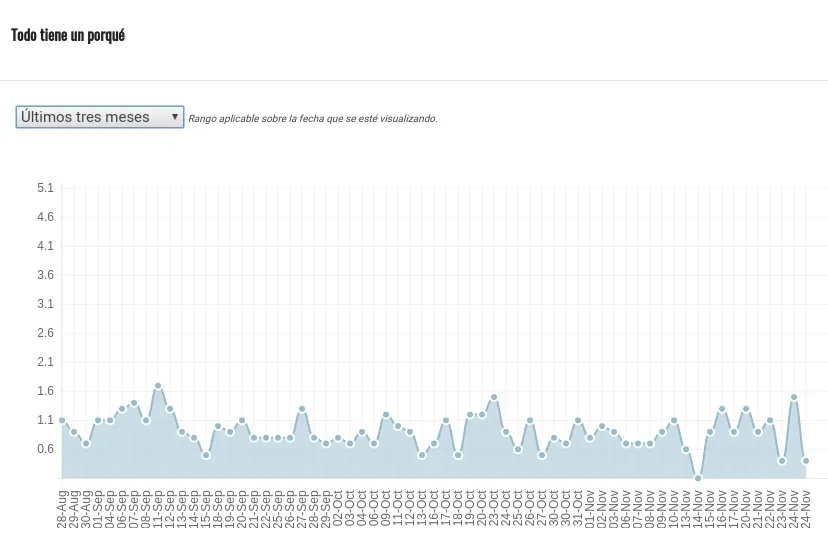
Average rating: 0.5-1.0 (See Fig. 1)
Also participating in the realization of experiments and puzzles: Ariel "Chucho" Rodríguez, Pablo Milrud.
To abbreviate, I will call the program TTUP.
Detailed description
It is an unusual program due to the combination of several factors:
1-In television in general, public and private, science popularization programs are few and in relation to the total programming they occupy little space (actually, time). Against the grain, TPA bet on a daily broadcast program.
2-In Argentina, prime time is usually considered from 21 to 23 and a more extended time slot starting at 20 h. The concept of prime time is linked to "family programming" under the assumption that most adults and young people in that time slot are at home (back from school or work) and together, as it is dinner time. Although outside that range, TTUP is very close, or to put it another way, it is not in a marginal time slot.
3-In a vertical analysis, it follows the line of the previous program (documentaries). Although the program's name emphasizes the why, in reality, the explanations revolve around the "how" (the why is often considered philosophical) and the following program, Cocineros, is also a program about how to cook.
4-In the horizontal analysis, it is a proposal against the grain of the rest of the channels that at that time offer information and entertainment based on the day's news (newscasts), magazines and games. In all those cases, the programs offer different degrees of "diversity," of changes in the topics to be covered, but TTUP is a thematic program.
5-The trend of offering entertaining science popularization is not new, but sometimes it goes from being unstuffy to extremes that are not very serious or highly speculative, whereas TTUP, with a colloquial style, addresses topics with a minimum of rigor, thanks to the fact that the word is given to those who know and with the contribution of the host and the columnists who ask questions like the ones the audience might ask. The addition of "Chucho" is not merely decorative and is one of the most anticipated moments of the program for me.
6-It is particularly important that at the end the members of the program propose a synthesis of what they learned.
Due to the combination of these factors, it is undoubtedly an out-of-the-ordinary program. Will the audience be up to the program? It's hard to say: the average indicated above comes from viewing the chart for the last three months provided by Television.com.ar (see Fig. 1). Certainly it is a low value compared to private channels and not so low for TPA. Interestingly, two of the most watched programs on the channel are the afternoon documentaries and Cocineros. On the one hand, TPA's audience seems to follow the cycle, but in relation to television audiences, most prefer other types of content. That, which is not new, would explain why it has not been usual for channels to have popularization programs and much less, daily ones.
Breaking with that tradition is a bet, and a high one considering the rest of the factors, like the time slot. Certainly I would not have thought of Paoloski as host and even less of his collaborators. But it has been a success. Germán had shown his histrionics in that famous "sports" program with Fernando Carlos. Later he hosted a midnight newscast and also shone in Pura Química and the talk show Nunca es tarde (NET).
Despite being part of Generation X, Paoloski does not clash with millennials and his collaborators seem to be in tune with that age range which is probably the target audience, though not exclusively. Given that, despite Germán's friendliness, he does not lose seriousness and asks interesting and thoughtful questions.
In this sense, credit must also be given to the production, which also gets another plus: it is very interesting how they relate disparate concepts. For example, if they address why the Earth shakes, earthquakes, then it is expected that before a break they will play a song that alludes to that concept.
I say it is a thematic program not only because of that, but also because generally one topic is addressed per broadcast. A topic can be exhausted quickly, so sometimes two not very distant thematic axes are touched upon.
Suggestion and criticism
I don't find something to criticize in a negative sense on a recurring basis. In some cases, some concept is not clear (e.g., when in a program about music it was suggested that tuning at 432hz is more natural) or that the chosen researcher was not the right one. A scientist may know a lot, but not know how to explain it to a "general" audience.
Another issue is whether the program can be improved in some way. It occurs to me that just as television often incorporates figures to enhance programming and it is already common for famous people to appear in soap operas, that resource could also be used. Athletes, singers, actors, journalists may be curious about some topic and could be invited to participate in the program that addresses that issue. Emanuel Ginóbili has shown curiosity about the sciences. Julián Weich participated in one broadcast.
On the other hand, the program's themes should address very current, timely issues, even though, from the start, the program proposes almost the opposite. Due to current situations, what is an explosion-implosion, how a submarine works, why objects float; why countries become independent; why glaciers are important, are topics of burning relevance. It is true that for each program there is prior production work that requires time.
Conclusion
If one considers the airtime of TTUP and adds the weekly hour of La liga de la Ciencia, the documentaries and also the programming of the Encuentro channel, the Sistema Federal de Medios is dedicating a valuable percentage, both quantitatively and qualitatively, to science outreach, continuing what was happening before the change of Government.
From both aspects, quantity and quality, TTUP stands out for being daily, in a good time slot, enjoyable but rigorous as local researchers participate. That the series is diverse in the topics it addresses and at the same time is thematic in each broadcast suggests a search for balance between depth of treatment and richness of interests. From fashion to inertia, turtles to lasers, everything has a why.
In September the series celebrated reaching 100 broadcasts. May they celebrate 100 times more and it become necessary to make a program to explain why TTUP is a success.
Sources and related links
- TTUP site of TPA
http://www.tvpublica.com.ar/programa/todo-tiene-un-porque/ - Television.com.ar Ratings
http://television.com.ar/ratings-del-viernes-24112017/68939