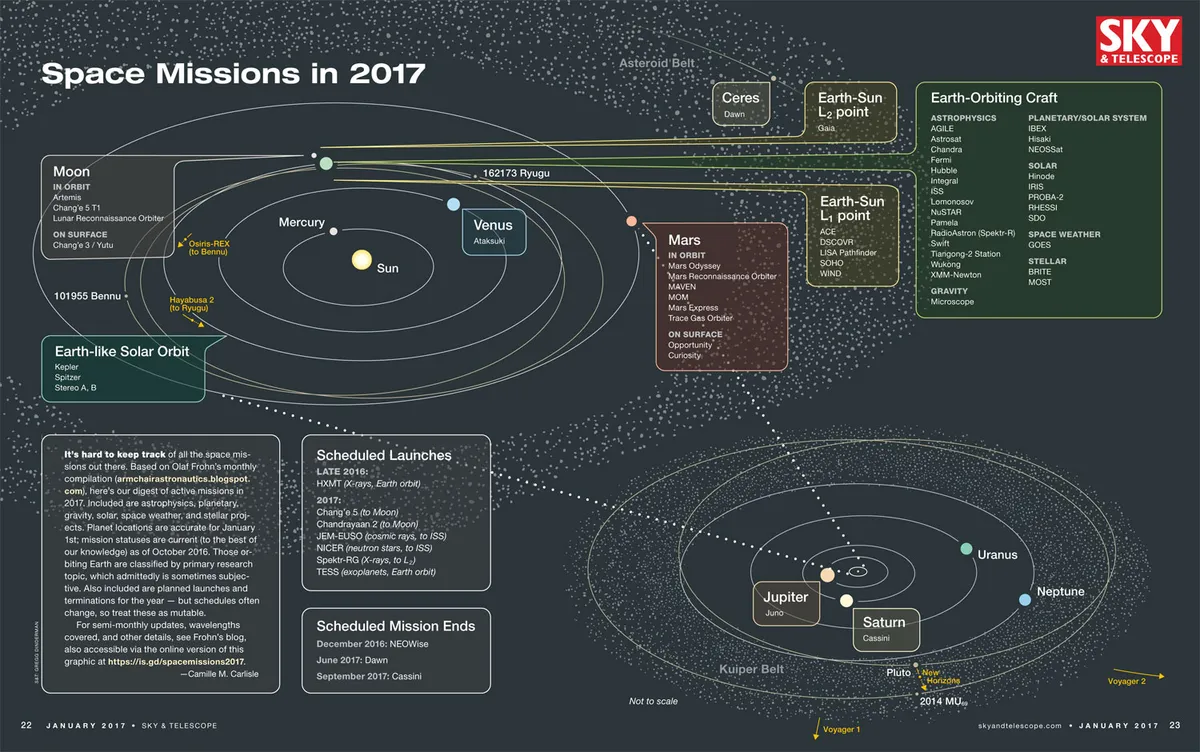
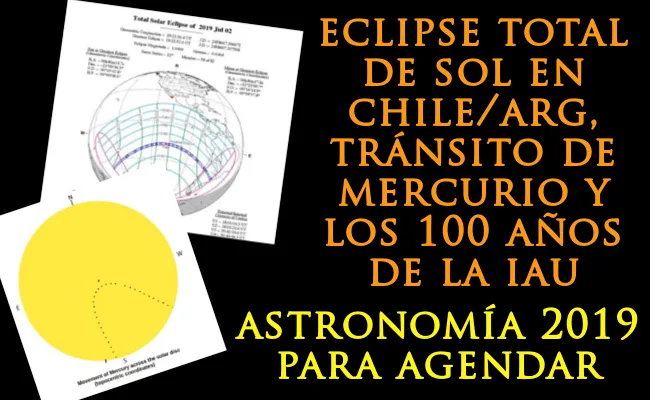
Some expected events for next year: launches by NASA, Europe, Japan and China; Eclipses and other astronomical ephemerides.
NASA has the following missions planned:
InSight Mars Lander
The launch of this probe to explore the interior of Mars is planned for May.
TESS (Transiting Exoplanet Survey Satellite)
This mission to discover exoplanets is planned for launch in June.
Parker Solar Probe
This solar exploration satellite would be launched in July.
OSIRIS-REx, already launched, will reach asteroid Bennu in August.
The James Webb Telescope was planned for launch in October, but was postponed to March-June 2019.
The Mars 2020 mission will continue its progress: So far there are three pre-selected sites for the descent of the new Martian rover.
In addition to studying other worlds, NASA investigates our own: ICESat-2 and GRACE Follow-On will be launched in 2018.
With the CST-100 Starliner and Dragon 2 capsules, Americans will once again have vehicles to transport people to the Space Station.
ESA
Europe is not far behind and -in collaboration with Japan- will send the BepiColombo probe to Mercury in October 2018. In addition, CHEOPS - CHaracterising ExOPlanet Satellite, to search for exoplanet transits, and the Solar Orbiter probe would be launched. It is worth noting that Europe's big bet is JUICE - JUpiter ICy moons Explorer for 2022, which will study Jupiter's icy moons.
JAPAN
Japan will be attentive to the arrival of the Hayabusa2 mission at asteroid (162173) Ryugu between June and July.
CHINA
The Chinese are not standing still and will send another probe to the Moon, Chang'e 4, at the end of the year, while continuing their plan to build their own space station.
ARGENTINA
Satellogic will launch two more ÑuSat satellites (previously Fresco, Batata and Milanesat). Apparently their names will be Ada Lovelace and Maryam Mirzakhani.
ASTRONOMICAL EPHEMERIDES
Eclipses
There will be no total Solar Eclipse in 2018, but there will be partial ones on February 15, July 13, August 11, and they will be difficult to see.
Lunar eclipses will occur on January 31 (at 13 h UTC); on July 27 (at 20 h UTC).
OTHER EPHEMERIDES (UT: UNIVERSAL TIME)
01/09/2018 06:21:43 UT Venus in conjunction
07/27/2018 Opposition of Mars
06/27/2018 Opposition of Saturn
05/09/2018 Opposition of Jupiter
02/16/2018 16:29:21 UT Occultation of Venus by the Moon
09/08/2018 22:45:54 UT Occultation of Mercury by the Moon
11/16/2018 04:52:02 UT Occultation of Mars by the Moon
12/09/2018 05:20:10 UT Occultation of Saturn by the Moon
Mars-Jupiter Conjunction 01-07 (11 with moon)
Mercury-Saturn Conjunction 01-13 (near dawn)
Mars-moon and Saturn 03/10
Mars-Saturn 04-02 (07 with moon)
To find out about astronomical ephemerides, you can consult pages like:
http://efemeridesastronomicas.dyndns.org/eventos_planetarios.htm
Lunar Perigee with full moon (illuminated +90%), "supermoons"
01/01/2018 21:48:49 UT
01/30/2018 09:57:28 UT
02/27/2018 14:38:55 UT (92%)
12/24/2018 09:49:00 UT
ENDING WITH MUSIC
I take this post to wish the readers a happy end of the year. I will surely publish another post, in particular, I am writing a brief note with recommendations of novels to read during the holidays that I hope to publish before the end of the month.
I also plan to visit the renovated Planetarium of the City. However, in case I cannot publish before the new year, I wish dark skies for observers, health and work for everyone.
I leave a musical piece that, in my view, is ideal for a good night of observation. The piece "Stars of the night" is by the artist Dynatron and belongs to the synthwave electronic genre, very much from the 1980s.
https://soundcloud.com/dynatronsynth/stars-of-the-night-aphasia
Sources and related links
- Fred Espenak's Eclipse site.
https://eclipse.gsfc.nasa.gov/ - ESA
http://sci.esa.int/cheops/54031-objectives/
http://sci.esa.int/solar-orbiter/55772-solar-orbiter-launch-moved-to-2018/ - NASA
https://www.nasa.gov/launchschedule/ - Wikipedia
https://en.wikipedia.org/wiki/2018_in_spaceflight
About the images
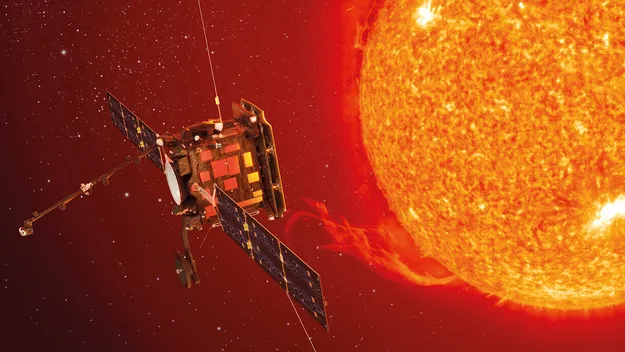
Illustration of Solar Orbiter near the Sun. Credit: ESA