A review of the SyFy miniseries based on the novel by Arthur C. Clarke, which is well worth watching, and rereading.
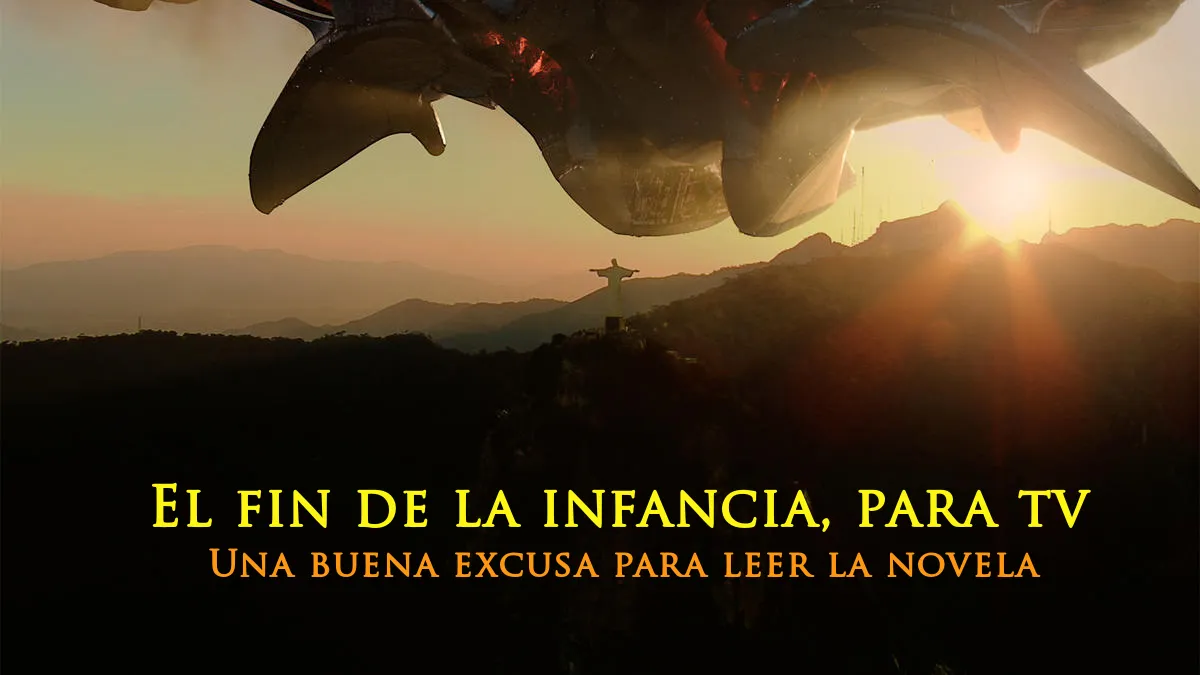
The science fiction channel, SyFy, produced this miniseries, based on the novel by Arthur Clarke, in 2015, but it was only in 2018 that it aired for Latin America.
Around the middle of the year it was announced that the channel would air the three episodes (each an hour and a half long) in Argentina. These episodes are shown again from time to time, but it is also possible to find them on the internet.
On the SyFy site, the plot is summarized as follows: "A bloodless alien invasion takes over Earth. The alien leaders bring with them a golden age of peace, health and security for all Humanity. But why do they continue to hide their appearance and their true intentions? While most of the world enjoys this new Utopia, some suspect there is a price to pay. When the leaders' true intentions are revealed, Humanity discovers that its destiny may not be a dream, but a nightmare."
I will try below to tell something about both the miniseries and the novel without revealing too much, as I recommend not only watching the audiovisual production but also reading the literary text. Between the two works, as is logical, the transposition leaves things behind or modifies them, so I think it's worth reading the novel first, although the essence remains.
It's worth saying, at least, that one difference from the novel is the temporal duration of the plot and therefore also the form that the ellipsis takes, that is, telling a part for the whole. In the novel the ET invasion lasts at least a century -as indicated in chapter 20 of the book "At last, after a century, I can tell you what it consisted of"-, while in the series it lasts decades. As a consequence of this, in the novel there are characters who at some point disappear, while in the audiovisual work this is less noticeable. In the miniseries there is an important character, Rikki Stormgren, who always seems the same, as if time did not pass for him, despite the fact that according to the plot, from the arrival until the "Overlords" physically present themselves to humanity, 50 years should pass. This character will be the human interlocutor before the Overlords for a certain time and in the novel he is the secretary of the United Nations, while in the series he is a farmer, a curious and interesting modification.
The story is well-known, as the novel is famous: the aliens, proclaimed "Overlords" or "superseñores" show off a great technology that prevents wars, they are even capable of generating "eclipses" only in some country to intimidate those who do not abide by their rules. In this way, peace (forced) reigns. Similarly, they will end hunger and disease. In the novel it is clearer than in the series that Humanity hardly needs to work anymore, by virtue of great automation and has a lot of "free" time to educate itself. At the same time, interest in science is lost, as all the big questions (or almost) will be answered.
The story in the series begins from the end, with a black astrophysicist (Milo) contemplating the end of something. Then it goes back in time and there we will see a child of color who lives through the arrival of the Overlords in his childhood and throughout the story will grow up with an appetite for science until he becomes an astrophysicist. His goal, he tells his grandfather when he is a child, is to be the first human to know the planet of the Overlords. And he will achieve it, with a relativistic journey included.
The series has only three chapters: In the first, The Masters, the arrival is narrated until they reveal themselves after many years. In the second, The Impostors, it begins to be noticed that something strange is happening with the children and Milo, the child of color now become an astrophysicist, discovers the system to which the Overlords belong. Here I stop: In the novel this also happens, in a more "mystical" way (through a Ouija board that also appears in the series), but somewhat more credibly, paradoxically. In Clarke's work, while several people are in front of the Ouija board, Milo (who in the novel is named Jan) asks which system the Overlords come from and gets an answer: NGS 549672. This information (although it came from a dubious source like a Ouija board) is consistent with the star designation system we know.
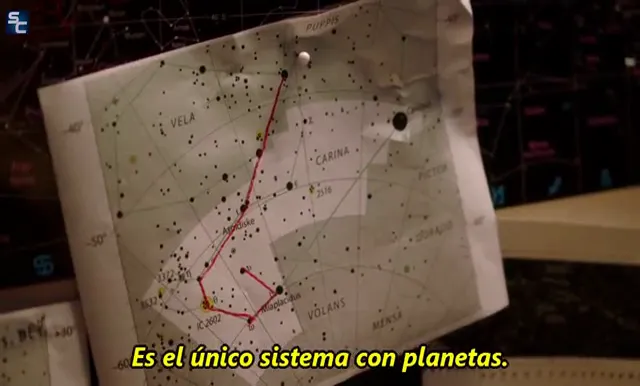
In contrast, in the series, the children draw a picture permanently and finally Milo deduces that it is a constellation -Carina- and that "it is the only system with planets," which is somewhat ridiculous, since a constellation is not a system.
The third part, The Children, will show more clearly that the destiny of the children is different from that of the adults.
The novel, for its part, has four parts: Prologue, Earth and the Overlords, The Golden Age, The Last Generation.
The end of the work bears some resemblance to 2001: A Space Odyssey, by the same author, also brought to film by Stanley Kubrick. Let's remember that in that work, both literary and cinematic, it is proposed that the human being evolved through the manipulation of objects, creating weapons and tools, up to the use of robots, computers and artificial intelligence (Hal 9000) on which it came to depend, to continue with its "evolution".
In this case, the extraterrestrials interfere to "correct" the course of Humanity, the consequence of which is a new "evolution", founded on the children.
This explains the name of the work of double valence, since on the one hand it is the end of humanity's childhood, towards a Golden Age or maturity, but it also implies that this maturity is going to end up germinating a new beginning, which is also the end of something. In this sense, the choice to begin the miniseries from the end is an attractive twist.
The literary work deserved a transposition to film, so the choice of the SyFy channel was very good. However, if what is expected is a striking audiovisual work, although it has its moments, it leaves something to be desired. The same with the performances, with a not very well-known cast, except for Charles Dance in the (red) skin of Karellen, the Overlord who is the interlocutor with humanity. Nor will we find a good use of music, as in the case of "2001".
Despite this, the miniseries is easy to watch, because unlike other current series, it has only three episodes and is an excellent excuse to read or reread the literary work. It is interesting to compare the technologies in both works, for example.
The role of the "Freedom League" is also interesting, which in the TV adaptation is done through a media magnate who at a press conference intervenes by putting the objectives of such a league in black and white: "That [the Overlords] get off our property".
Throughout both works, the literary one and the TV adaptation, there is a contrast and comparison between religions with the arrival of the Overlords, reinforced by the appearance of these beings.
As will be noticed, there are strong coincidences between the reality we are living through and what the novel proposes and with philosophical reflections such as the meaning of social and technical progress, creativity and the search for answers, freedom. This is why the novel is part of hard science fiction.
A fragment of the novel is curious, which serves to describe post-Overlord arrival human society:
"Today we live in a placid, uniform and culturally dead world: nothing new has truly been created since the arrival of those beings. The reason is obvious. There is nothing to fight for and there are plenty of distractions and entertainments. Have you noticed that five hundred hours of radio and television are broadcast every day? If one did not sleep, and did nothing else, one could not follow more than a twentieth of the programs. It is not strange that human beings have become passive, absorbing sponges, but not creators. Do you know that the average time a man spends in front of a screen is already three hours a day? Soon people will have no life of their own. They will live following the episodes of television!"
Sources and related links
- Childhood’s End arrives at SyFy
http://television.com.ar/childhoods-end-llega-a-syfy/81592 - SyFy: CHILDHOOD'S END. EL FIN DE LA INFANCIA
http://www.syfy.es/series/childhoods-end-el-fin-de-la-infancia
Book El fin de la infancia, by Arthur Clarke; Ediciones Minotauro, 1956, Buenos Aires. Translation by Luis Domenech.
About the images
Initial image from SyFy and TV capture.
https://www.syfy.com/childhoodsend/photos/episodic-gallery-the-overlords