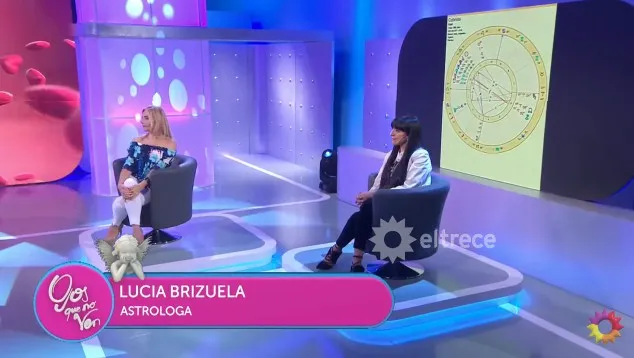
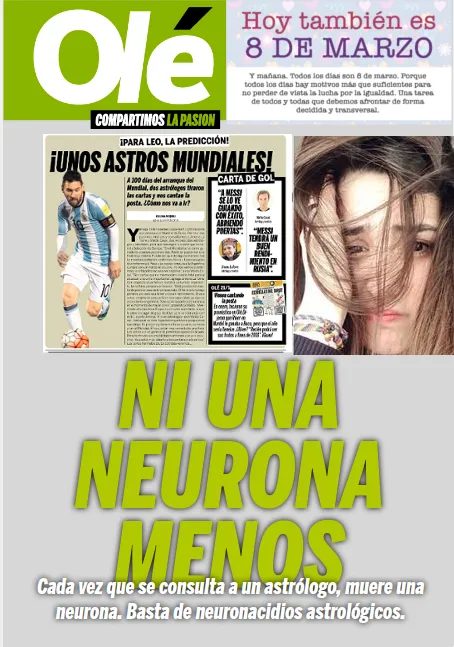
Prejudices and stereotypes are a way of chaining us to social mandates. As Colombian physicist Alexandra Olaya says, they are "social black holes".
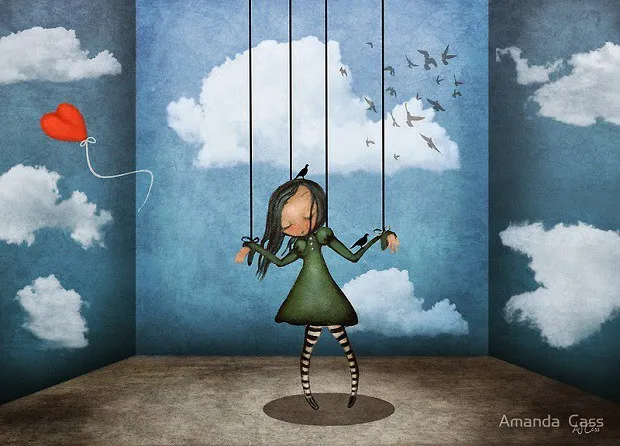
Diego Samara, a psychologist with a degree from UBA, wrote on his blog about social mandates. I quote:
Based on inclusion-exclusion parameters, what is accepted as normal, as known, is defined, and what remains outside as strange, abnormal.
In this way, faced with the need to be recognized, not to be rejected by a family, group, or institution, certain social mandates are incorporated through that filtering process without being processed by the individual's uniqueness, confusing the social demand, "what should be" with one's own desire, "what one wants to be".
Note that some people "want to be"... Cancer or Leo or Scorpio, under the assumption that people in that "group" are a certain way. From the should be to the want to be.
I quote one more paragraph:
Responsibility becomes evident in cases where two siblings of the same age react differently to an authoritarian father, one rebels by pouring out explanations, while the other is submissive in the face of his imposing presence. Two different positions in the same situation. The first questions in an attempt to change traditions, the second continues with the automatic repetition of those marks (mandates, obedience) that preserve more of the same.
If we analyze it, the psychologist relates prejudices to authoritarianism and the acceptance of those prejudices to a submissive attitude.
Hence it can be said, in a sense, that astrological prejudices generate "slaves of astrology".
SLAVES OF PREJUDICES
I confess that the title of this post occurred to me in comparison with a current TV series called "Slaves of Scientology". However, treating someone as a "slave" is quite derogatory. Therefore, I think a necessary clarification is appropriate: All of us, to different degrees, are "slaves" to certain customs or traditions: the great difficulty in quitting a harmful addictive habit, like smoking or drinking alcohol excessively; obsessive-compulsive disorders. Other cases, less serious, but similar in the basics are: putting up the Christmas tree on December 8th no matter what (by tradition, because if you don't do it "it looks bad", because it is assumed that is the "should be"); greeting each and every person present in a place when entering, instead of giving a single general greeting, for example; letting a woman go through a door first, under any circumstance; etc.
In these second examples, the similarity is that these behaviors are not done because they are truly necessary, but to look good with a supposed "should be", without questioning it.
Although some people today do nothing similar, they surely did in the past. Therefore, this is something that can be changed, as long as it is made conscious.
I use, then, the word "slaves" not in its primary meaning, nor as a derogatory form, but as a description of behaviors that are done "because it is assumed that's how it should be or that's how it is", even if it is not that way.
Before continuing, an important distinction about pigeonholing is needed.
CLASSIFYING, THAT TEMPTATION
Classifying and therefore labeling or pigeonholing is not something "bad" in itself. When we say cats are mammals we classify, label, or pigeonhole them. When we say blondes have yellow hair, too. In none of these cases would we say it's wrong, because the classification is true or, to put it another way, the label is consistent with reality.
The problem is when that is not the case. Saying blondes are stupid is labeling all blonde women under the consideration that they are all the same, and at the same time, overlooking that brunettes or redheads or men of any hair color can also be stupid in some cases. Besides being a bias against a sector, it is a false idea that presupposes that "stupidity" is linked to hair color, which is scientifically false. Therefore, it is a bad classification.
STEREOTYPE AND PREJUDICE
From the page of the Museum of Memory and Tolerance (Mexico) I take this paragraph:
Stereotypes are social constructions that we acquire and assimilate, assuming them as valid; they are usually transmitted socially through generations and lead us to make general statements, whether positive, negative, or even neutral, about the stereotyped group. Stereotypes often generate prejudices, as they induce prejudgment, that is, to issue a judgment without having sufficient information to support it.
In this sense, stereotypes are generalized ideas or generalizations and prejudices are thoughts and behaviors based on insufficient or false information. Example: Stereotype: People with long hair do drugs. Prejudice: This person has long hair, therefore, they do drugs.
The relationship between one thing and the other is basically the same: it is an invalid conclusion. That some people with long hair do drugs does not mean that all people with long hair do it and only those with long hair. We reach invalid conclusions permanently in daily life. It is rather inevitable. What can be avoided is turning that first or apparent idea into a strong idea. Since we already know that it is easier to be wrong than to be right, then, faced with such an idea, we can tell ourselves: "maybe it's not that way".
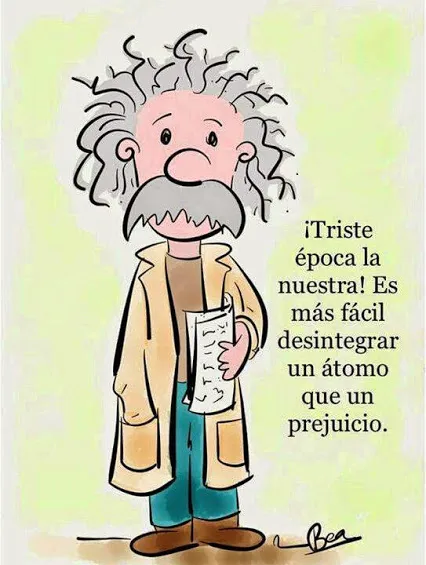
ASTROLOGY IS A SET OF PREJUDICES AND STEREOTYPES
Many astrologers do not blush to point out that astrology is based on "archetypes", they even give it a "professional or academic" spin by relating the term to a certain psychological theory. But "archetype" is nothing more than stereotypes, which ultimately is a form of classification. The problem is that it is an invalid classification.
I will give an example of an invalid conclusion:
Suppose a survey is conducted that yields this result: in private schools there is a greater number of children with obesity than in public schools; and in public schools there is a greater number of children with lack of food than in private ones.
An invalid conclusion with that data is the following: For obese children to stop being obese, they must be sent to public school.
It is an invalid conclusion because this conclusion does not follow from the given data.
It is possible (continuing with the fictional example) that obese children eat more because their parents have greater economic power and indulge them. Coincidentally, having greater economic power makes it possible to send the child to a private school. But the cause of obesity will be the eating habit, not the type of school the child attends.
Two variables that seem related may be so, but secondarily, primarily, or not be related at all.
Another example:
I mentioned Colombian physicist Alexandra Olaya earlier: she won an international prize in 2016. In a video talk she says that for 44 years, that prize was awarded only to men. Could it be because only men deserved it? Perhaps yes, but it is also possible that:
1-Women were barred from certain research positions that prevented them from reaching such positions, under the prejudice that women were not as capable as men.
2-Female researchers, who did achieve the position, were not taken into account due to the same aforementioned prejudice.
Suddenly, in the last decade, five women have won the prize. Did women's ability increase radically or did the judges' criteria change?
Astrology comes from antiquity. We know that back then natural phenomena were linked to gods. Today we know there is no need to appeal to Zeus to explain lightning. That is understandable in the past, as they had no other way to explain things.
Thus, visible astronomical objects (like the planets, the sun and the moon) were surely linked to human events like wars or births.
Since the use of the telescope, we could do the same with a huge variety of objects: when a war starts there will be some planets visible in the sky, and also multiple other astronomical objects (nebulae, galaxies, etc.) visible with instruments. Also at those times there will be traffic lights on or loose tiles. That two events occur simultaneously does not necessarily mean they are related.
If a man steps on a loose tile and at that moment his wife gives birth to a girl, will there be any relationship between stepping on the tile and the child's sex? Saying yes is absurd.
Astrology says that: that the planet Mars emits who knows what, immaterial thing, that influences newborn people in the formation of their personality.
Personality may have some hereditary component, but it is basically social. Personality can be explained. Astrology explains nothing, it stipulates an unfounded "should be". It is just prejudice and stereotypes.
Paradoxically, people who are clearly against xenophobic, sexist, racist, etc. prejudices, at the same time consider astrology "cool and trendy". That it is a trend does not make it acceptable, because it is false.
Human personality and conduct and behavior do not depend on the position of the planets, moon and sun in the sky. We can think of planets as giant mountains. Do mountains influence our personality? Is there "people of Aconcagua"?
THE JUSTIFICATORY FASHION AND THE GENDER BIAS AND THE "HUMOR"
Some articles on astrology published recently seem to justify the new boom of this pseudoscience in that it is a fashion. However, musical genres like cumbia were massive or popular, but they were only considered "fashion" when that music gained acceptance in certain social sectors. There are "cool" fashions and others that are not, apparently. The former are called "trends".
In the U.S. almost 60 million people voted for Trump. Being xenophobic and racist seems to still be "cool" and "trendy". With a difference, at least in that case, another 60 million people voted for another candidate, that is, there was a very even number of people in favor as against Trump. With astrology something different happens on that point: there is a boom of those in favor, not of those against.
As a consequence: only in this month of January 2018 and only considering the most important news portals of Capital Federal, 12 articles on astrology were published. If we count the newspaper El País of Spain we would have to add two, with the following consideration: of those 14, only 1 is minimally critical. Of the rest: two are articles from the Entremujeres section of Clarin.com; two from the women's magazine Ohlalá; two from the Rouge section of Perfil.com; one from the women's magazine Para Tí (on Infobae); the other article from El País was published in the women's section S Moda. Another is an article written by a woman in relation to another note published in The Atlantic, also written by a woman. These data reinforce others obtained and commented on this blog previously regarding a gender bias in astrology, which could lead us to think that they are prejudices within prejudices.
Another type of justification in some articles can be summarized like this: human beings are "narrative" beings, we need stories that give us security and satisfaction... even if they are false or fictional stories.
If we combine the two previous notes, it is possible that cultural development (not only in the West) has led to the presumption that women need greater or different securities than men, that they cannot handle uncertainty. Traditionally, finance and business were associated with men more than with women and horoscopes are not published in the economic press.
Could it be because women can get pregnant? However, female astronomers - who in many cases are also mothers - despite their uncertainties or insecurities do not consult astrologers. And many other women (in science or not), also do not do so and can deal with the ups and downs of life and motherhood. Astrology is not necessary.
In The Atlantic article it is stated that astrology enthusiasts are sure it is a fictional discourse, without descriptive or predictive value in the following way: Astrology is false, but Tauruses are different from Geminis. It's like saying "it's false and I don't take it seriously; but I like to believe it totally".
It's like saying: "I am not racist, but I hate black people" [NOTE: Any coincidence with reality is NOT pure coincidence].
It is a perfect synthesis of the liquid times of modernity, but it is not something new, as Socrates and Aristarchus would surely notice.
That article also tries to justify astrology on the grounds that it is a meme, therefore it is not something to be taken seriously. To explain that, the article used more than 3,500 words. At least that article is not a meme.
CONCLUSION
Giving space to astrological discourse (as happens with other "mancies") is to let oneself be dominated by stereotypes and prejudices, originating in coincidences noted in antiquity that were only that, coincidences, like stepping on a crack.
With the internet in general and social media more recently, the prejudiced discourse of astrology has been revitalized. It is logical to have uncertainties about the future. We have to learn to deal with uncertainties in an adult manner.
Astrology is useless. For nothing good. It only serves to foster prejudices.
If someone realizes they were "caught by that black hole of social prejudice," as physicist Olaya would say, it is time to start thinking about to what extent astrological postulates are based on real-world data. I invite such people to take that first great leap of breaking with a social mandate, a deeply rooted, naturalized, entrenched custom. To those who succeed, I invite them to do the same, that is, to circulate this other discourse, to "liberate" - as in Plato's cave - the others.
Sources and related links
- From social mandates to one's own desire
https://diegosamarapsi.blogspot.com.ar/p/de-los-mandatos-sociales-al-propio.html - STEREOTYPE AND PREJUDICE
http://www.myt.org.mx/tolerancia/estereotipo-y-prejuicio.html - The power of option B to break stereotypes. | Alexandra Olaya - Castro
https://www.youtube.com/watch?v=t2GxMJDsl6Q - The Atlantic: The new age of astrology
https://www.theatlantic.com/health/archive/2018/01/the-new-age-of-astrology/550034/
About the images
Illustration by Amanda Cass https://www.redbubble.com/es/people/theartoflove/works/4290603-you-pull-my-heartstrings