On the insecurity generated by alerts of near-Earth asteroids.
As everyone connected to the internet should already know, NASA announced that asteroid 2002 AJ129 will pass safely near Earth next February 4, even though the asteroid was categorized as "potentially hazardous." So which is it?
The orbits of solar system objects, particularly the planets, are very stable over billions of years. With comets and asteroids, things change, as their trajectory may not be so well known and because they are less massive objects, more prone to changing their path due to the gravitational influence of larger bodies along their journey.
In the case of AJ129, its existence has been known since 2002, that is, it has 16 years of study. How do we know if an NEO/NEA is dangerous? NEO is what we call Near-Earth Objects, by its English acronym, and NEA is the same but specifically for asteroids.
The calculation of the impact risk with Earth is complex. For each object, the orbital elements (which are six) are obtained and are never known perfectly. The calculations are complex to explain here, but from the point of view of outreach, there are at least two considerations to keep in mind:
PHA: Potentially Hazardous Asteroids, or PHA by the English acronym, is a concept used by NASA for those asteroids whose minimum orbital intersection distance is 0.05 AU or less and an absolute magnitude (H) of 22 or less. AU is an astronomical unit, equivalent to 150 million km. 0.05 AU is 7 million km.
If we take distance as a criterion, we can also express it as 18 Lunar Distances (considering that the average Earth-Moon distance is 384 thousand km).
The magnitude criterion is related to size, which is very important because a small asteroid, even if it collided with the planet, could completely disintegrate in the atmosphere without causing any damage.
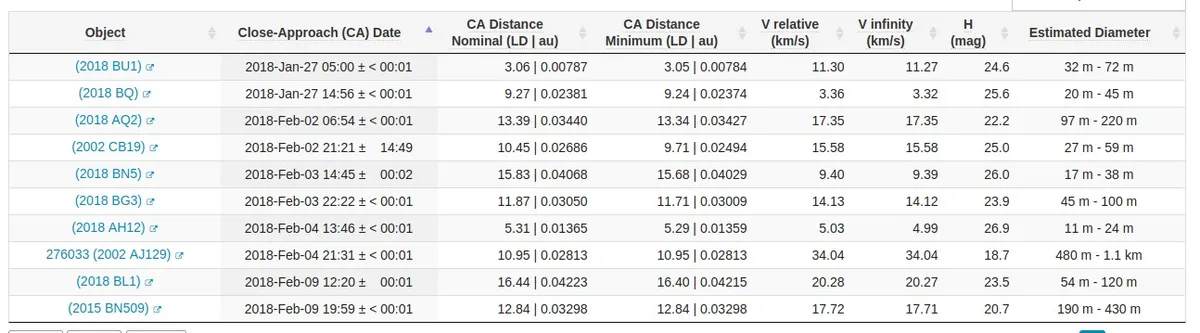
In the case of AJ 129, the absolute magnitude is 18.7 and the estimated diameter is in the range of 480 m to 1.1 km and the distance at which it would pass is 10 lunar distances. For both reasons, magnitude and distance, it fits into the PHA category of potentially hazardous.
The hazard consists, above all, in the size, since an asteroid 1 km in diameter could do a lot of damage if it impacts the planet. However, the distance calculation indicates it would pass at 4 million km.
So where is the risk?
On one hand, since the orbital elements are not exact, there can be a calculation error. On the other hand, in the event of any contingency, say an unforeseen event, like a collision with another unknown object, it could alter the asteroid's trajectory and given that the estimated distance is large, but not that large, astronomically speaking, then there would indeed be some greater risk.
Finally, it's worth remembering that asteroids and comets do not have identical orbits over time, and they can get closer with each orbit to some planet until finally colliding, after passing nearby several times.
The public should then know about the Torino Scale, which is not the only one used, as specialized astronomers use another, the Palermo Scale, which is logarithmic. The Torino Scale is simpler: it goes from 0 (zero) to 10 (ten), with 0 being a null impact and 10 a certain impact.
The media should report on this scale every time they publish an alarmist note about near-Earth asteroids, something that rarely happens. And the public should know that this scale exists and demand it from the media.
If we go to NASA's NEO center and look at the list of most risky objects, we will see that all have 0 on the Torino Scale, except the first one which has 1, which is still low. This scale is calculated based on the data available at a certain moment. In that table we will also see a range of years, for example, in the first case, it is 2057-2064. When running simulations of the object's orbits, it is possible that within that range of years, the object could impact Earth.
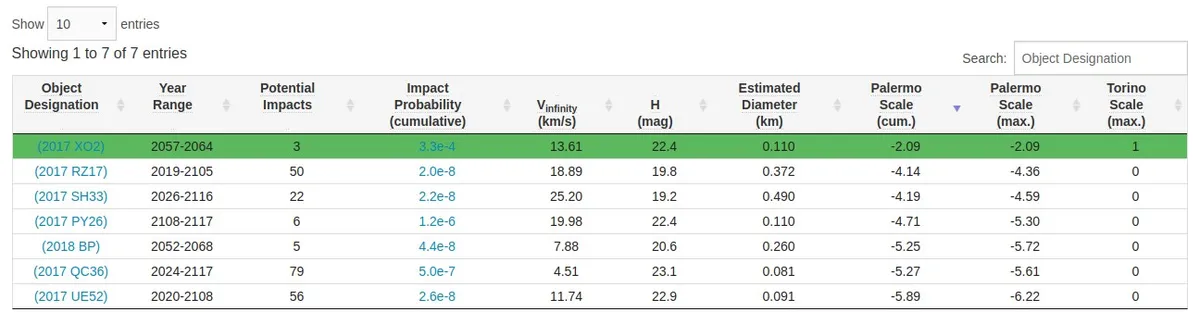
The second on the list is 2017 RZ17 whose impact range is 2019-2105, so there will be no shortage of alarmists saying from next year that we are about to collide with that asteroid.
Another factor is speed. AJ 129 will pass very quickly due to its closest approach to the Sun (gravity is energy).
NASA has said in a statement: "Our calculations indicate that asteroid AJ129 has no chance —zero— of colliding with Earth on Feb. 4 or at any time over the next 100 years."
Does this information justify publishing alarmist articles?
NO, it does not justify it in any way, except by appealing to morbid curiosity and misinformation to sell publications.
ANALOGY WITH TRAFFIC
Perhaps a comparison with traffic is educational: when we cross a street and take the precaution of doing so with the traffic light in our favor, however, the cars traveling in the same direction are also moving and it is possible that some other careless driver does not pay attention to the traffic light and a collision could occur. If two cars collided, one at high speed, and we are traveling nearby, it would be potentially dangerous for us.
If this same thing happened, but at a distance of 100 m, our risk is much lower.
On the other hand, we could collide with people walking or with people riding bicycles, which implies some risk, but in general, very low, because even if we collided, there would be no major damage.
This example makes it clear that proximity is a factor to consider, but if only proximity were taken into account, we could never walk down the street, because we always have people around us. The risk of bumping into another person can be high (more so in times when people look at their phones), but even if the risk of collision with people is high, the risk of damage will be very low.
AJ129 will pass relatively close, in astronomical terms, but far enough away not to worry us. It's like a car traveling at high speed 100 meters away from us. If that car collided with another, it could be sent flying in our direction. In that case, the risk of damage would be greater, but even so, we would have 100 meters of distance. In astronomical terms, more than distance, one should think in terms of angle or angular size. There is, of course, a difference: as pedestrians we can move to dodge a car, but we cannot do the same with Earth, since we do not control its movement. Eppur si muove...
Synthesis: it is not the same for an object to pass relatively close (in astronomical terms) to Earth as for there to be a risk of impact. The Torino Scale is used for the latter. 'Bullets that whiz by close,' there are many. It's full of mosquitoes...
JUSTIFICATION OF NEO INFORMATION
However, it is possible, in addition to what has already been said, to add another point of view. It is possible to compare information about NEOs with police cases or security issues regarding crimes such as robberies, murders, rapes, etc., or cases like missing persons.
In the vast, enormous majority of those police cases, we, the media audience, do not know the people who were involved in those events. Why should we care?
We care because as people we feel empathy for other people, even without knowing them.
And we also care because it is a way of knowing about things that happen, which has the consequence of generating in us a feeling of security or insecurity. If events occurred, but we did not find out, we would have a feeling of security, even though reality were different. A false feeling.
But informing is not enough to form a realistic feeling, for two reasons:
1-It is impossible to report on every single event that occurs.
2-As a consequence, to form a realistic idea we need some statistical criterion to evaluate the information we do have.
Similarly, it is necessary to inform about asteroid close approaches, first of all because it happens. Secrecy is not a good conductor.
But giving information without context, without the possibility of evaluating it realistically, also does not lead to anything good.
Sources and related links
- Asteroid 2002 AJ129 to Fly Safely Past Earth February 4
https://www.jpl.nasa.gov/news/news.php?feature=7042 - NEO Earth Close Approaches
https://cneos.jpl.nasa.gov/ca/ - Sentry: Earth Impact Monitoring
https://cneos.jpl.nasa.gov/sentry/ - Expreso: Astronomer from Unison Warned About Disinformation on Dangerous Asteroids
http://www.expreso.com.mx/seccion/conexion/ciencia-y-tecnologia/30774-alertan-sobre-los-danos-que-genera-la-desinformacion-en-temas-de-astronomia.html
About the images
NASA/JPL-Caltech