New research by international astronomers (including an Argentine) sheds light on planetary nebulae.
One could think and say that planetary nebulae are objects, although they can also be thought of as a stage or transition. First, it should be noted that they have nothing to do with planets, despite the name.
In astronomical literature they are abbreviated as PNe (in English; NeP would be in Spanish) and are characterized as a stage that marks the end of the active life of 90% of stars. They are the transition from a red giant to a degenerate white dwarf. Stellar models predict that only stars with a mass twice that of our sun can form a bright NeP. But the ubiquitous presence of bright NeP in old stellar populations - such as elliptical galaxies - contradicts this: such high-mass stars are not present in old systems.
The luminosity function of NeP (called PNLF) is almost invariant between young spiral galaxies, with high-mass stars, and old elliptical galaxies, with only low-mass stars. In a new paper published in Nature, it is shown that low-mass stars are capable of explaining the decades-old mystery. The new model predicts that our Sun, at the end of its life, will also form a NeP, albeit a faint one.
I think it is appropriate to clarify, in relation to what was said before, that the morphology of a galaxy does not by itself establish the age of the stars that compose it. Earlier it was indicated that spirals are young and ellipticals are old. The age of stars is more linked to metallicity, elements heavier than helium. This allows stars to be classified into populations (I, II and III). Population I stars are richer in metals, population II stars are less so. The former are typical of spiral galaxies, the latter, of ellipticals.
Low or intermediate mass stars (up to 8 Solar masses) end their lives with a phase of massive mass loss. The stellar envelope is ejected, leaving a degenerate core. The core ionizes the ejection, which remains visible as a planetary nebula for thousands of years until it mixes with the interstellar medium.
The new model made use of LPCODE, the La Plata stellar evolution code, used since 2003 by Althaus (a graduate of FCAyGLP) and others. The work published no less than in Nature acknowledges the work of each signatory: The first two (from Poland and England) developed the concept, and Marcelo Miguel Miller Bertolami (Instituto de Astrofísica de La Plata, UNLP-CONICET) provided the post-AGB evolutionary sequences obtained with the code and computed the supplementary data.
AGB is an acronym used in English to refer to the asymptotic giant branch, that is, the red giant period. NeP are a transition after the giant, prior to the white dwarf.
The conclusion of the work is that the time it takes for the core to heat the ejected material is less than previously thought, therefore, low-mass stars can also produce NeP. Planetary nebulae are the most luminous phase of the evolution of their host stars, to the point that the PNLF can be used as a distance estimator. This luminosity comes from some bright lines, in particular the [O III] 5007 Å (Angstrom) line. But the analysis of NeP in the galactic bulge suggested that the speed of stellar evolution in the NeP phase had been underestimated by a factor of 3 or more.
But, will our Sun be capable of forming a planetary nebula?
"What we show is that the core will be hot enough in five to ten thousand years after the ejection of the outer layers. The Sun is just at the lower limit of being able to form a planetary nebula", Albert Zijlstra told The Guardian.
Of course, it won't be very nice to live on Earth when that happens, but the Sun is in the middle of its active life, so at least in two billion years we shouldn't worry about that.
It should be emphasized that the work was accepted in Nature astronomy and should be a source of pride that an Argentine professional contributed to the better understanding of that phase of stellar evolution, using and developing a numerical code that has already borne fruit and is the result of other Argentine professionals such as Leandro Gabriel Althaus and others.
It is one more example of why public education and scientific research in Argentina should not be underestimated.
Sources and related links
- New ideas about how stars die help solve a decades-old mystery
https://www.sciencenews.org/article/planetary-nebula-stars-death-mystery - The mysterious age invariance of the planetary nebula luminosity function bright cut-off
K. Gesicki, A. A. Zijlstra & M. M. Miller Bertolami
DOI: 10.1038/s41550-018-0453-9 - arXiv:1805.02643 [astro-ph.SR]
https://arxiv.org/abs/1805.02643 - Sun 'will flare into massive planetary nebula when it dies'
https://www.theguardian.com/science/2018/may/07/sun-will-flare-into-massive-planetary-nebula-when-it-dies
About the images
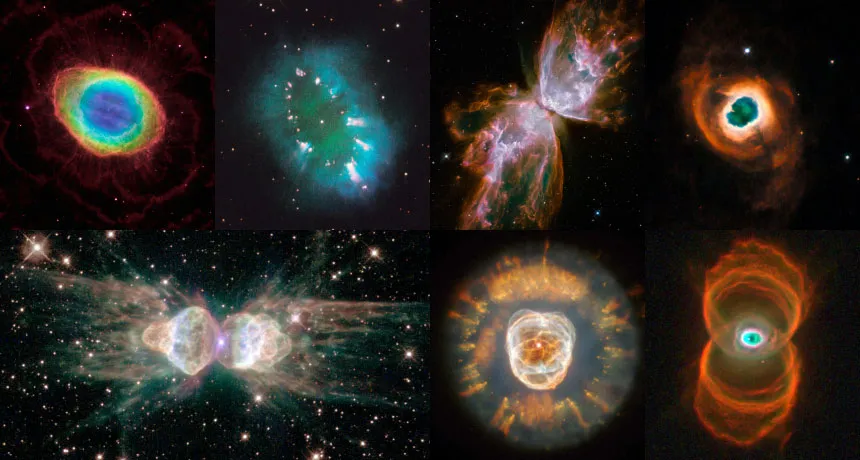
Image compilation from ScienceNews:
CLOCKWISE FROM TOP LEFT: D. THOMPSON/LARGE BINOCULAR TELESCOPE OBSERVATORY, C.R. O’DELL/VANDERBILT UNIV., NASA, ESA; HUBBLE HERITAGE TEAM/STSCL/AURA, NASA, ESA; HUBBLE SM4 ERO TEAM, NASA, ESA; HUBBLE SM4 ERO TEAM, NASA, ESA; RAGHVENDRA SAHAI AND JOHN TRAUGER /JPL, THE WFPC2 SCIENCE TEAM, NASA; ANDREW FRUCHTER, THE ERO TEAM/STSCI, NASA, ESA; HUBBLE SM4 ERO TEAM, NASA, ESA