Researchers found that a singular pulsar could be the slowest known transitional pulsar. An Argentine participated.
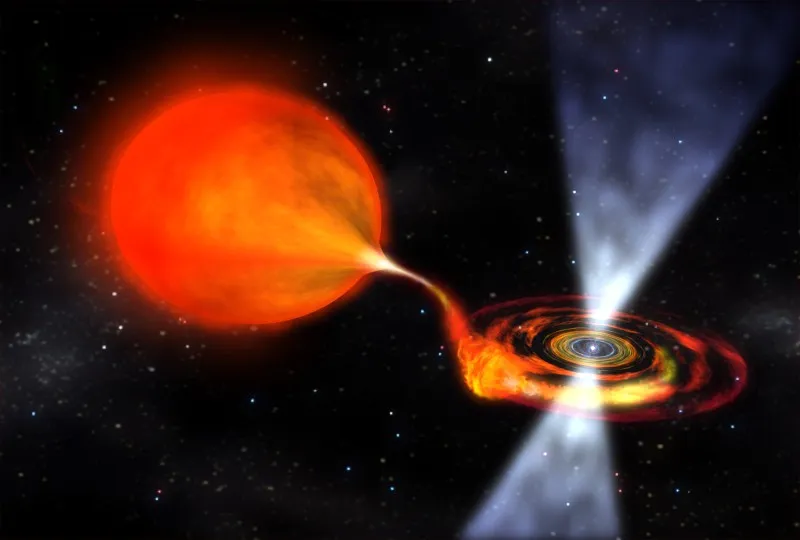
Jamie Court, an astronomer at the University of Southampton (England), also found for the first time that the pulsar has a tendency to "hiccup" when removing matter from its neighboring star.
The object in question has been known since 1995. In English it is nicknamed the "Bursting Pulsar" and its designation is GRO J1744-28. It was discovered using the Compton Gamma-Ray Observatory. A pulsar is a rapidly rotating neutron star. In this case, it goes through a bursting stage during which it emits gamma rays and X-rays with peaks of 20 bursts per hour and then quiets down. It is a Type II X-ray pulsar.
The observations were presented in a paper published in MNRAS Letters together with Diego Altamirano (from the same University) and Andrea Sanna (University of Cagliari). Diego Altamirano obtained his undergraduate degree from the FCAyGLP (UNLP) in Argentina.
Using data from NASA's RXTE observatory that returned to Earth on April 30, Court and Altamirano discovered that the object could be the slowest transitional pulsar, with a magnetic field 100 times greater than any other.
"In a transitional pulsar system, a neutron star pulls matter from a nearby star similar to our Sun onto its surface. This colossal river of stellar matter causes the star's rotation to increase, like an engine, leading this city-sized object with twice the mass of the sun to rotate hundreds of times per second and heat up to millions of degrees, causing it to shine in X-rays that we can see from Earth", explained Court.
This flow of matter cannot last forever and, as the neutron star's companion is stripped of matter, the flow stops, not neatly.
"It is now thought that in neutron stars near the end of this process, the flow can turn off and on, causing the X-rays to drop slowly like a dying engine. Even with the flow present, it stops being smooth, a constant struggle between the incoming gas and the magnetic field causes the matter to be swallowed in discrete gulps or hiccups".
Court added that the object is unusual in several ways: "The neutron star only rotates twice per second, which might seem fast for something 20 km in diameter, but it is 100 times slower than other transitional pulsars discovered so far, suggesting that the matter flow failed to spin up the star as much as it should have. This in turn suggests that there is still much we do not understand about how these incredible dense stars evolve over time".
But that's not all: "Additionally, the star in this system has an incredibly powerful magnetic field, more than 100 billion times that of Earth and 100 times greater than any other of its kind. This exciting discovery will allow us to explore the rare physics of these cosmic hiccups in an extreme environment better than ever and shows that after 6 years of being out of service, the RXTE satellite continues to help us do new science".
The co-author, Diego Altamirano, obtained his undergraduate degree from UNLP with the thesis "Observaciones en Rayos X del cumulo abierto NGC 6611", supervised by Virpi Niemela, in 2003.
http://secyt.presi.unlp.edu.ar/cyt_htm/tesisunlp/tesis/niemela_altamirano.htm.
He then emigrated to the University of Amsterdam -Anton Pannekoek Institute for Astronomy- to pursue his doctorate, whose thesis was "Different manifestations of accretion onto compact objects", which can be downloaded online and in whose acknowledgments several of his Argentine colleagues appear.
https://dare.uva.nl/search?identifier=bfea9ff6-21e0-407d-ab57-e908ae62f059
Sources and related links
- Bursting pulsar found to ‘hiccup’ during crucial stage of its lifecycle
https://www.southampton.ac.uk/news/2018/05/bursting-pulsar-hiccup.page - Diego Altamirano's personal page
http://daltamirano7.wixsite.com/welcome/ - The Bursting Pulsar GRO J1744−28: the slowest transitional pulsar?
J M C Court D Altamirano A Sanna
Monthly Notices of the Royal Astronomical Society: Letters, Volume 477, Issue 1, 11 June 2018, Pages L106–L110,
DOI: https://doi.org/10.1093/mnrasl/sly056
About the images
Press material image from University of Southampton.