Sin Azul No Hay Verde (SANHV), the marine program of the NGO Conservation Land Trust (CLT), promotes the creation of Marine National Parks in Argentina and raises public awareness about the importance of conserving our oceans.
SANHV COMMUNIQUÉ
On June 8, 2017, the national government assumed the commitment to protect the Argentine Sea through a decree that granted the National Parks Administration authority over our waters.
Until that day, it was the fishing industry together with the Ministry of Agroindustry and the Federal Fisheries Council who made decisions about how our marine resource should be managed, but with this act a long process began that would come to a successful conclusion.
Argentina is a complete novice in what corresponds to the management of its exclusive economic zone. The law for the Federal Fisheries Regime was only enacted on December 9, 1997 and it was not until last June 8 that a new debate began on the conservation of our sea, the creation of marine protected areas.
Within the framework of the National System of Marine Protected Areas (MPA) law, work was done on a bill to create the first MPAs. In contrast to the management of the sea, which goes hand in hand with production and has an objective view in relation to the fishing resource, marine areas have an ecosystem view, therefore they take into account all the factors that are essential to preserve in order to have a healthy sea.
What we don't know is that we need the ocean more than it needs us. The ocean regulates the world's climate, reduces hunger with fishing, generates jobs, provides medicines and produces most of the oxygen we breathe. Today we know that the role of the sea is in danger. The World Conservation Organization states that marine populations worldwide have been reduced by half in the last 40 years and some by up to 75%. The increase in temperatures caused by climate change has devastating effects on cities and communities that live by the sea. The plastic flooding the oceans has already reached our tables.
Considering that 36% of Argentine territory is sea and that only 2.6% is protected, Sin Azul No Hay Verde together with a group of NGOs decided to work for the creation of protected areas in the sea that would ensure a safe refuge for ocean ecosystems.
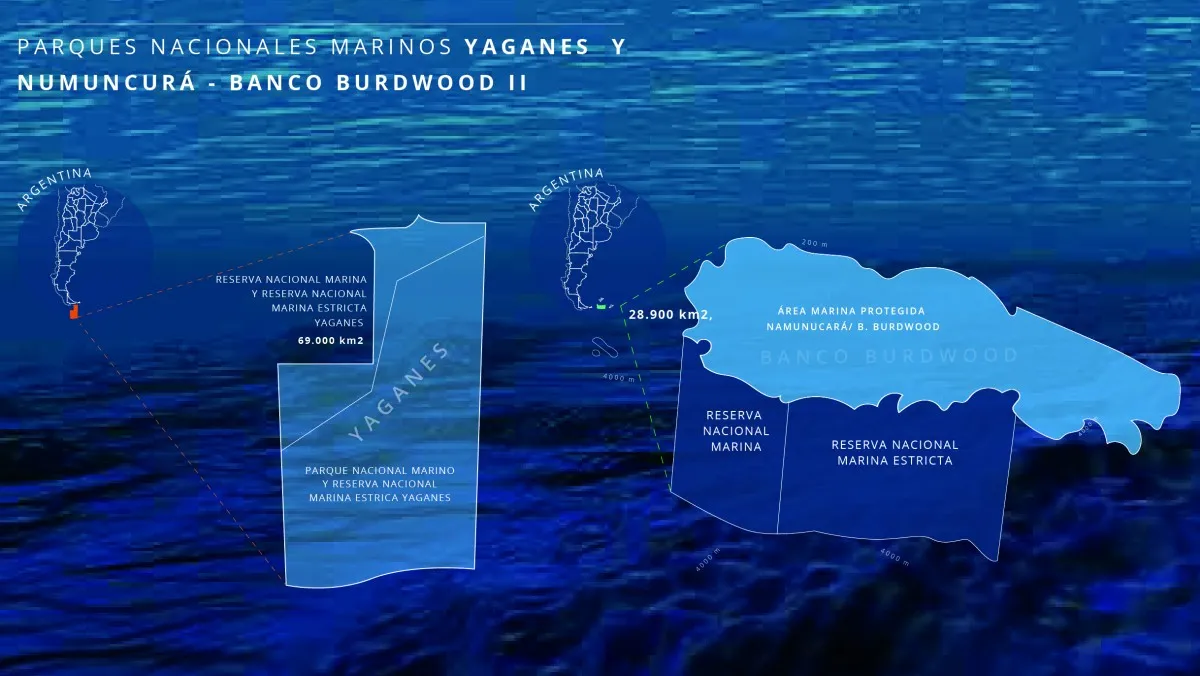
In December 2017, the Bill entered Congress. The law proposes to begin by protecting 2 areas: Namúncura Bank – Burwood, in Tierra del Fuego, and Yaganes, also at the southern tip of Argentina. The speed at which our planet is changing demands that measures be taken quickly.
Yaganes Marine National Park
It is located south of Tierra del Fuego and Isla de los Estados, in the Drake Passage that connects the Atlantic Ocean with the Pacific. Its 69,000 km2 are close to the dimensions of the province of Formosa (72,0066 km2) and its seabed is mostly unexplored. Submarine canyons have been detected and there is evidence of underwater forests that likely contain high species diversity.
The main purpose of creating this Park is to conserve and protect the various types of marine habitats and the sensitive, rare species or those with key functions for these ecosystems (bottom invertebrates, sharks, fish, birds and marine mammals).
Namuncurá – Burdwood Bank II Marine National Park
It covers approximately 28,973 km2, comparable to the province of Misiones (29,801 km2). Burdwood Bank is a submerged plateau that, being shallower than the surrounding areas and thanks to the currents that surround it, generates the upwelling of nutrients from the depths, creating an explosion of life. Burdwood II is an extension of the current marine reserve, Namuncurá - Burdwood Bank.
The main purpose of its creation is to extend the current Marine Protected Area, to conserve a steep slope with submarine canyons where communities of fragile and unique seabed species such as corals (true corals, soft corals and false corals) and sponges live. These form animal forests that give shelter to other species.
Both parks include spawning areas for fish of commercial interest such as Southern Blue Whiting, Patagonian Toothfish, Little Grenadier and Fuegian Sprat. Furthermore, they are feeding and transit areas for birds and mammals threatened with extinction, such as the Wandering Albatross and the Fin Whale.
Protecting the ocean is not optional, it is an obligation we have to future generations. It is our duty to understand that without oceans there is no life. What we do or allow to be done in these next 10 years will forever impact the health of our oceans.
Nature does not follow our schedules.
Sin Azul No Hay Verde invites everyone who wants to join to sign on the website www.sinazulnohayverde.com, participate in actions and on social networks and above all spread the knowledge.
Conservation is forever.
Sources and related links
Web: http://sinazulnohayverde.com/
Instagram SANHV https://www.instagram.com/sinazulnohayverde/
Facebook SANHV https://www.facebook.com/parquesnacionalesmarinos/