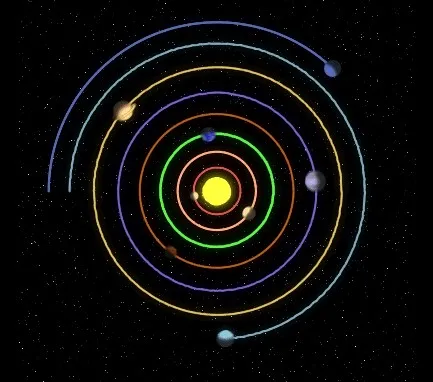
What would it be like to observe the sky of the red planet? Is Earth the best of the planets in the Solar System for doing astronomy? I bet it is. For now...
Has anyone thought of making a version of Stellarium for Mars? If it hasn't been done yet, it would be a good nerd astronomy project.
But that doesn't stop us from dedicating ourselves to thinking a little about what our neighbor's sky would be like.
ROTATION, REVOLUTION
Let's start with the basics: rotation and revolution. Earth's rotation generates the concept of a day, which on our planet lasts 24 hours. On Mars it lasts 24 hours, 40 minutes. At NASA they call the Martian day a sol (lowercase).
On Earth, the revolution lasts 365 Earth days. On Mars, the revolution lasts 668 sols, which is almost double.
As a consequence of this, the motors used to move telescopes with equatorial mounts, used in long-exposure astrophotography or in automated-movement telescopes, would have to be slightly modified.
The climate on Earth depends, among other things, on the seasons, and these occur due to the tilt of the equatorial plane by 23.5°, not very different from Mars, whose tilt is 25°. However, there is a greater difference in the eccentricity of the orbit, which on Earth is 0.01 and on Mars is 0.09, and this greater eccentricity has consequences for the temperature differences on Mars. It is not an impediment for us to do astronomy there.
Hold on: could we breathe? Obviously not, unless we take precautions. Imagination is not free: you have to pay the toll of verisimilitude, so I propose we set up a glass dome acclimated to our needs. Then, we continue.
NORTH AND SOUTH CELESTIAL POLES
If we are going to do astrophotography, we will have to polar align the telescope. On Earth, the North and South Celestial Poles are used and they are located via nearby stars. In the Northern Hemisphere, Polaris; in the Southern Hemisphere, the very faint Sigma Octantis.
The North Celestial Pole on Mars is in Cygnus, a constellation also known as the Northern Cross. Deneb, the brightest star in the constellation, and Gamma Cygni (also called Sadr) would act as "pointers" towards the North Celestial Pole. We would have to extend the segment between both stars a little, stretching towards Alpha Cephei.
Here, an illustration from Wikipedia:
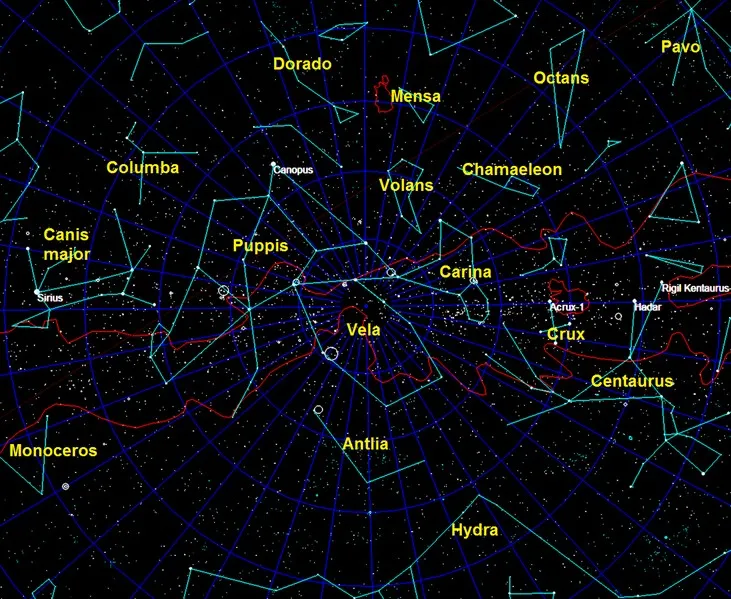
As the amateur observer will notice, Polaris is not very far away.
Something similar happens with the South Celestial Pole, not very far from where we locate it on Earth, but slightly shifted in place:
Very close to Kappa Velorum, which would function as the pole star in the Southern Celestial Pole.
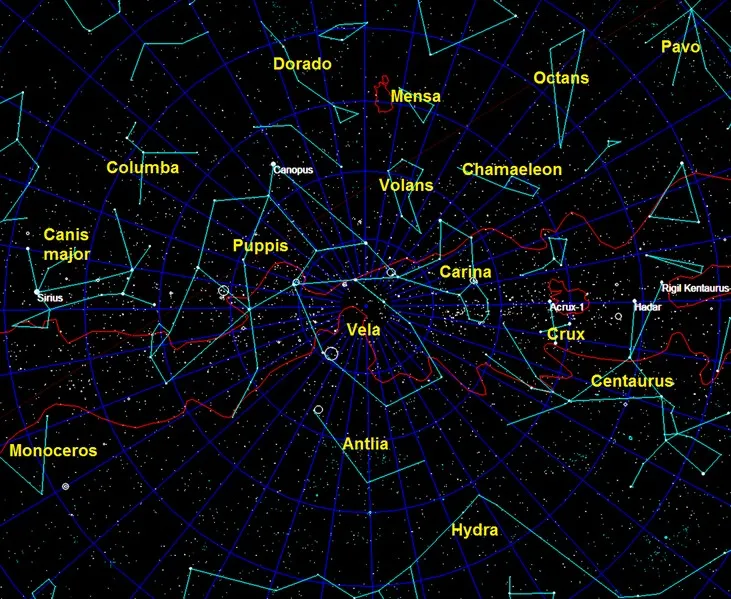
As is obvious, after thousands of years, the pole stars change due to the precession motion, which also exists on Mars, although it is somewhat smaller.
MOONS
Mars has two moons, Phobos and Deimos, very small, considered captured asteroids. Compared to our Moon they don't seem like much, but if we lived on Mars we would pay a lot of attention to them.
Phobos has one-third the angular diameter of our full Moon, while Deimos looks like a star, without a disk. Phobos orbits so fast that it rises in the west and sets in the east twice per sol (Martian day). Deimos rises in the east and sets in the west and is two and a half sols above the horizon.
ECLIPSES
Will there be eclipses on the Red Planet?
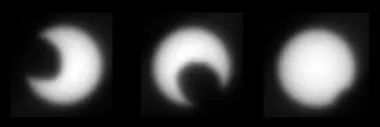
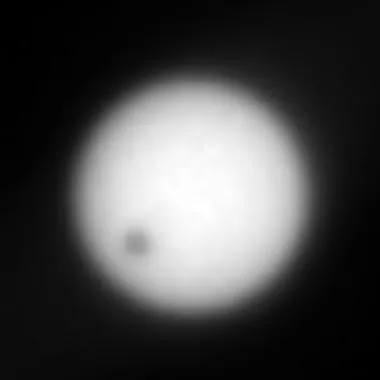
Let's start with solar eclipses. The angular size of Phobos can be up to half the angular diameter of the Sun, so its transits can be considered annular eclipses. In the case of Deimos, as its angular size is much smaller, it only appears as a point, more than an eclipse it would be considered a transit.
We would also observe lunar eclipses, in which Mars's shadow would darken each full moon.
With the Mars Exploration Rovers, these images of a solar eclipse by Phobos and a transit of Deimos were obtained:
OBSERVATION OF EARTH FROM MARS
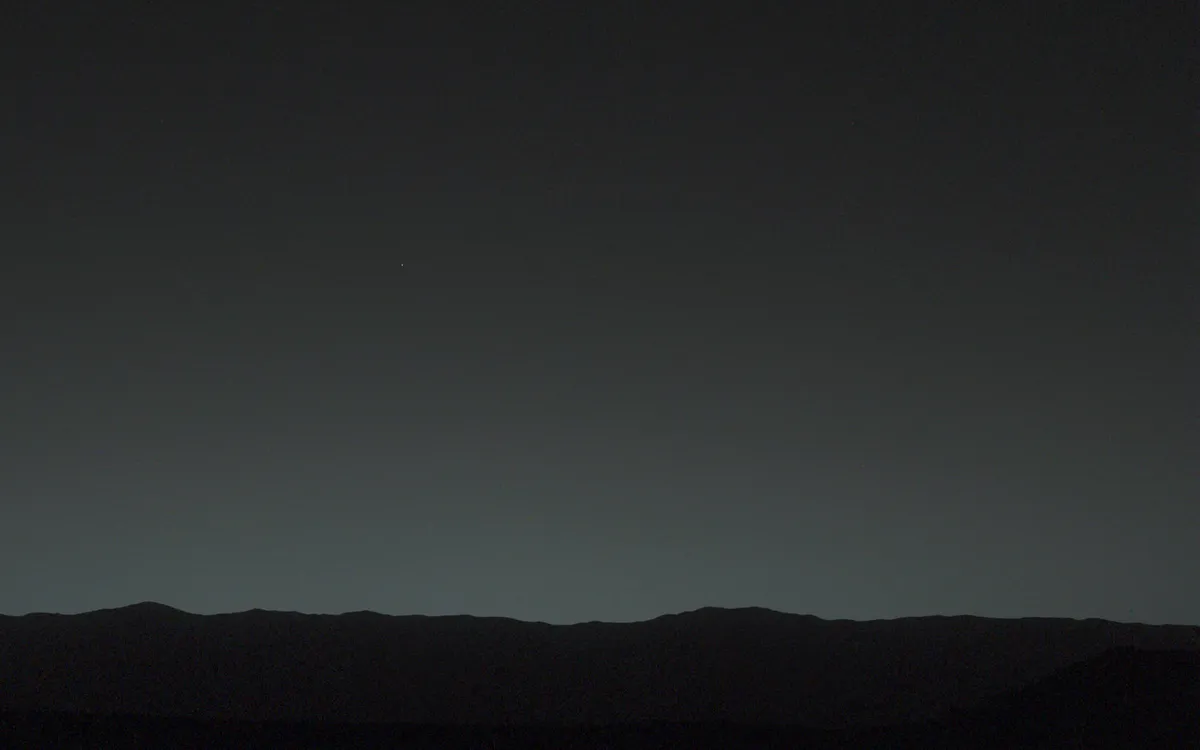
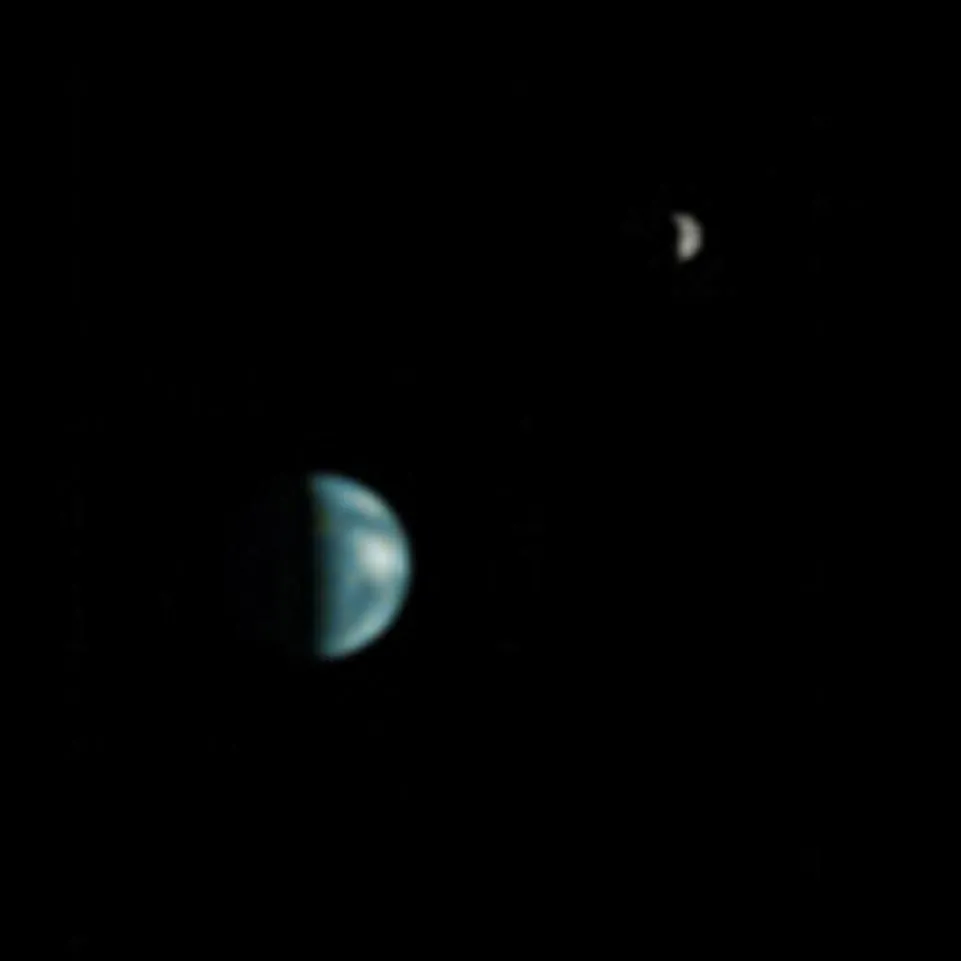
Will we be able to see our planet from the neighbor? One might think not, on the grounds that if we are on a hemisphere or face of Mars pointing towards Earth, then it would also point towards the Sun. But we can see the Moon on Earth during the day, just as we can see Venus as a "star" of dawn or dusk.
Similarly, Earth would be seen from Mars as a dawn and dusk object, near the Sun.
In January 2014, NASA's Curiosity rover took a photo of Earth and the Moon.
Also, with the Mars Global Surveyor spacecraft, NASA took this photo:
METEOR SHOWER
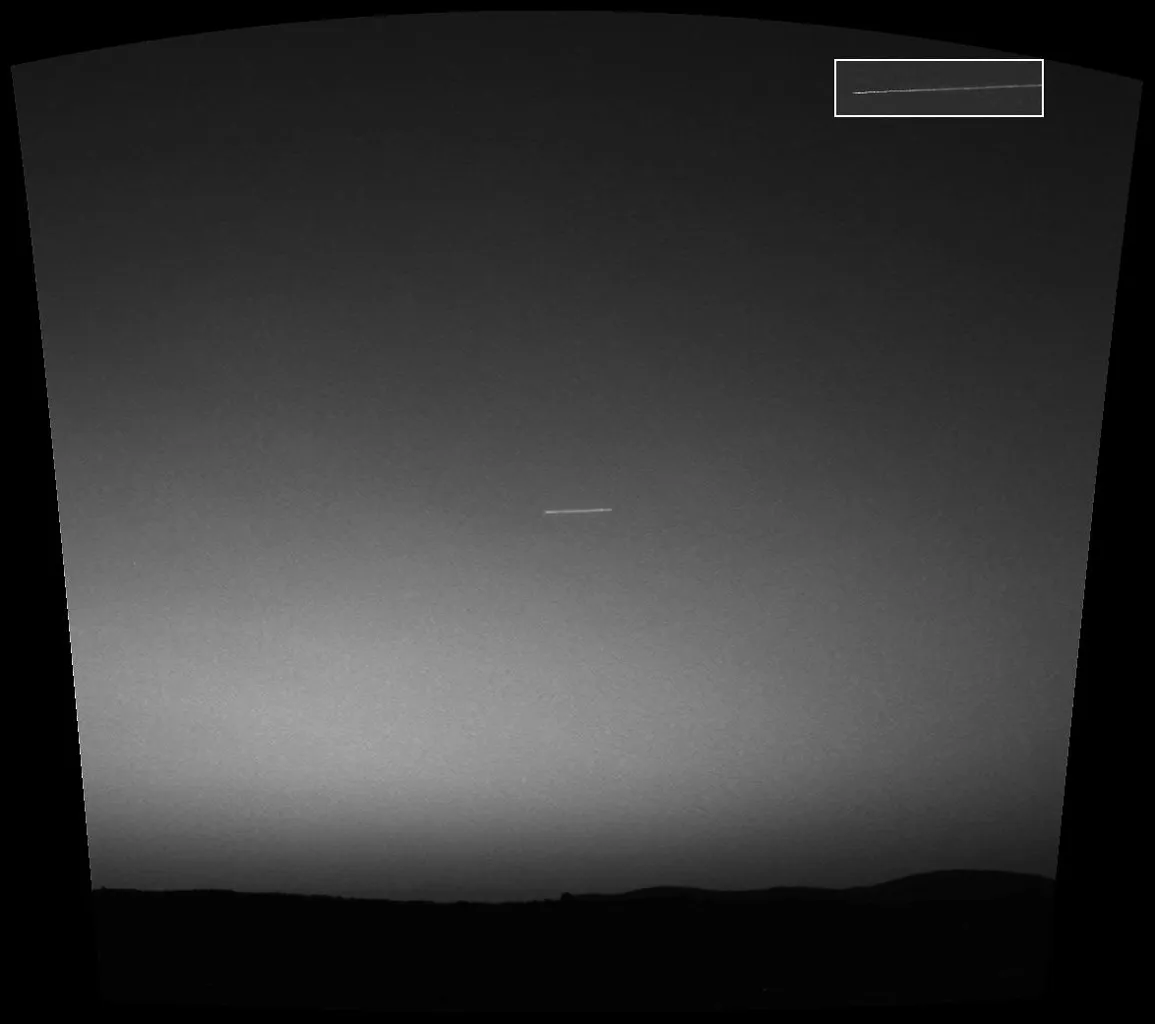
There would be no impediments to seeing meteor showers. In fact, NASA with the Spirit rover took a photo showing a "streak" that would be the result of a meteor shower, although at the time it was speculated that it could be a defunct artificial satellite.
LIGHT POLLUTION
If setting up a telescope is usually difficult, more so in the Southern Hemisphere due to the faintness, almost at the limit of visual observation, of Sigma Octantis, it is much more complicated in urban centers where, due to light pollution, that star is directly imperceptible. Still, moving away from large cities, visual astronomy can be done. Still. Mars is virgin in that sense and has a very thin atmosphere, which reduces diffraction effects, although it has its downside: less protection from solar radiation. But, undoubtedly, its nights are darker than ours.
CONCLUSION
Astronomy cannot be done on Mars, unless we can first live: air, water, food, netflix, the basic needs must be satisfied first. But if we manage to overlook this and survive without Whatsapp for a while, assuming we have a conditioned glass dome, we could do amateur visual astronomy as on Earth, with some modifications.
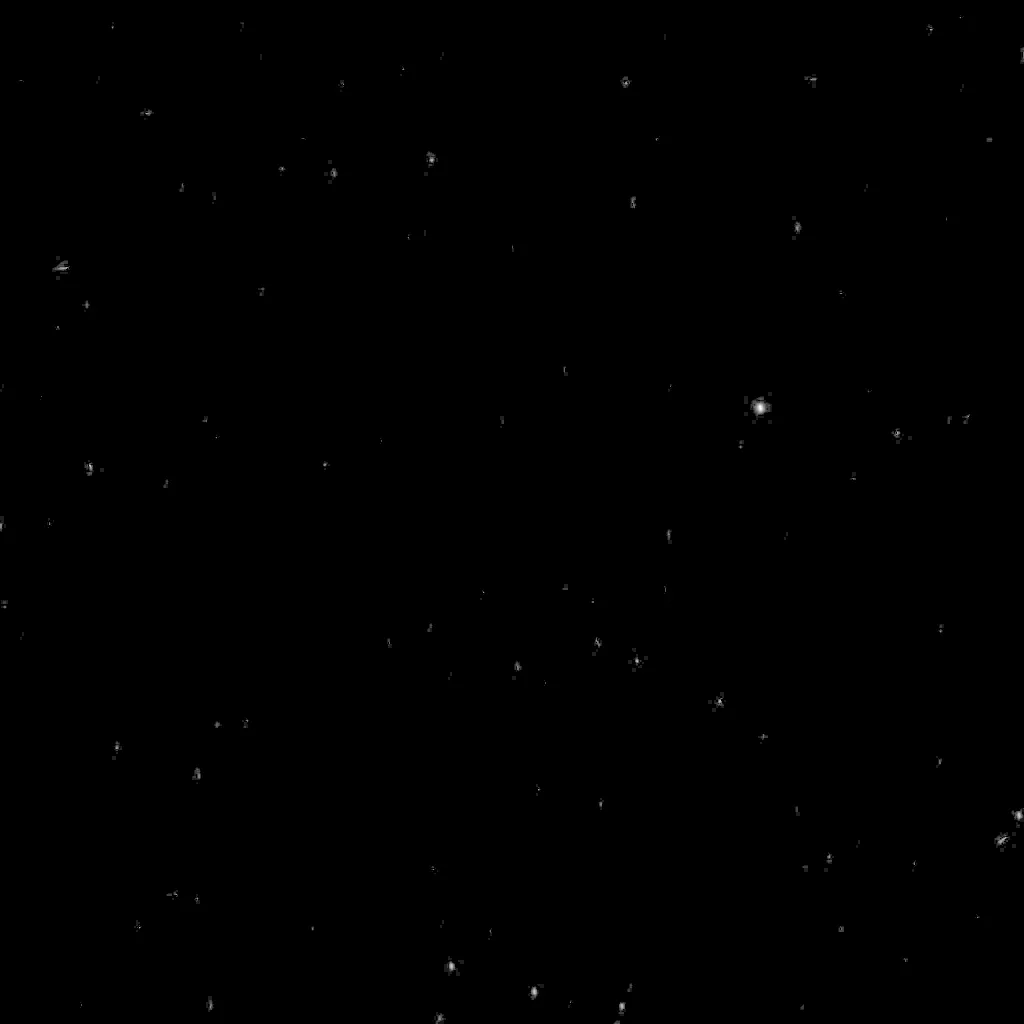
So, as usual, when looking up at the night sky, we would see something similar to the image at the beginning, which shows the arrangement of the stars of the Constellation Orion in the Martian sky.
In contrast, Mercury with its very high and very low temperatures, radiation and absence of natural satellites would not be a good place. (See separate text). The planets of the outer solar system are gas giants where it is hard to stand, although one could imagine the possibility of settling on some moons of Jupiter or Saturn, but which in some cases will be more interesting for geologists due to their resemblance to the early Earth. They are not very stable places, like a Windows Millenium.
We are left with Venus, although its high cloud density and its strong greenhouse effect make it a true hell.
Everything seems to indicate that, very strikingly, we are on the best of possible planets within the Solar System to do astronomy.
But we could have said the same billions of years ago regarding Mars or Venus, which were similar to Earth.
Luckily, our human influence on environmental conditions is not enough to generate the same as on Venus, right?
For some, the Buenos Aires G-20 meeting was a success because there was no disorder, that is, violence. That, because they do not perceive the violence of climate change, which is very long-term, but which contains a human industrial influence, provoked, above all, by powers like the United States and China, which in that matter, have no war between them.
Except for some neo-hippies, no one wants to return to feudalism; industrialization is necessary. But the industrial effects on the environment must be considered and mitigated with serious measures. On this point, the G-20 was a complete failure.
If the trend of recent decades is maintained, in the long run, doing astronomy on Earth will be like doing it on Venus.
Great, then we'll migrate to Mars!, someone will say. Mars will be colonized by the United States and China and they will not accept "foreigners". We Earthlings will be thought of as migrants are thought of now: as pariahs.
On the other hand, that's the way of thinking of the Predators...

THE BEST PLACE IN THE UNIVERSE FOR AN OBSERVATORY
Ground-based observatories are installed in places where the best conditions for observation exist, that is, the greatest number of clear nights.
Although Earth may be the best place to live, it may not be the best place to install an astronomical observatory.
The Moon, for example, has day and night. It is said that one face is hidden because we always see the same face, but it is not always dark. The Moon's rotation period is 29 days, while on Earth it is 24 hours. That implies the Moon has almost two weeks of night. But near the poles there are areas that never see the sun. A crater near one of the Moon's poles would be a place of permanent night, a delight for astronomy, even more so due to the absence of an atmosphere which causes problems of light diffraction.
However, temperatures would be very low. An instrument could be installed there to be operated from Earth. This instrument would need energy to function. Some way of taking light from the Sun from the illuminated areas would have to be designed to generate enough energy to move the instrument. Perhaps other precautions would be necessary, against micrometeorites, for example. When the instrument fails it would be relatively easy to go and repair it.
MERCURY OPTION
Another option could be Mercury, whose rotation period is 58 days, double that of the Moon. If the axial tilt of the Moon is very low with respect to Earth (1.6º vs. 23.5º), on Mercury it is 0º. At the poles, the Sun would barely appear above the horizon. The trip to Mercury would be longer than to the Moon, but it would still be a relatively short trip (*).
On the other hand, infrared astronomy is interesting for studying certain objects and phenomena, but on Earth there are some limitations given by the atmosphere, for example in the 2.5-3 µm (micron) range.
Gentlemen of NASA: You know, if you like the idea, the name for the instrument must be BlaMeIT (Blanco Mercury Infrared Telescope). If China steals the idea, you'll know who's to blame...
(*) Although the distance is not great, landing successfully (without crashing) on Mercury is very difficult, since the orbit is short and fast, the planet is small and the sun pushes in favor, that is, the spacecraft would have a lot of speed and to land it would have to brake, but a lot of fuel would be needed. For comparison: the BepiColombo probe will take 7 years to reach Mercury.
Sources and related links
- What Does Earth Look Like From Mars?
https://astrobob.areavoices.com/2012/08/10/what-does-earth-look-like-from-mars/ - Astronomy on Mars, on English Wikipedia
https://en.wikipedia.org/wiki/Astronomy_on_Mars - Decolonize Astronomy?
https://upliftconnect.com/decolonize-astronomy/ - On the Moon, NASA Probe Sees Where Sun Never Shines
https://www.space.com/20302-dark-moon-craters-lro-spacecraft.html
About the images
Celestial North and South Poles on Mars
By Tomruen - Own work, CC BY-SA 4.0, https://commons.wikimedia.org/w/index.php?curid=54844289
Bright 'Evening Star' Seen from Mars is Earth https://www.jpl.nasa.gov/spaceimages/details.php?id=PIA17936
Photo Earth and Moon from Mars MGS https://photojournal.jpl.nasa.gov/catalog/PIA04531
Martian Moon Eclipsing Sun, in Stages https://www.jpl.nasa.gov/missions/mer/images.cfm?id=1079
Deimos Crosses Face of Sun https://www.jpl.nasa.gov/missions/mer/images.cfm?id=1081
Meteor shower on Mars https://www.jpl.nasa.gov/spaceimages/details.php?id=PIA05557 https://mars.nasa.gov/mer/gallery/press/spirit/20040311a.html
Image credit: NASA/JPL/Cornell
ORION FROM MARS https://www.jpl.nasa.gov/spaceimages/details.php?id=PIA05546
Stars in Orion as Seen from Mars https://www.jpl.nasa.gov/missions/mer/images.cfm?id=1067
Composition China vs USA
IMDB: Aliens vs Predator
©20th Century Fox https://www.imdb.com/title/tt0370263/mediaviewer/rm1321871872
Trump Confirms "Very Important" Meeting With Xi Jinping In Argentina https://www.ndtv.com/world-news/donald-trump-confirms-very-important-meeting-with-xi-jinping-argentina-1956518