A couple of possible uses of this technology in professional astronomy.
Although there is enough shared information on the web about "blockchain" technology, it is worth at least a simple explanation for those who have no idea.
A blockchain is a technology whose main intention was to record transactions in a decentralized and encrypted way. Each block can contain many transactions and each block is related to the previous and the next one. When the recorded transaction is validated, it cannot be modified. It is, therefore, like a database, encrypted, decentralized, and unmodifiable. Regarding the latter, it should be added that a company indicated it would dedicate itself to creating an editable blockchain version, although that would already be almost another technology because the impossibility of editing is one of the core ideas.
Although the concept was to record money transactions, it is possible to use the same technology for other types of data, even to use it not to record an exchange, but directly as storage, an alternative to the "cloud".
Can this technology be used in astronomy?
There are at least two possibilities: The site Coinatory reported a few months ago that two startups (technology companies) called AIKON and Hadron would use this technology to process data obtained with Hubble by the Space Telescope Science Institute (STScI), gaining efficiency in data processing resources.
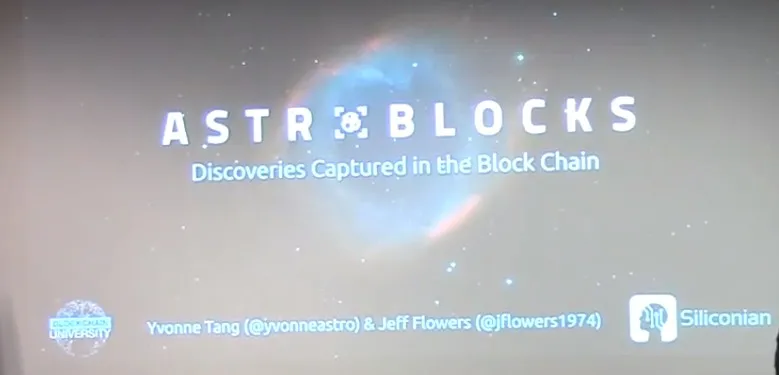
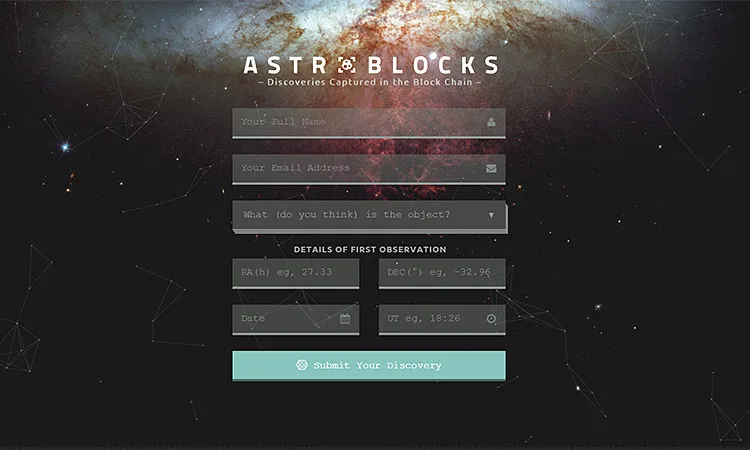
The other case is Astroblocks, a project by Dr. Jeff Flowers and Yvonne Tang, with the goal of achieving a secure, peer-reviewed scientific publication of data, as they state in Inside Bitcoins. It can also be used in amateur astronomy, for example, when comets or variable stars are discovered. Through an application, the user registers the discovery within a blockchain. The record has a timestamp and is then sent to a panel of experts who will validate or not the record.
Bitcoin mining
According to the newspaper Metro, Dr. Dan Werthimer, from the SETI project, stated that data block mining is preventing research into whether intelligent extraterrestrial life exists. The issue is that for such research, a lot of data is collected that must then be processed. Computers with advanced GPU boards, graphics processing units, are usually used for this purpose, but according to this astronomer, in recent months such boards are scarce, as they are intensively used for virtual currency mining.
Cryptocurrency mining is the processing of those transactions to validate them. It requires large computational calculation capacities and, therefore, consumes a lot of energy.
FROM CITIZEN SCIENCE TO SCIENTIFIC BUSINESS
It is not far-fetched to compare the two blockchain use projects with distributed computing initiatives like BOINC. Here I have told about several projects from that platform linked to astronomy. Basically, to process large volumes of data, researchers appeal to many common users, since nowadays home equipment has good calculation capabilities. The user installs a program and chooses one or several projects and, depending on how it is configured, the program will download data from the project, the CPU/GPU will process that data and send the result. As a consequence, the user's computer spends more energy, which the citizen pays. Those who win are the researchers and, particularly, the institutions to which those researchers belong—whether private or state—since they save that processing. Does that make sense? It does insofar as many users have very powerful computers of which they only use a part of those calculation capabilities, which is a waste. Since the user has no obligation and obtains no benefit, but on the contrary, will increase their energy expenditure, it is advisable to configure the program so that it does not make intensive and permanent use of the computer.
The use of blockchains in the aforementioned projects does not seem very different, except for the economic issue. Instead of science institutions using their own computers to process data, or renting calculation capacity from third parties (like clusters), blockchain mining would be used for processing. Such mining generates virtual coins and commissions for those who do it faster and correctly. If business is about obtaining a benefit, then there is business in both cases, since in both someone gains something and someone loses.
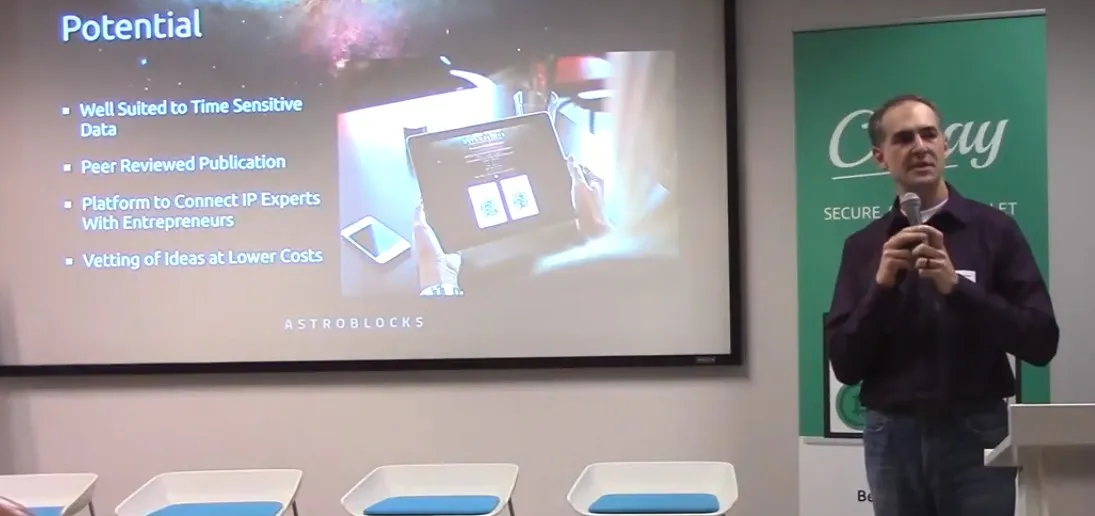
In the presentation of Astroblocks, a slide was shown with the potential of that application which included the item: The platform connects intellectual property experts with entrepreneurs.
It is worth adding to the current technological scenario that many desktop and notebook computer users have been replacing those devices with smartphones that are not very compatible with cryptocurrency mining, since cell phones are not connected to the electrical grid, but have batteries of not very long duration. It does not seem that most people can process large volumes of data with smartphones or personal computers for home use. One might wonder to what extent this is "decentralized".
That is to say, we move from the romantic citizen who voluntarily and freely collaborates in science projects (saving a cost for private or state institutions and assuming that cost), to the entrepreneurial citizen who processes data to obtain virtual coins. That is to say, the science that is truly at stake is economics.
For some years now, the judicial system in Argentina and journalism have spoken of investigating "the money trail" in some corruption cases. However, one should always trace, in all cases, the money trail. A possible common denominator in all cases is that the game of economics is always the same: a zero-sum game.
Sources and related links
- Astroblocks Puts Proofs of Scientific Discoveries on the Bitcoin Blockchain
https://insidebitcoins.com/news/astroblocks-puts-proofs-of-scientific-discoveries-on-the-bitcoin-blockchain/31153 - Blockchain for astronomy
https://coinatory.com/2018/07/27/blockchain-for-astronomy/ - Bitcoin cryptocurrency craze is stopping us from finding aliens, astronomer claims
https://metro.co.uk/2018/02/14/bitcoin-cryptocurrency-craze-stopping-us-finding-aliens-astronomer-claims-7313084/ - Siliconian: ASTROBLOCKS
https://www.siliconian.com/component/content/article/11-portfolio/blockchain/4-astroblocks
About the images
Image and screenshots: Credit: Siliconian/Blockchain University.