The challenges of the data deluge in modern astronomy and the LSST of the Rubin Observatory.

Astronomy can be a solitary activity, and in its development we find stories of achievements made individually by astronomers with their bodies bent to put their eye to the telescope's eyepiece. Analog photography contributed to the development of astronomy, and it was common for professionals to place an emulsion-coated glass plate at the back of the telescope to later develop it, like a roll of film. To discover transient phenomena (brightness-position changes), scientists had to compare one image with a previous one, scanning them with a magnifying glass. Astronomy was artisanal.
Today is very different. It is digital. An example to account for the scale difference with the recent past is the LSST (Legacy Survey of Space and Time) project to be carried out by the Rubin Observatory. With its 8.4-meter diameter telescope, from late 2022 as planned, this space-time survey will take a complete image of the Southern Celestial Hemisphere every three nights for ten years. The good thing is that it will collect a huge amount of data. The bad thing is that so much information is difficult to handle, making the most advanced computing for data management and storage indispensable.
Ultimately, astronomers are increasingly trying to put the sky into a computer, paraphrasing that album by The Police, "Ghost in the Machine" or "El Fantasma en la máquina" which included the song "Demasiada información":
♫Too much information running through my brain
Too much information driving me insane♫
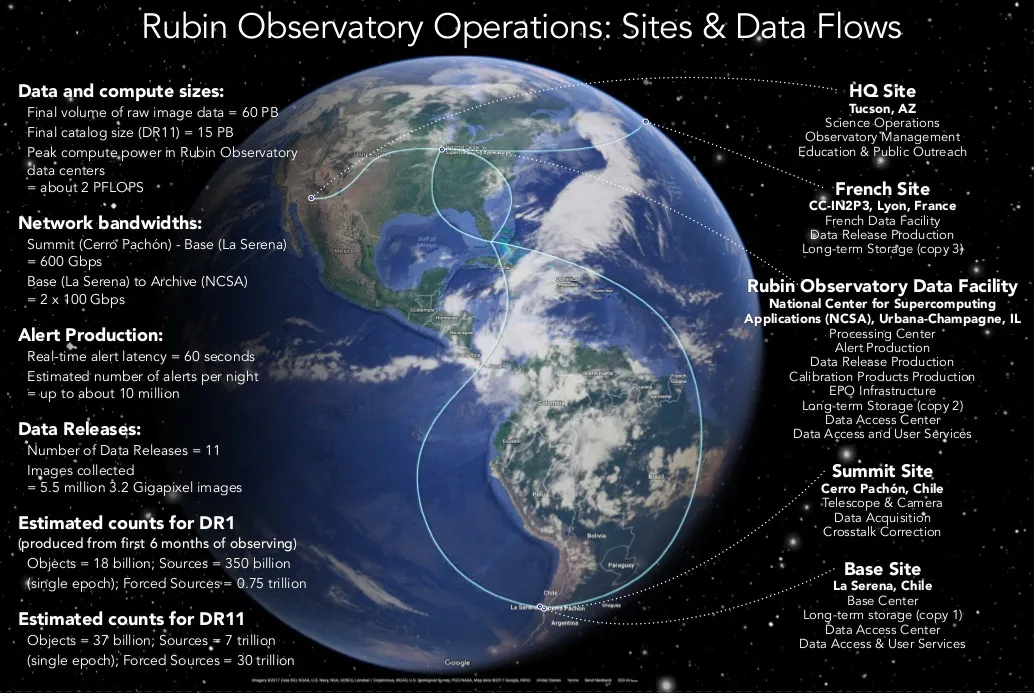
It is expected that the Observatory will produce about 20 terabytes (TB) of raw data per night. Over the planned 10 years, it will be 60 petabytes (PB).
FROM THE SKY TO THE CLOUD
The size of this data is largely due to the 3200-megapixel camera. "It only takes gigantic photographs. A single image would need 378 4K televisions to be displayed at its real size", commented Dino Bektešević, a scientist at the DiRAC Institute at the University of Washington.
With this camera, an image will be taken every 30 seconds, every night, for a decade. The camera measures 1.65 x 3 meters and weighs almost three tons. It has a field of view of 3.5º.
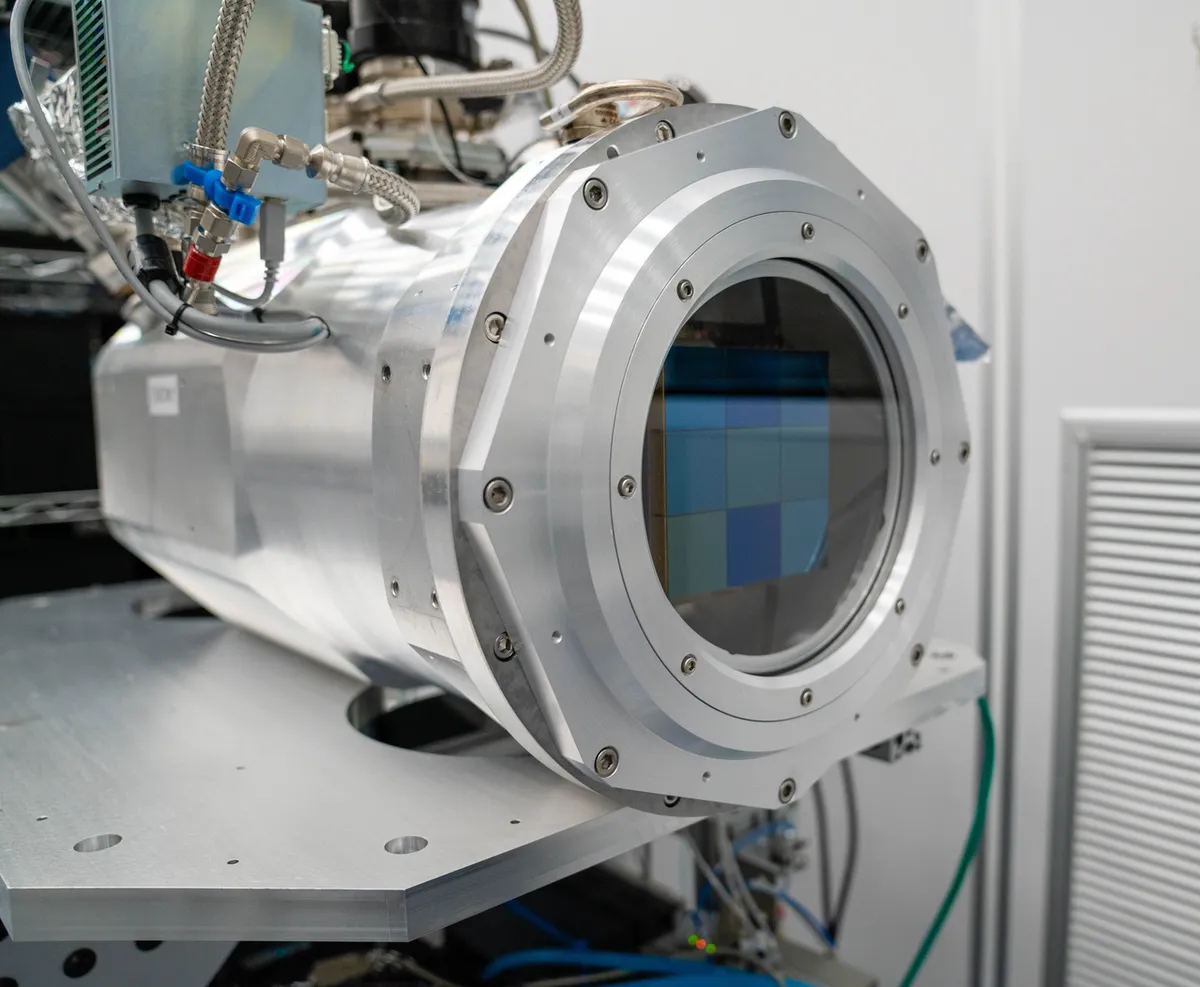
The observatory's optical design consists of three mirrors with a refractive corrector, capable of observing 9.62 square degrees of the sky, about 40 times the area of the full moon.
Each image contains a lot of information that must be cataloged and processed quickly. Even in real time, as they attempt to create an alert system to detect transient phenomena.
For these reasons, astronomers working at the Rubin Observatory must develop advanced algorithms to store and process large amounts of data and make them available for research quickly. In many cases, astronomers will conduct their research through the data included in a catalog produced by image reduction through a pipeline architecture.
But it could be very useful to perform custom analyses of some subset of the original data. That would require a much larger infrastructure, so they have turned to cloud services.
"We are getting astronomers to no longer look at individual objects with telescopes, but we are actually giving them a series of data on which they can do proper statistics", says William O'Mullane, head of the Rubin Data Management Team.
The developed system uses Amazon Web Services (AWS). In particular, the S3 service which is object storage. Unlike more traditional file systems that handle data as a hierarchy of files or data blocks in sectors, object storage handles data as objects. This allows storing massive amounts of data without structure.
The size of the data volume to be collected, night after night, is unprecedented. The Hubble Deep Field images revolutionized contemporary astronomy by finding thousands of galaxies in a small sector of the sky. Rubin astronomers estimate that the first data release (DR1), with only 6 months of observations, will contain 18 billion objects. And from there, double each year, for a decade. However, this will depend on the computing capabilities to manipulate the data so that astronomers can conduct research and make discoveries.
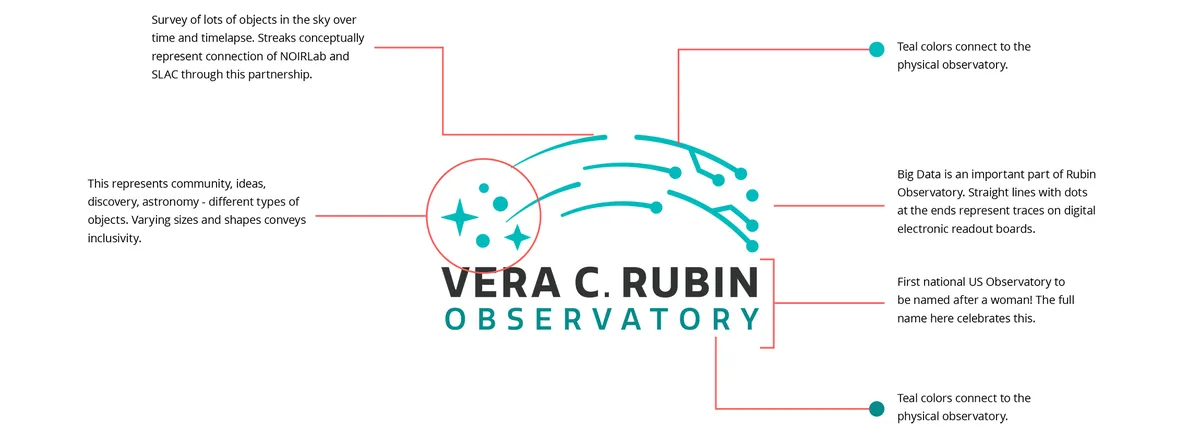
The advanced technology of the Rubin Telescope to carry out the LSST is so important that it is part of the Observatory's new logo: the lines with dots represent electronic circuits.
That album by the British trio The Police also contained the track "Invisible Sun". With the Rubin telescope and the LSST survey, astronomers will be able to find enormous quantities of suns invisible to the human eye, transforming them into zeros and ones in a silicon memory. The astronomers -sky police- are bringing on the night (Bring On The Night) to store their Message in an electronic bottle☉
♬I woke up this morning, don't believe what I saw/
A hundred billion bottles washed up on the shore/
Seems I'm not alone at being alone/
A hundred billion castaways, looking for a home♬
Sources and related links
- Eyes to the sky
https://sciencenode.org/feature/Eyes%20to%20the%20sky.php - A Gateway to Astronomical Image Processing: Rubin Observatory Science Pipelines on AWS
https://www.youtube.com/watch?v=u1Se4wjxYyk - LSST in the Cloud
https://dirac.astro.washington.edu/lsst-in-the-cloud/ - LSST
https://www.lsst.org/
About the images
Credits: LSST.org
Initial image: A visual representation of the Rubin Science Platform in use with a background image of the Rosette Nebula https://www.lsst.org/news/rubin-observatory-will-partner-google-cloud-host-interim-data-facility