Lecture by Dr. Gabriel R. Bengochea, Friday the 26th. Also, OpenHouse, guided tours to learn about the Planetarium's history and architecture.
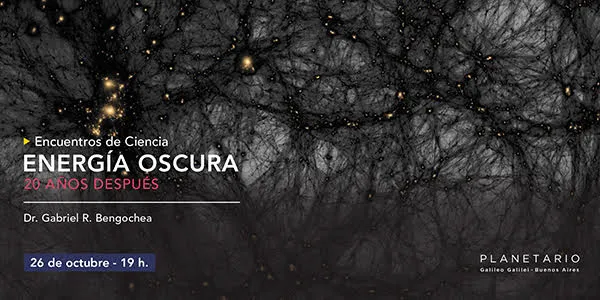
Talk: Dark Energy: 20 years later
Dr. Gabriel R. Bengochea
IAFE (CONICET-UBA)
This year marks 20 years since the Big Bang model took a new turn. It happened after two independent groups presented the first observational evidence that led us to think the universe is expanding in an accelerated manner, due to something we generically call "dark energy".
Dr. Gabriel Bengochea will give a lecture at the Buenos Aires Planetarium in which he will review the theoretical concepts and observational data that led to the discovery of dark energy and will mention some alternatives being analyzed as candidates to account for the nature of this dark component.
Friday, October 26, 19 h.
Free admission with prior registration at www.planetario.gob.ar
Buenos Aires Planetarium Galileo Galilei.
Avda. Figueroa Alcorta and Avda. Sarmiento
CV
Gabriel R. Bengochea holds a Bachelor's and Doctorate in Physical Sciences from the University of Buenos Aires, completed post-doctoral studies at the Institute of Astronomy and Space Physics (IAFE, CONICET-UBA) and is currently a CONICET Researcher, part of the Group of Relativistic Quantum Theories and Gravitation at IAFE. He has had research stays in the Gravitation Department of the Institute of Nuclear Sciences at the National Autonomous University of Mexico, maintaining collaborations since 2012. He works in observational cosmology, dark energy models and inflationary cosmology. He is also president and coordinator of outreach activities for the amateur astronomy group CAIFA.
Festival of architecture and urbanism for the city of Buenos Aires
The Galileo Galilei Planetarium will offer guided tours every half hour to learn about the history and unique architecture of the building.
October 27 and 28 from 10 h to 12:30, the last tour ends at 13 h.
Free activity - no reservation required - each tour has a capacity of 15 people.
Thanks to collective will, during one weekend a year, this event proposes to open the doors of buildings that spark curiosity. Incredible places, of great architectural, cultural and heritage value. Citizens of each neighborhood will be able to discover the closest and the farthest heritage, the private and the public, and place it within each person's experience and history, learning to value it. All activities are free and open to all those interested.
The Buenos Aires Planetarium Galileo Galilei participates in this activity by receiving visitors who will be able to tour the building. Meteorites, a sundial, the representation of the local time zone, moon rocks, the Copernican Instrument, the old Zeiss Planetarium and the unique architecture of the place will be the main attractions of the guided tours that will start every half hour. October 27 and 28 starting at 10 h, and the last tour ends at 13 h.
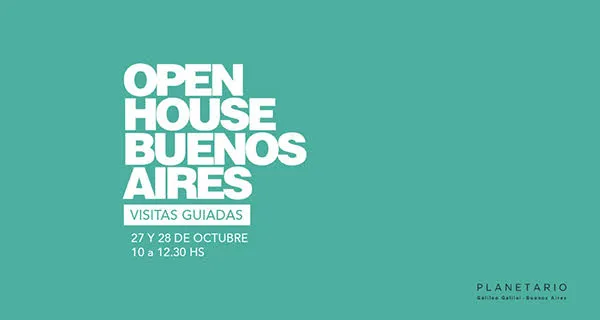
Open House Buenos Aires is part of the Open House Worldwide Family. The Open House concept is developed all over the world and on all 5 continents, in cities such as London (founding city), Melbourne, New York, Rome, Madrid, among others. In 2018, the second Argentine city was incorporated: Rosario.
Organizers
CoHabitarUrbano is a non-profit civil association created with the purpose of fostering a creative link between the city and its people. We promote a critical look at the built environment by sharpening people's perception of their cities. We believe that in this way we become true citizens capable of demanding quality places for the development of life in the city. We are a multidisciplinary team that looks and acts from and for the city from different points of view, trying to capture the multiple sensibilities of those of us who cohabit the city of Buenos Aires.
Sources and related links
Planetario Galileo Galilei www.planetario.gob.ar