Children's astronomy and talks for adults at Amigos de la Astronomía and the Planetarium.
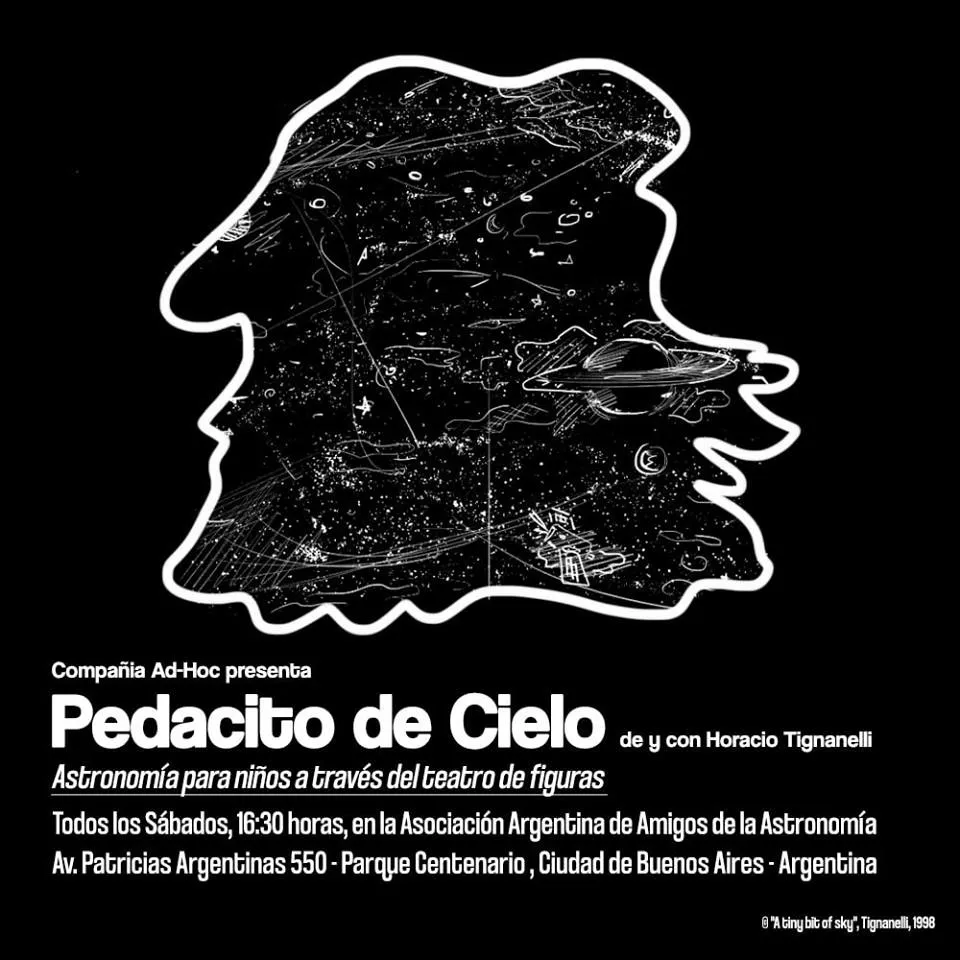
Amigos de la Astronomía informs us that "Pedacito de Cielo" is coming to the Association, an emblematic show by Compañía Ad Hoc for the whole family (ages 5 and up) where, through objects, figures and puppets, some basic ideas of elementary astronomy are reviewed. By and with Horacio Tignanelli, "Pedacito de Cielo" will be on Saturdays at 16:30 h. We await you from 15:30 h. to pick up your tickets.
Capacity is limited, and once it has begun, the doors will remain closed.
General admission $150.-
Conferences
Also at the Amigos de la Astronomía headquarters:
"The Quantum Origin of the Universe (and our perception of reality)", by Dr. Gabriel Bengochea - IAFE -CONICET-UBA-
Saturday, October 26, at 19:00 hours, at the headquarters of Asociación Argentina Amigos de la Astronomía (ASARAMAS), Av. Patricias Argentinas 550, Parque Centenario, Capital.
Addressing the study of the origin of the universe implies encountering the interface between two of the most successful theories that appeared in the 20th century: General Relativity and Quantum Physics. Einstein's General Relativity is the theory that best describes, to date, all known gravitational phenomena. On the other hand, Quantum Physics describes the processes of nature at microscopic scales. Modern cosmology (in particular the process that generated the primordial seeds in the universe) is the ideal ground for investigating the link between both theories. How did everything we see in the sky today arise? What is the universe made of? Where did the primordial 'cosmic seeds' come from? What roles do our perception, objectivity and realism play in this entire model?
In this meeting we will talk about the main ideas of Quantum Physics that are behind the model of cosmic inflation and the origin of the universe, we will pose problems that exist in this explanatory scheme and I will mention some proposals that attempt to answer the previous questions.
And at the Galileo Galilei Planetarium
"Cosmic rays in Antarctica"
An Argentine detector at Marambio Base to study solar activity and space conditions
Dr. Sergio Dasso (IAFE-DCAO) – Together with: Adriana Gulisano (IAA-IAFE), Omar Areso (IAFE) and Matías Pereira (IAFE).
Friday, October 25, 2019, 19 h (STARTS ON TIME)
Galileo Galilei Planetarium CABA
Cosmic rays are particles of extraterrestrial origin. These astro-particles contain a great deal of information and their study allows us to understand different aspects of our universe. By observing them at different energies we can, for example, infer properties of solar activity and the interplanetary medium in our solar system. Due to the magnetic shielding that surrounds planet Earth, these particles are much more abundant in regions near the poles. This talk will describe different aspects of cosmic rays, with emphasis on those linked to the project developed by our group during the last Antarctic campaign of our country, where the first detector of galactic cosmic rays at an Argentine Antarctic base was installed.
In addition to developing the scientific aspect of the project, various Antarctic experiences, lived during the campaign work carried out over more than two months on the white continent, will be shared.
Dr. Sergio Dasso is a CONICET researcher and professor at UBA. He is an expert in Space Physics and has more than 200 scientific publications in his specialty. He has worked at NASA and is a member of the World Meteorological Organization's panel of experts in Space Meteorology.
IAFE / PLANETARIUM Lecture Series
At the Planetarium they celebrate together with IAFE its 50 years in Argentine Astronomy.
The Instituto de Astronomía y Física del Espacio was born in the midst of the space age boom through the initiative and drive of Dr. Jorge Sahade. Its objective is to achieve the joint work of physicists and engineers dedicated to space physics and astronomers dedicated to observational astronomy and theoretical astrophysics.
IAFE is currently a thriving Institute, dependent on the Universidad de Buenos Aires (UBA) and CONICET, located within the grounds of the UBA's Ciudad Universitaria. Its mission is research in the field of the sciences of the universe. But over these years it has also stood out in the permanent training of young researchers and in outreach.
The Planetarium joins the celebrations for the 50 years by offering a series of talks with researchers from the Institute.
Sources and related links
- 50 years of IAFE - Meeting VI
https://planetario.buenosaires.gob.ar/50-anos-del-iafe-encuentro-vi - Asociación Argentina Amigos de la Astronomía
https://www.amigosdelaastronomia.org/