Some experiments confirm the "spooky action at a distance" rejected by Einstein.
12 billion years ago, fast particles of light left a very luminous object called a quasar and began their journey toward a planet that did not yet exist. More than 4 billion years later, other photons left another quasar for a similar journey. While Earth and the Solar System were forming, the particles continued their journey. Finally, they arrived at a pair of telescopes on the Canary Island of La Palma, configured to perform an experiment that seeks to know the true nature of reality.
The experiment was designed to study quantum entanglement, a phenomenon that connects quantum systems in ways that are impossible in our classical macro world. When two particles, like a pair of electrons, are entangled, it is impossible to measure one without knowing something about the other. Their properties, such as momentum and position, are linked.
Entanglement emerged as a thought experiment devised by Einstein (and which forms the Einstein-Podolsky-Rosen Paradox or EPR). In a 1935 paper, Einstein and his two colleagues showed that if quantum mechanics fully describes reality, then making a measurement on one part of an entangled system would instantaneously affect our knowledge about future measurements on the other part, which would imply that information is being sent between particles faster than the speed of light. The German physicist called that "spooky action at a distance" and since that is supposed to be impossible, within the framework of relativity, it would imply that there is something wrong or unknown in quantum physics.
Decades later, quantum entanglement has been experimentally confirmed several times. While physicists have learned to control and study the effect, it remains to find a mechanism that explains it or to achieve a consensus on what it means.
BELL'S THEOREM
The world of quantum mechanics—the physics that governs the behavior of the universe at very small scales—is truly strange. According to its laws, the building blocks of Nature are both particles and waves, without local definition in space. Another system that observes or measures is needed to push those particle-waves to "choose" a definitive state. And entangled particles seem to affect each other's "decision" instantaneously, at any distance.
For Einstein this could not be real, but an illusion resulting from our ignorance of what he called "hidden variables". In the 1960s, physicist John Bell thought of a test for models with hidden variables that was called "Bell's inequalities" or Bell's Theorem.
From Bell's Theorem and the EPR Paradox arise these assumptions:
-Objects have properties that are maintained whether observed or not (realism)
-Nothing can influence something sufficiently far away that a signal between them would need to travel faster than light (locality)
-Physicists can make measurements freely and without influences from hidden variables (freedom of choice)
Testing quantum entanglement is key to putting these assumptions to the test. If experiments show that nature obeys these ideas, then we live in a world we can understand in a classical way and hidden variables only create the illusion of entanglement. If experiments show that the world does not follow these ideas, then entanglement is real even if it is strange or difficult to understand.
The statistical correlations
Physicists can measure properties of particles, such as their spin, momentum or polarization. Experiments showed that when particles are entangled, the result of those measurements is more statistically correlated than expected in a classical system, violating Bell's inequalities.
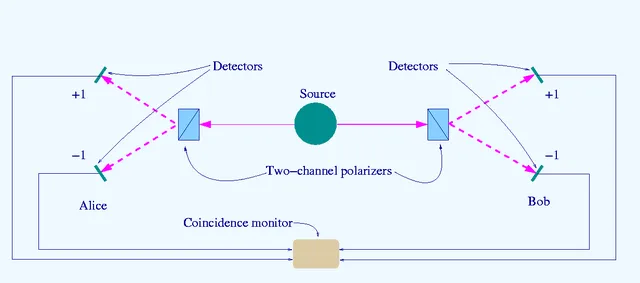
There are different forms of Bell experiments. In one, scientists send two entangled photons to separate detectors. Whether the photons reach the detectors depends on their polarization: if they are perfectly aligned, they will pass through the detectors; otherwise, there is a probability they will be blocked, depending on the alignment angle. Physicists seek to know if entangled particles end up with the same polarization more frequently than expected in classical statistics. If they do, at least one of Bell's ideas cannot be true. If the world does not obey realism, the properties of particles are not well defined before measurements. If particles can influence each other instantaneously, then they communicate faster than light, violating locality and special relativity.
Scientists have speculated that previous experimental results could be explained if the world does not obey one or both of Bell's two ideas, realism or locality. But recent work showed that perhaps the culprit would be the third argument, freedom of choice. Perhaps the scientists' decision about the angle by which photons are allowed to pass through the polarizer is not as free and random as they thought.
The quasars experiment was done to test the idea of freedom of choice. Scientists determined the angle that would allow photons to enter the detectors based on the wavelength of light from two distant quasars, something determined 7.8 and 12.2 billion years ago.
In this way, say the physicists, those quasars took the place of a random number generator and thus the experiment would be freed from human influences.
Finally, the team found many more correlations between the entangled photons than expected in a classical world. This means that if there were hidden classical variables determining the experiment's results, in the most extreme case, the measurement decision would have had to be fixed long before human existence, which would imply a highly predetermined universe.
Quantum entanglement has still not been explained, just as it is not known how measuring an entangled system turns it into a classical one or if the particles communicate with each other. Paradoxes usually cease to be so when new knowledge is acquired, that is, they seem inexplicable only because something is missing to be known. Hence it is logical to think about hidden variables. If it is impossible to transmit information faster than the speed of light, then how to explain that two "twin" particles, born together and entangled, when a characteristic of one particle (like polarization) is changed, then that same characteristic also changes in the other particle, even though, in the meantime, both have been moving away at speeds close to the speed of light and are very far from each other.
Another idea, no less strange, is this: perhaps spacetime is a kind of field, like an electric or magnetic field. So that when both particles arise, that field is in a certain state. When something changes in particle A, the field associated with that particle is also modified, but so is that of particle B, and this latter change alters particle B. In that scenario, what would be transmitted faster than the speed of light is information about spacetime itself, which does not contradict special relativity.
THE EXPERIMENT
The experiment was led by Anton Zeilinger with the collaboration of the University of Vienna, who used the Telescopio Nazionale Galileo (TNG) along with the William Herschel Telescope (WHT) at Roque de los Muchachos. The results were published in Physical Review Letters.
In the experiment, the telescopes were aimed at two different locations in the sky. Each telescope was equipped with a two-channel photometer and collected light from a quasar. An optical filter in the photometer split the quasar's light into redder and bluer photons, and these, upon falling into one of the photometer channels, were used as random measurement decisions. That decision was used to control the reference system in which to measure the polarization state of the pair of entangled photons.
The pair of photons were generated from a mobile laboratory installed at the Nordic Optical Telescope and one was sent to a receiving station at the TNG and the other to a station at the WHT. There, the individual polarization of each photon was measured in relation to the fluctuations of the light from each quasar.
According to the "spooky action at a distance" as per Einstein, the measurement of one photon in an entangled system instantly influences the measurement of the other. The question is: how is it decided what measurements to make on the two photons? It is evident that it would be desirable to have independent measurements so they do not have an influence from a common cause.
In this experiment, two quasars were used for the first time as random number generators. The fluctuations of the light from those quasars lying at 12 and 8 billion light-years in opposite places in the sky, decided for each photon which polarization is measured. Since the light from the quasars reaches us from shortly after the Big Bang, any possible influence on both quasars would have had to occur in only 4% of the known universe.
"The crucial challenge in the experiment was to ensure that the decision of the polarization measurement on each entangled photon was made in a completely independent manner from us and from any environment", said Dominik Rauch, first author of the paper.
Bell inequalities
Why are they called "inequalities"?
What Bell showed can be written like this:
Number (A, not B) + Number B (not C)>= Number A (not C)
Suppose A is sex, male-female; B is height (short, tall); C is eye color (blue, green)
Then we can say: "The number of short males plus the number of tall people (male or female) with green eyes must be equal to or greater than the number of males with green eyes. This surely cannot be otherwise."
It's not very hard to realize, algebraically, that this must be true, at least for "classical", macroscopic objects with fixed properties. People don't dye their hair in the middle of the experiment, don't put on high heels or use contact lenses.
But in the quantum world, things change, due to Heisenberg's Uncertainty Principle. What is measured, polarization (which is also spin), cannot be measured in two different directions (90º, up or 45º) at the same time. Therefore, the values of both properties can be found if we have entangled photons. If up spin is A, and 45º spin is B, then by measuring A in one particle, we can later test property B in the other. But since the three properties of each particle cannot be measured, only two, it cannot be said whether Bell's inequality is broken or not. The best that can be done is to run the test on many thousands of particles and consider the statistics of the result. The first published experiment was done by Clauser, Horne, Shimony and Holt in 1969 (CHSH).
Sources: Andrew Thomas.
https://web.archive.org/web/20081121055459/http://www.ipod.org.uk/reality/reality_entangled.asp http://www.faculty.umb.edu/gary_zabel/Courses/Parallel%20Universes/Texts/Quantum%20Entanglement.htm
David M. Harrison Bell's Theorem https://faraday.physics.utoronto.ca/GeneralInterest/Harrison/BellsTheorem/BellsTheorem.html
Sources and related links
"Cosmic Bell test using random measurement settings from high-redshift quasars”, Dominik Rauch, Johannes Handsteiner, Armin Hochrainer, Jason Gallicchio, Andrew S. Friedman, Calvin Leung, Bo Liu, Lukas Bulla, Sebastian Ecker, Fabian Steinlechner, Rupert Ursin, Beili Hu, David Leon, Chris Benn, Adriano Ghedina, Massimo Cecconi, Alan H. Guth, David I. Kaiser, Thomas Scheidl, and Anton Zeilinger, Physical Review Letters, 2018.
DOI: https://doi.org/10.1103/PhysRevLett.121.080403
The quest to test quantum entanglement https://www.symmetrymagazine.org/article/the-quest-to-test-quantum-entanglement
The TNG and the confirmation of quantum entanglement using photons from distant astronomical objects http://www.tng.iac.es/news/2018/08/23/cosmic/
Bell's theorem on Wikipedia https://es.wikipedia.org/wiki/Teorema_de_Bell
About the images
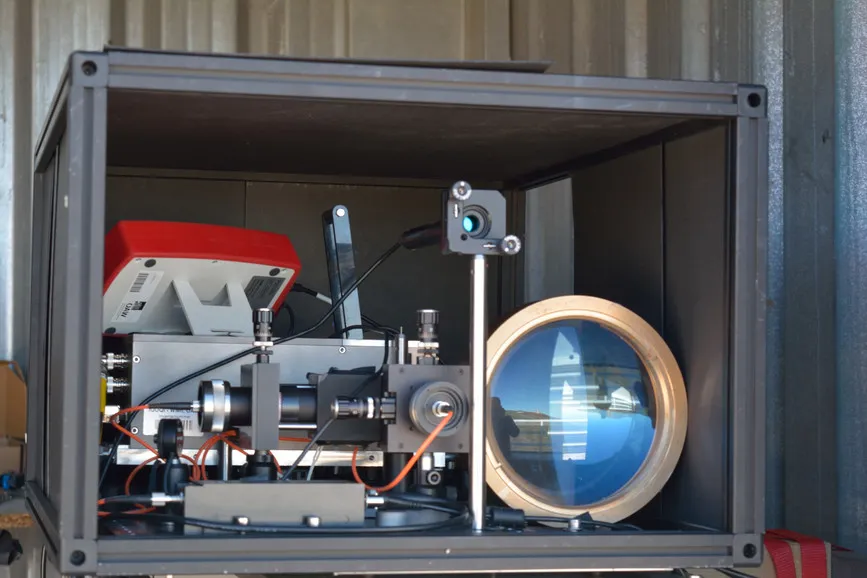
Initial photo: One of the mobile receivers for entangled photons operated by the Austrian Academy of Sciences in La Palma. Credit: Dominik Rauch/OeAW.
Illustration of a possible Bell experiment. CC BY-SA 3.0, https://commons.wikimedia.org/w/index.php?curid=641329