A review of the staging of Michael Frayn's play, directed by Mariano Dossena, at the Centro Cultural de la Cooperación (CCC).
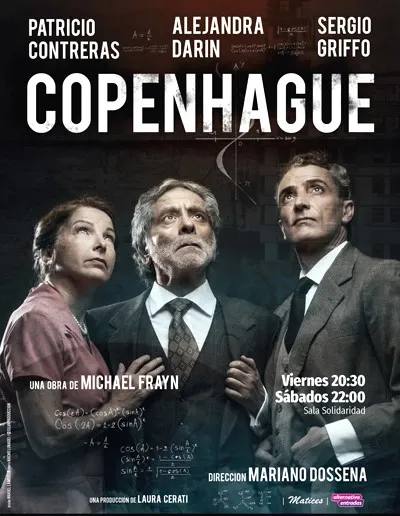
The play Copenhagen is challenging. It narrates the brief historical meeting between Niels Bohr and Werner Heisenberg at the former's house in Denmark in 1941, in the middle of the Second World War. They are accompanied by Margrethe, the Danish physicist's wife. The entire play takes place there, in the house and the garden, with the same characters always on stage. Monotony lurks. Ingenuity and good acting are needed to avoid it. I had not seen any other theatrical production of the same play, but I had seen the film starring Daniel Craig.
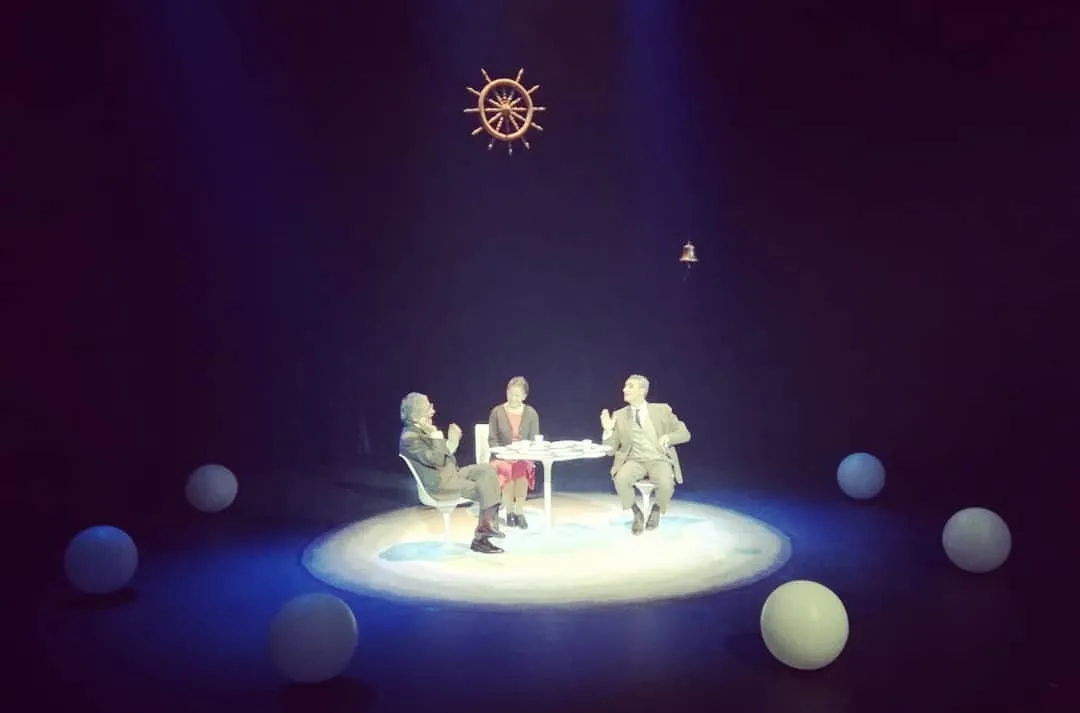
The CCC Floreal Gorini then bets on reviving this play that fuses physics and politics within the intellectual framework of quantum mechanics, playing metaphorically with the Uncertainty Principle. Although it is a rather "cold" play, another metaphor was bet on here, an emotional one, centered on sailing and the story of the death of one of the couple's sons falling from a boat. That explains the rudder hanging high up and the sound of water, which repeats and breaks through silences. Is not death the greatest human uncertainty? Is not the death of a child the greatest loss for a father/mother?
Everything happens "in the afterlife," in fact, since it is proposed that the three characters are dead and narrate their past from there, despite the intricacies of memory. Therefore, it is not really known where or when the play takes place, but it is known that they remember that meeting about which so much has been written. And the question floats: Why did Heisenberg go to Copenhagen?
Perhaps it was to agree with his teacher that they would not tell their respective authorities (of England and Germany) that there is any possibility of making a bomb, they would say it cannot be done and they would prevent its use.
Perhaps it was to sound out his colleague to find out if he had solved the uranium-235 problem.
Both know they are being listened to, which is why they decide to go for a walk in the garden of the house, as in other times.
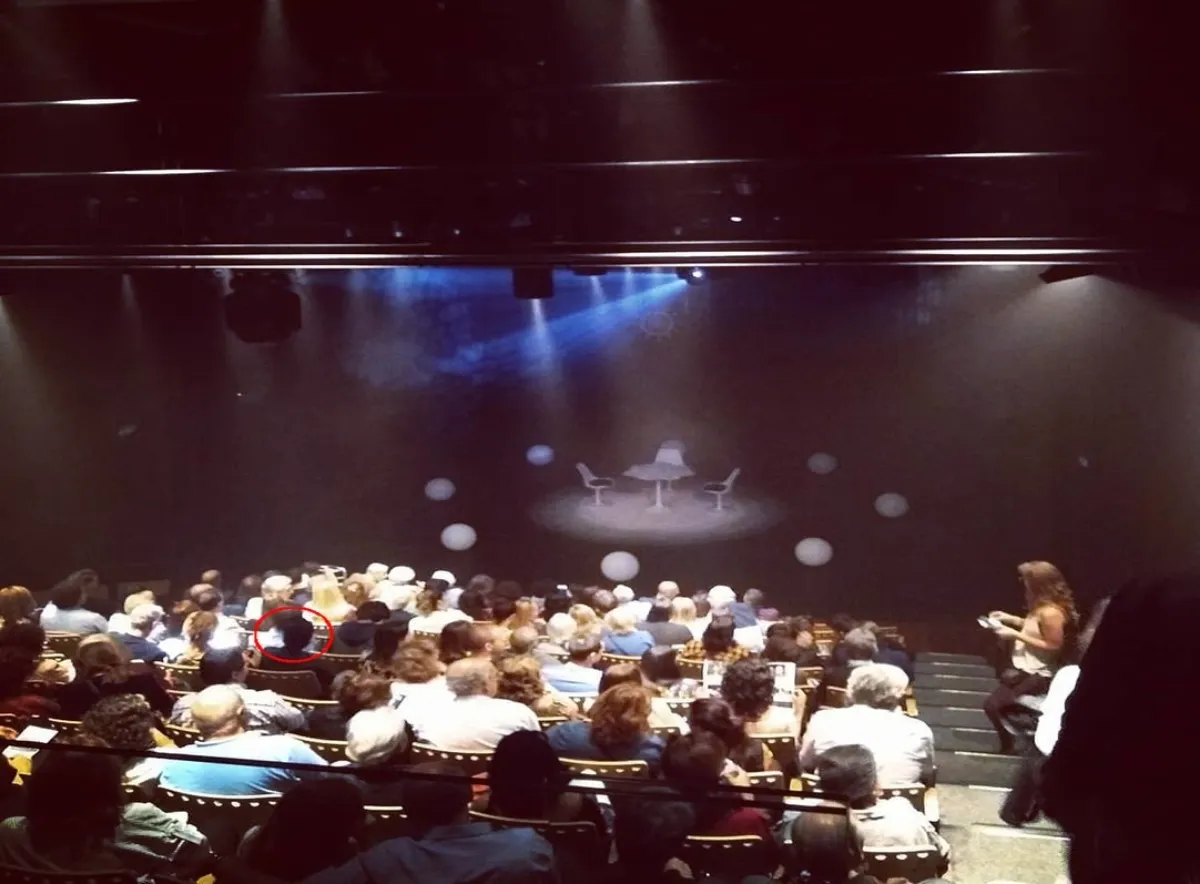
The set design is very simple and apt: a table with three white chairs in the center (more 1960s style than 1940s) and everything surrounded by a circle whose circumference is given by some illuminated spheres. The garden, then, is circular. They will walk there several times, along that path as singular as infinity, a geometric and rhetorical figure that contains an irrational number. There the question will arise, the German's comment about the bomb.
But it is not known exactly what they talked about. Not even they remember it clearly. If they remember one thing, they forget another, as if memory were made of particles of which only one state can be known.
Bohr is played by actor Patricio Contreras; Heisenberg by Sergio Griffo; Margrethe by Alejandra Darín. All three, dressed appropriately for the time of the meeting, fit the physique du rôle and Darín lives up to what is expected of an actress of her caliber. The three actors can shine with a complex text that allows for soliloquies from each character. Darín makes the most of hers, at the end. Griffo, whom I did not know, hits the right tone and has good diction and voice projection, despite some disguised slip-up. Contreras is off-key. Perhaps there was a lack of rehearsal. It's a shame, since he is a great actor, star of the unforgettable "Made in Argentina," as well as the series "Buscavidas," among other very good works.
The play of overhead lights on the actors is well achieved. The music accompanies, but at least at the beginning it has a higher volume than necessary and covers the protagonists' voices.
The performance lasts longer than the 90 minutes listed on the program, almost two hours that are felt, to the point of wishing it would end. Only Darín manages to revitalize the play with her accomplished performance that stimulates emotion in the viewer.
In any case, it is worth going to the theater. Cinema has thousands of resources, among them, editing. A possible comparison between cinema and theater is what is called a "long take" (whose greatest exponent was "Russian Ark," A. Sokurov, 2002). It is a sequence filmed with a single camera without cuts. Therefore, if something goes wrong, the entire scene must be filmed again. It requires, for that reason, great rehearsal and synchronization.
That is theater. It's like programming in Assembler. It has few resources and requires a lot of work, but it is very powerful. Precisely for that reason, each performance is different and surely the acting difficulties can be smoothed out and the music will be adjusted. Listening to a CD or MP3 is not the same as going to a concert. There are the actors, in the flesh. Perfection cannot be expected, not even in a play that includes a certain scientific precision.
The audience and critics remember a previous staging of the play, at the Teatro San Martín. If, like me, you missed it, this is another possibility. The CCC Floreal Gorini is a nice theater space that includes a library and a cultural center. I invite you to get to know it and see the play, which opened on March 8. It is a good opportunity for reflection on the winding path between science and politics.
It is very easy to accuse the German physicist of collaborating with the Nazi regime "for the fatherland." It is more complicated when we realize that, in the end, those who dropped the bomb were on the other side and did it with the same argument. Or perhaps only because they could...
Why did the great Heisenberg, with his mathematical and musical mind, fail in calculating the critical mass? Why didn't he do the calculation? Why didn't Bohr do it? Didn't they do it because -unconsciously- they didn't want to? Or couldn't they? Did these two physicists love each other or were they competitors and enemies?
What if the Allies had had the bomb earlier? What if Germany had had it?
Questions that orbit like a chain reaction from the meeting of two physicists that provokes a fission between them. Like a collision, of a neutron with a nucleus, which releases energy and more neutrons that, in turn, continue to fission nuclei, recursively.
To conclude, besides recommending the production directed by Mariano Dossena, I invite you to watch the film and, for those who know English, I indicate below a "study guide" for a performance by the theater company Timeline.
Play details
Author: Michael Frayn
Cast: Patricio Contreras, Alejandra Darín, Sergio Griffo
Costumes: Vanesa Abramovich
Scenery: Nicolás Nanni
Lighting: Horacio Novelle
Scenery construction: Bea Blackhall
Social Media: Juan Gabriel Yacar
Original music: Rony Keselman
Photography: Nacho Lunadei
Graphic design: Nahuel Lamoglia
Consulting: Juan Carlos Imbrogno
Production Assistance: Fausto Labraña, Ana López, Giselle Obregón
Directing Assistance: Esmeralda Gimenez
Press: TOMMY PASHKUS AGENCIA
Executive production: Pablo Silva
General production: Laura Cerati
Direction: Mariano Dossena
Duration: 90 minutes
CENTRO CULTURAL DE LA COOPERACIÓN
Corrientes 1543 - Buenos Aires - Argentina.
Sources and related links
- Timeline Study Guide
https://timelinetheatre.com/timeline-experience/explore-learn-copenhagen/ - Bohr family on English Wikipedia
https://en.wikipedia.org/wiki/Bohr_family - Copenhague on Alternativa teatral
http://www.alternativateatral.com/obra63528-copenhague?op=1 - Centro Cultural de la Cooperación
http://www.centrocultural.coop/
About the images
Header image from the Alternativa teatral site.
Photos from Instagram @marianodossena https://www.instagram.com/marianodossena/