Activities for International Day of Light 2018, at the Planetario de Buenos Aires.
The Executive Committee of the United Nations Educational, Scientific and Cultural Organization (UNESCO) decided to establish the International Day of Light to promote the importance it has had throughout human history and to recognize how this natural phenomenon affects our lives in more than one aspect. In 2018 it is celebrated on May 16.
The Planetario de Buenos Aires Galileo Galilei participates in this international event by presenting various proposals on this topic throughout an entire week.
The role that light plays as a fundamental part of humanity's development is of utmost importance. This phenomenon has been in our lives from the beginning and has progressed with human intelligence, which has found different ways to adapt it and use it to our advantage, both in the scientific field and in the field of art. Recognizing its value and importance aims to be one of the engines that make us more aware of its effects and its correct use.
UNESCO invites to carry out coordinated activities around the planet with the aim of contributing to different areas of development.
The Planetarium extends the celebration and proposes a thematic week with various proposals:
-Monday, May 14 to Friday, May 18 EXPERIENCES WITH LIGHT on the access esplanade of the Planetarium for all attendees to the DOME and the MUSEUM
(Free activity - No registration required)
-Monday, May 14 MISSION TO MARS
The gaze of a group of kids illuminates the future for us.VIDEOCONFERENCE WITH NASA Inspired by Carlos Bayala
One of the objectives of the Day of Light is to educate new generations around the world through activities related to science. To invite young people to think about the possibility of becoming engineers, physicists, biologists, etc. to design how to live in the future on this or another planet. The kids participating in this activity, after the presentation of the Mars project, will have a videoconference with NASA to be able to talk, exchange ideas, give suggestions, express desires and fears, regarding such an adventure.
(Full capacity)
-Tuesday, May 15 Open class "Special effects in the sky"
Taught by Diego Hernández
A series of natural and artificial phenomena that we can all see in the sky but whose scientific explanations are often unknown.
The students of the course DISCOVER, OBSERVE AND ENJOY THE SKY will share their class with 60 attendees from the general public
(Free activity - Requires registration)
-Wednesday, May 16 Open class on LIGHT, TELESCOPES AND ASTROPHOTOGRAPHY Taught by Mariano Ribas.
On International Day of Light, the students of the GENERAL ASTRONOMY course share their class with 50 attendees from the general public to talk about this phenomenon.
(Free activity - Requires registration)
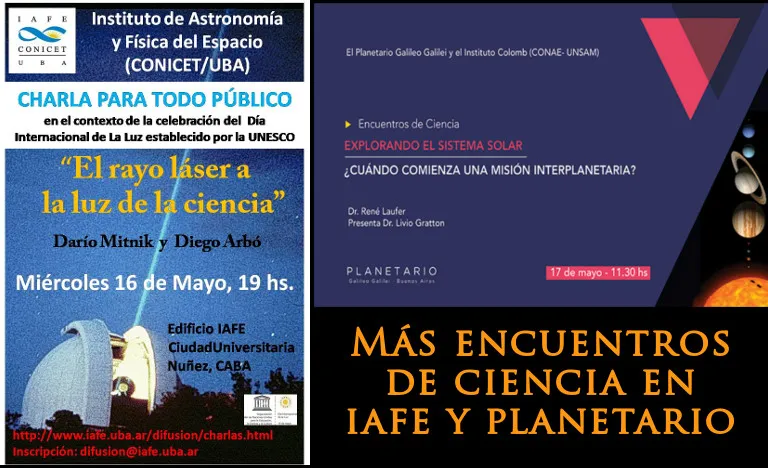
-Friday, May 18 SCIENCE ENCOUNTERS AT THE PLANETARIUM presents THE LIGHT RAY IN THE LIGHT OF SCIENCE
Dr. Darío Mitnik and Dr. Diego Arbó
On May 16, 1960, Theodore Maiman managed to turn on the first "laser beam". At that time, it was not well known what it could be used for. So much so that it was called "a solution in search of problems".
Today, the laser is part of our daily lives and we practically do not spend a single day without using it. Therefore, in this talk we are not going to tell you what we use it for, but rather what that special type of light is and what scientists use it for.
(Free activity. Requires registration)
-Saturday, May 19 JUPITER NIGHT
Light allows us to discover a large part of the wonders of the sky, let's enjoy them!!!! We have programmed a party finale for this thematic week. We will observe with telescopes the most outstanding phenomenon of the month. Jupiter, the largest planet in the Solar System, is located in the sky opposite the Sun, and at its minimum distance from Earth in all of 2018: 658.2 million kilometers from our planet. It will reach an impressive visual magnitude of -2.5, and an apparent diameter of 44.7 arc seconds. Excellent conditions to observe and share a brilliant astronomical evening
(Free activity - NO registration required. Canceled in case of rain or heavy cloudiness)
Registration is done on the Planetarium's website: www.planetario.gob.ar
About the International Day of Light https://m16dialuz.unlp.edu.ar/
https://www.lightday.org/