A study just published indicates that astronomers enjoy science outreach more than other scientists.
Marta Entradas and Martin Bauer, from the London School of Economics and Political Science (LSE), conducted a survey among 9,000 members of IAU, the International Astronomical Union. Of the total, only 2587 (30%) responded, of which the majority (87%) indicated that they carry out outreach activities, whether through lectures, exhibitions, local events, school visits, etc.
The most prolific, who carried out about 20 activities per person per year, are from Africa and South America, which surprised Marta Entradas who assumed she would find that in astronomers from developed countries due to having greater resources.
The study, published in Nature, also accounts for two important aspects:
1-The motivation for outreach activities is not strongly associated with the search for awards or recognition, but with a sense of duty and a form of pleasure (on nature.com it says joie de vivre, joy of living).
2-Contrary to the idea that outreach or popularization activities could put scientists' reputations at risk, 96% considered that their commitment or engagement with the public does not have negative consequences regarding their reputation.
It is also noted that those who carry out and enjoy these activities the most usually do not have specific support, nor targeted training, nor great resources.
On the IAU site, they echoed the study and there they use the following graph of the frequency of participation in online channels by professional astronomers:
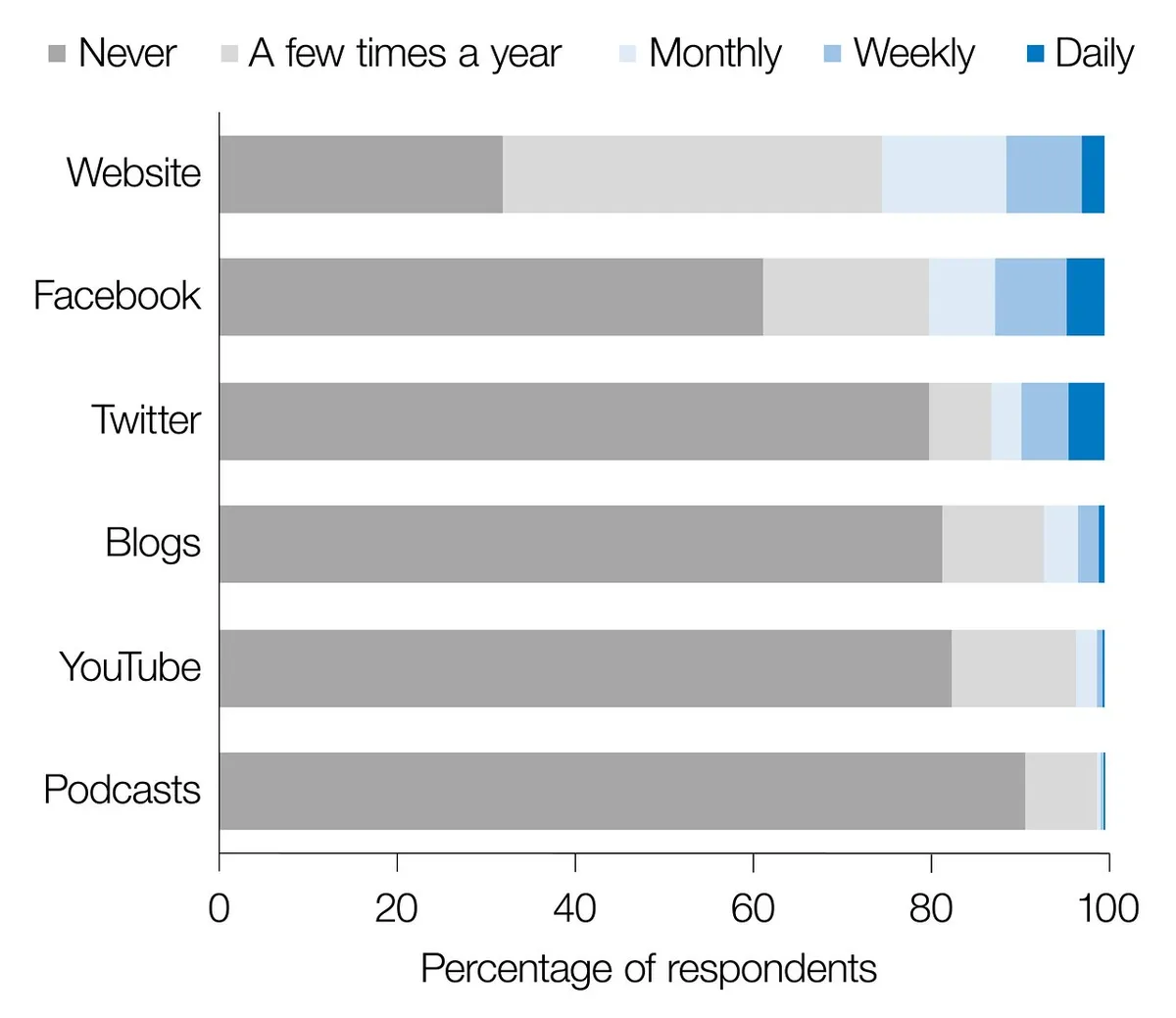
This would indicate, then, that the link between professionals and the general public is established more in person than online.
It occurs to me to add that, as a consequence of this, many astronomy outreach activities are not properly documented or recorded, which in turn has other consequences: there seems to be less outreach than there really is; these activities are like islands, isolated from each other, when knowledge of their realization could generate a link between astronomers and their outreach initiatives.
OUTREACH IN GENERAL AND IN ASTRONOMY IN PARTICULAR, A BALANCE
It is difficult to make a balance if you do not have enough data obtained in a methodological way. Despite this, I believe a first approximation is possible:
In recent decades there has been an increase in outreach activities of different kinds, for multiple reasons. On the one hand, in Argentina for example, there were initiatives for the publication of books like the Ciencia que ladra collection from the publisher Siglo XXI and TV programs for the channel Encuentro.
On the other hand, the Futuro supplement of Página/12 disappeared and the program TN Ciencia stopped airing. In the newspapers of the Capital Federal, a science supplement is not published, except on Saturdays in the newspaper La Prensa, dedicated almost exclusively to health topics. The newspaper Página/12, however, has a fixed section on Wednesdays, with interviews with Argentine scientists, conducted by Pablo Esteban.
In the newspapers "del interior" from the rest of the Argentine provinces, it is difficult to find science supplements.
In the provinces where there is greater astronomical activity, more journalistic articles are recorded, such as in Córdoba, San Juan and for some years now, Salta.
Planetariums, now digital, are also centers of astronomical outreach. The Faculty of Astronomy of the UNLP stopped publishing its monthly bulletin, however, that institution continued with outreach through other means, in particular the La Plata Planetarium, as well as the usual visits to the Observatory.
In terms of professional communication, ESO and NASA set the standard in the creation of online outreach materials, both in text format, as well as in the dissemination of images, graphics, and videos.
This balance, then, allows us to account for advances and setbacks, but it is not enough to make an "accounting entry" with a favorable or negative result.
It is valid, however, to take into account that some things have been done in favor of science outreach and astronomy in particular.
WHAT IS MISSING
It is also possible to think about pending issues. IAU knows that a pending issue lies in translation. There are many very good materials for outreach, which are in languages that the public does not master, generally English. IAU has a specific translation initiative for astronomy materials.
The same can be said, not only for texts, but also for images or videos, which also require forms of translation or subtitles, in the case of videos.
It would be good to have an open repository of materials without copyright limitations, in Spanish or translated into Spanish, so that outreach workers can use them easily.
It would also be desirable for there to be initiatives between astronomy professionals and communication professionals.
ASTROARG: THE NODE OF ARGENTINE ASTRONOMY
At some point, on this blog, I suggested the need for an Astronomy Node in Argentina that would bring together outreach materials and have a federal agenda of events, among other things. That Node would also gather news from observatories and publications by professionals in terms of outreach, that is, it would be a good place to document, record, and accredit the initiatives of professionals in popularizing astronomy. That, at the same time, would allow coordinating activities among astronomers.
On the other hand, sometimes somewhat distorted information arises through the mass media, as happened a few days ago with the object Oumuamua, about which professionals could make the relevant clarifications in such a Node, even if the mass media do not consult them. Ultimately, it would be a source of consultation for the general public, which could also be considered by the media.
It would be logical for such an initiative to be taken by the Asociación Argentina de Astronomía.
That platform, in addition, could count on the contribution of amateurs who in many cases are true experts in observational astronomy and astrophotography. Doing it would not require great economic resources, because it would basically be a website, forum-type, with sections and for its administration it would not require a large number of people either.
As far as I know, there is no initiative of this type in any country in the world. If we did it, we would be pioneers.
It is worth noting that I mentioned this proposal in the post where I celebrated the blog's 10th anniversary, but the proposal was made in pdf format hosted on another site. To give it greater diffusion, I now indicate it with the corresponding link in the blog's margin.
Sources and related links
- Nature.com Astronomers have an outsize passion for outreach
https://www.nature.com/articles/d41586-018-07519-2 - Bustling public communication by astronomers around the world driven by personal and contextual factors
Marta Entradas & Martin W. Bauer
Nature Astronomy (2018)
DOI: 10.1038/s41550-018-0633-7 - IAU Astronomers Show Exceptional Involvement in Outreach Activities
https://www.iau.org/news/pressreleases/detail/iau1813/?lang - Star performers
http://www.lse.ac.uk/News/Research-Highlights/Society-media-and-science/Star-performers - Proyecto AstroArg en Scribd
https://es.scribd.com/doc/260749536/Proyecto-Nodo-Astronomia-Argentina-Astro-Arg
About the images
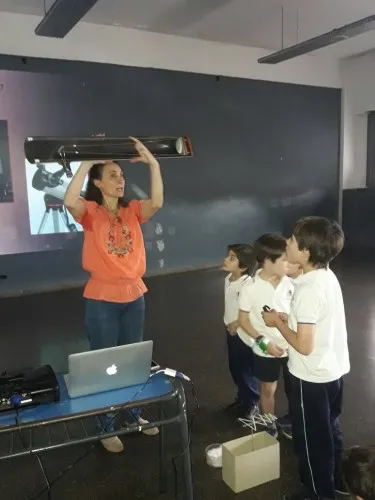
Opening image: Dr. Mariela Corti giving a class. Credit: IAR. In the newsletter: http://tux.iar.unlp.edu.ar/boletin/bol-mar18.htm
Chart: NATURE/M. Entradas (LSE, ISCTE-IUL)