Two unmissable talks for astronomy enthusiasts. Engineer Pablo de León at the Planetario de La Plata and Dr. Rodrigo Díaz at Amigos de la Astronomía to celebrate Global Astronomy Month.
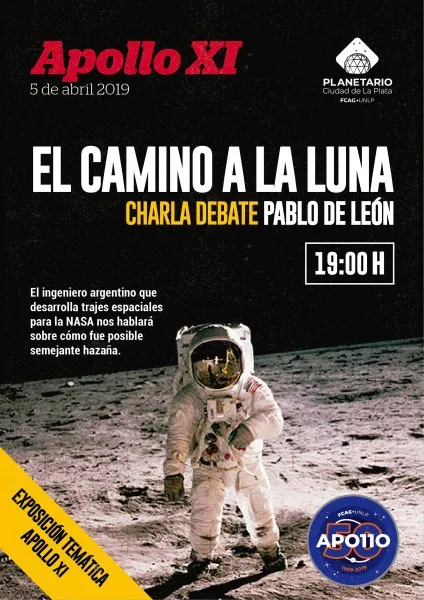
The people from the Planetario de La Plata inform us of the visit of engineer Pablo de León as part of the international celebrations of the 1969 Moon landing taking place this July. I transcribe the announcement:
On the 50th anniversary of Apollo 11, Argentine engineer Pablo de León (Director of the Human Spaceflight Laboratory at the University of North Dakota, USA) and a talk about the great human feat.
It was the dream of many peoples throughout history. Exactly 50 years ago, the United States achieved that goal: landing on the Moon, walking on it, and returning its messengers safe and sound to Earth.
This impressive achievement was only possible due to a socio-political context in which the two superpowers of the time (the United States itself and the former Union of Soviet Socialist Republics) confronted each other on all existing fronts, particularly the space front. Leading access to space represented nothing less than absolute control over the entire planet.
From the very beginning of that fierce space race, the Soviets took the lead. They were the first to place a satellite in Earth orbit (Sputnik I), the first to put a living being in space (the little dog Laika in Sputnik II), the first human to become an astronaut or, to be more precise, a cosmonaut (Yuri Gagarin in Vostok I). It can also be mentioned that they managed to be the first to perform a spacewalk (Alexei Leonov in Voskhod II). During those early years, the Americans were systematically the "seconds".
However, due to certain key circumstances, the knockout blow was delivered by the Americans, by achieving the first crewed Moon landing on Sunday, July 20, 1969.
That majestic epic was achieved through the Apollo space program, the most colossal of all time. In this talk by aerospace engineer Pablo de León, we will trace the path that enabled NASA to fulfill the dream proclaimed by President Kennedy in the early 1960s.
Pablo de León is director of the Human Spaceflight Laboratory at the University of North Dakota, United States, being one of the most important specialists in the world regarding the design and development of space suits. With vast experience in the space field and with significant grants received from the US space agency for the development of space suits and habitats, de León is, without a doubt, an Argentine ambassador par excellence.
This Friday, April 5 at 19 h, the Planetario Ciudad de La Plata will once again have the opportunity to host his visit and enjoy, once more, his stories and experience.
At the end of his presentation, de León will present a thematic exhibit on the Apollo space program.
You are all invited to enjoy a pleasant moment and be moved by the greatest of human adventures.
http://planetario.unlp.edu.ar/
50 years in IAU100
The International Astronomical Union (IAU), which celebrates its centenary this year, launched a specific website with materials on the Moon landing. The site will register events held globally.
https://www.moonlanding50.org/
NOC Argentina: http://sion.frm.utn.edu.ar/NOC-Argentina/
Exoplanets at Asaramas
Amigos de la Astronomía inform us of an unmissable talk:
We are pleased to invite you to the first conference of the year, titled "The exoplanets closest to the Solar System and the search for life." By Dr. RODRIGO DÍAZ (CONICET – Argentine researcher who led the international team that detected the third closest exoplanet to the solar system). It will take place next Saturday, April 13, 2019, at 19:00 hs. at our headquarters at Av. Patricias Argentinas 550 – CABA –
The exoplanets closest to the Solar System and the search for life.
The search for life outside Earth is one of the most fascinating activities of current scientific research, and promises to yield results in the next decade. The study of extrasolar planets plays a central role in this endeavor, as measurements of their atmospheres are expected to allow us to deduce the presence of biotic activity on the surface. In this talk I will describe how extrasolar planets are discovered, how their atmospheres can be characterized, and how a signal produced by life can be recognized. I will emphasize the importance of discovering the rocky planets closest to the Solar System, for which we will be able to study the atmospheres in detail in the next ten or fifteen years.
Rodrigo F. Díaz
Asociación Argentina Amigos de la Astronomía
Av. Patricias Argentinas 550, Parque Centenario, C.A.B.A.
www.amigosdelaastronomia.org