A new infrared spectrograph proved useful in finding exoplanets around M-dwarfs and would confirm the existence of a super-Earth around Barnard's Star. Also, an Argentine led a research team that detected a nearby exoplanet.
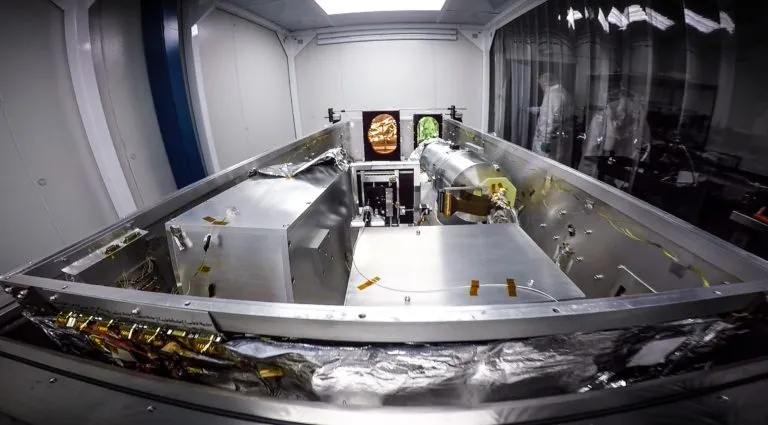
A team of American astronomers, from various universities, led by Andrew Metcalf, began using the Habitable Planet Finder (HPF), a new spectrograph, and demonstrated its effectiveness with the detection of an exoplanet orbiting Barnard's Star, a neighboring star of the Sun, in a paper published in Optica.
The instrument, attached to the 10-meter Hobby-Eberly Telescope, at McDonald Observatory in Texas, the HPF operates at infrared wavelengths, making it very useful for finding rocky exoplanets that orbit relatively cool, small and faint M-dwarf stars, very abundant in the galaxy.
"Nearly 70% of the stars in our galaxy are M dwarfs, like Barnard's star, but the near-infrared light they emit makes them difficult to detect with optical telescopes", explained Paul Robertson of the University of California Irvine.
The HPF was designed and built to search for low-mass planets in the habitable zones of stars where liquid water could exist.
Until now, the method used was the measurement of Doppler spectroscopy (radial velocity) of the star due to the tug of a planet around it. Combined with photometric measurements of the planet transiting in front of the star (transit method), astronomers could know the mass, density and distance of the object from the star. The radial velocity technique by Doppler spectroscopy is effective below 700nm, that is, within the visible range and not beyond, in the infrared.
The new instrument is used together with others, such as the laser frequency comb, in a scheme that can be described as follows:
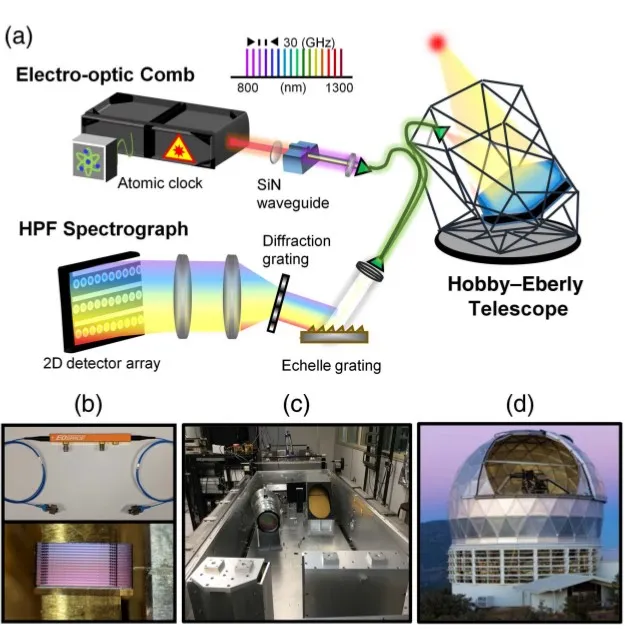
(a) Starlight is collected by the Hobby-Eberly Telescope and directed to an optical fiber. Lasers are used to generate an optical frequency "comb" with teeth spaced by 30 GHz and stabilized to an atomic clock. In both cases the light is coupled to the HPF, where tiny wavelength changes in the stellar spectrum are tracked with the precise calibration grid provided by the laser frequency comb. (b) Components for frequency comb generation: top, an integrated fiber-optic electro-optic modulator; bottom, silicon nitride chip (5 mm × 3 mm) on which nanophotonic waveguides are patterned. Light is coupled to a waveguide from the left and the supercontinuum is extracted from the right with a lensed fiber. (c) The open HPF spectrograph, showing the camera optics on the left, the Echelle grating on the right, and the relay mirrors in the front. The spectrograph footprint is approximately 1.5 m × 3 m. (d) The 10 m Hobby-Eberly Telescope at McDonald Observatory in southwest Texas.
Observations of Barnard's Star over 86 days, coincide with the recent announcement by a group of Spanish astronomers of the possible detection of an exoplanet in the system, of 3.2 Earth masses with a 233-day period.
AN ARGENTINE DISCOVERY
In other news, an international team of researchers led by Argentine scientist Rodrigo Díaz (IAFE) discovered a new exoplanet. Named Gliese 11 b, it orbits a star located eight light-years from the Sun, and has a mass three times that of Earth. The work, carried out through the Haute Provence Observatory in France, was accepted for publication in Astronomy & Astrophysics (see below). At that facility another spectrograph -SOPHIE- is used, which operates at wavelengths between 3872-6943 Å (angstroms), which expressed in nanometers are 387.2-694.3.
Sources and related links
- Astronomers from UCI, other institutions use new technique to find extrasolar planets
https://news.uci.edu/2019/02/20/astronomers-from-uci-other-institutions-use-new-technique-to-find-extrasolar-planets/ - A. Metcalf et al
"Stellar spectroscopy in the near-infrared with a laser frequency comb," Optica 6, 233-239 (2019).
DOI: 10.1364/OPTICA.6.000233 - Ribas; C. Rodríguez López; et al. (2018).
"A candidate super-Earth planet orbiting near the snow line of Barnard’s star".
Nature 563 (365).
DOI: 10.1038/s41586-018-0677-y
R. F. Díaz, X. Delfosse, M. J. Hobson, I. Boisse, N. Astudillo-Defru, X. Bonfils, G. W. Henry, et al.
"The SOPHIE search for northern extrasolar planets. XIV. A temperate (Teq∼300 K) super-earth around the nearby star Gliese 411", accepted for publication in Astronomy & Astrophysics (2019)
arXiv:1902.06004 [astro-ph.EP]
https://arxiv.org/abs/1902.06004 http://www.obs-hp.fr/presse/Communique_GJ411.html
Infobae: Led by an Argentine, scientists discovered the third exoplanet closest to the Sun https://www.infobae.com/salud/ciencia/2019/02/20/liderados-por-un-argentino-cientificos-descubrieron-el-tercer-exoplaneta-mas-cercano-al-sol/
About the images
Graphic credits: A. Metcalf et al.
The initial photograph of the HPF: Gudmundur Stefansson / Pennsylvania State University.