On Hubble's Law, now named the Hubble–Lemaître Law and its astronomical consequences.
In late 2018 the IAU (International Astronomical Union) decided by a vote of its members to change the name of Hubble's Law to the Hubble–Lemaître Law to recognize the contribution of the Belgian astronomer (and priest).
At the XXX General Assembly, through resolution B4, the IAU states that:
Considering
1. That the discovery of the apparent recession of galaxies, which is usually referred to as "Hubble's Law", is one of the greatest milestones in the development of astronomy in the last century and can be considered one of the fundamental pillars of modern cosmology;
2. That the Belgian astronomer Georges Lemaître, in 1927, published (in French) the paper titled "Un Univers homogene de masse constante et de rayon croissant rendant compte de la vitesse radiale des nebuleuses extra-galactiques". In that work he rediscovered Friedman's dynamic solution to Einstein's General Theory of Relativity equations that describes an expanding universe. He also inferred that the expansion of the universe implies that the spectra of distant galaxies have a redshift in an amount proportional to their distance. Finally, he used published data on the velocities and photometric distances of galaxies to derive the expansion rate of the universe;
3. That at the time of publication, the limited popularity of the Journal in which the paper was published and the language used caused the remarkable discovery to go unnoticed by the astronomical community;
4. That both Lemaître (IAU member since 1925), and Hubble (IAU member since 1922) attended the 3rd General Assembly in Leiden in July 1928 and exchanged views on the relevance of redshift and observational velocity data in extragalactic nebulae (as galaxies were then called);
5. That Edwin Hubble, in 1929, published the paper titled "A relation between distance and radial velocity among extra-galactic nebulae" in which he proposes and derives the linear distance-velocity relation for galaxies, finally including new data in another 1931 paper with Humason. Shortly after that, cosmic expansion became universally known as "Hubble's Law";
6. That in 1931, invited by the journal MNRAS, Lemaître translated his 1927 original into English, deliberately omitting the section in which he derived the expansion rate because he did not find it advisable to republish that discussion on radial velocities, "which is not of current interest";
and as a consequence:
7. To pay tribute to both astronomers for their fundamental contributions;
8. To honor the intellectual integrity of Georges Lemaître who preferred the progress of science to his own benefit;
9. To highlight the role of IAU Assemblies in fostering exchanges of vision;
10. To inform future scientific discourse with historical data.
and resolve
11. To recommend that from now on, the expansion of the universe should be referred to as the "Hubble–Lemaître Law".
The resolution was voted on by a total of 4060 astronomers, of which 3169 (78%) voted in favor; 798 (20%) against; and 93 (2%) abstained.
THE CONSEQUENCES OF H0
The Hubble–Lemaître Law contains a constant, the Hubble Constant (H0), which has been measured since the 1920s. The first measurements were very high, around 500 km/s/Mpc. I will explain that combined unit of measurement shortly. Recent measurements, made with different instruments and methods, gave much lower results.
In any case, the value of H0 is around 70 (km/s)/Mpc.
Mpc means Megaparsecs. 1 parsec is a unit of measurement equivalent to 3.26 light-years. The prefix "mega" means one million, therefore, 1 Mpc is equivalent to 1 million parsecs (3.26 M light-years).
The H value implies that, if a galaxy is located 1 Mpc away from Earth, it has a recession velocity of 70 km/s. This velocity is not the proper velocity, but the apparent velocity, given by the expansion of space between us and the galaxy.
If, on the other hand, a galaxy is at a distance of 2 Mpc, its velocity is H*2, 140 km/s. And if it is at 3 Mpc, the velocity will be 210 km/s.
That is: V=H*D, where V is the recession velocity, H is the constant and D is the distance to the galaxy in Mpc.
If this is so, one might ask: will there be a galaxy whose recession velocity is very high? A very high velocity could be the speed of light, 300,000 km/s. If there were a galaxy with such a speed, how far away would it be?
And we can answer algebraically, by solving the previous equation, therefore:
if V=H*D, then D=V/H.
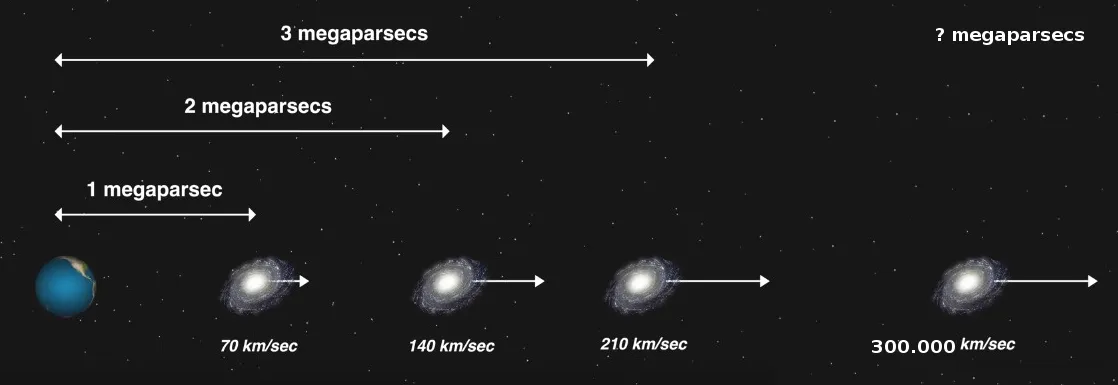
If we want to know at what distance a galaxy would be and we know its velocity and the constant, by dividing those two quantities, we get the distance in Mpc: 300,000/70= 4285 Mpc. Converting Mpc to light-years, we multiply by 3.26 M and get 14 thousand million light-years.
Consequently, if a galaxy is at that distance, it is moving away from us at the speed of light and, therefore, if any galaxy is farther away, it is moving away faster than the speed of light. This does not violate the Law of Relativity, which states that it is impossible for an object with mass to reach that speed and that massless particles only have that speed, but not greater. What has that speed are not the galaxies (which have mass), but spacetime itself, whose composition is unknown.
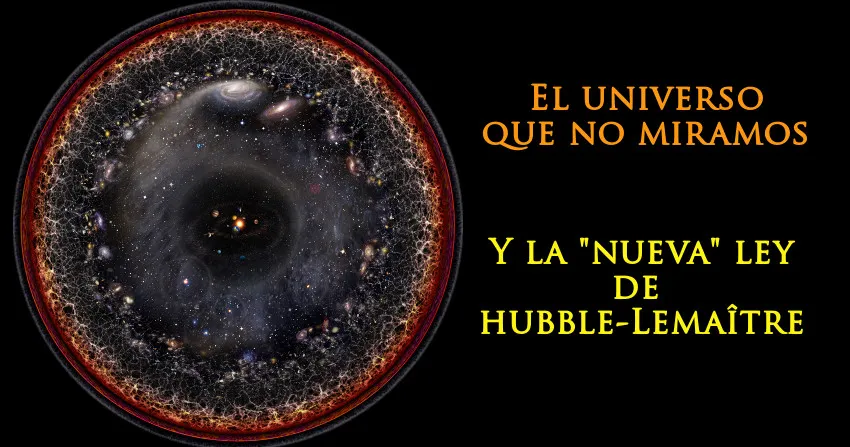
It is possible to think of the result in this way: imagine Earth at the center of a circle (or sphere, since the universe has three spatial dimensions) whose radius is 14 thousand million light-years. Everything outside that circle (or sphere) is moving away faster than the speed of light. And therefore, all of that cannot be observed, since those galaxies emit light that travels at the speed of light, but the space between those galaxies and us expands at a greater speed, so the light from those galaxies can never reach us. The aforementioned circle-sphere is known as the "observable universe".
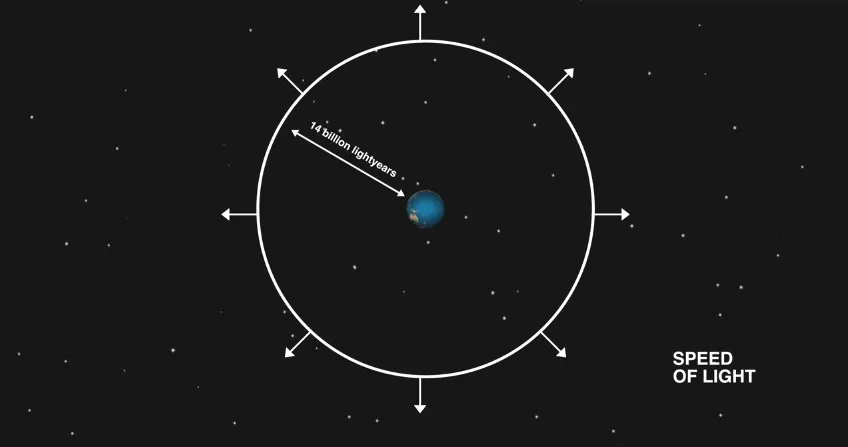
This fact, however, has a problem: if a galaxy can be observed right at the edge of this sphere, because its light does reach us, we will be seeing a galaxy as it was 14 billion years ago, during which time the universe expanded, therefore, that galaxy now should not be there, but much farther away (that is called "comoving distance"). Calculations indicate that the radius of the observable universe is, in reality, 46.5 billion light-years, or rather, a sphere with a diameter of 93 billion light-years. It is for this reason that professional astronomers do not use distances when dealing with the early universe, but the value z, the cosmological redshift.
It must be added that this frontier is not the only one: the current model says that before the first second, the universe had an accelerated expansion that multiplied its size by a factor of 1026, but that until 380,000 years the light from all that time cannot reach us because it was "trapped" in a sea of charged particles. Only after that time did the density and temperature drop enough for atoms to form (a period called "recombination") and then the light could make its way. That light is the cosmic microwave background radiation.
The size of the observable universe can be calculated, but not the size of the unobservable universe, although it is logical to think that it is incredibly large.
Conclusion
In Argentina, there was a TV program called "El país que no miramos" (The Country We Don't Look At). In that case, it was about towns not known by the rest of the inhabitants, precisely because of the distance (among other reasons).
It's worth reflecting that there is also a Universe we don't look at. But not only distant galaxies, but the "Lemaître Case" shows that there are parts of history and people we are unaware of even though there is no physical law preventing that knowledge. It's like a movie! We knew that the universe expands before we knew the author of the idea!
To know requires human work, both to know what the universe is like and to know how we people act. In the age of Artificial Intelligence and automation, à la Blade Runner, IAU astronomers are hunters of replicants with implanted memories.
Until the 1920s, we only knew of the existence of one galaxy, the one we inhabit and about which little was known. In less than a century, we have been able to observe almost to the edge of the observable universe. What we don't see is a lot, but the path traveled is astronomical!
As the Argentine rock group Eruca Sativa says in the song Inercia:
♪ I moved away and saw you completely
From a distance, certain things are seen better
There are a thousand galaxies and a thousand planets and in none do I find that there is a connection
You see the mountain
Not what it hides♪
Sources and related links
- IAU members vote to recommend renaming the Hubble law as the Hubble–Lemaître law
https://www.iau.org/news/pressreleases/detail/iau1812/?lang - El país que no miramos: Santiago del Estero, la ciudad sol, 1988
https://www.youtube.com/watch?v=nTXDlrqiV0U - Have We Mismeasured the Universe?
By Corey S. Powell on February 6, 2019
https://www.scientificamerican.com/article/have-we-mismeasured-the-universe/ - Eruca Sativa - Inercia
https://www.youtube.com/watch?v=24fZuClUG0k
About the images
How to travel faster than light
Dr. Don Lincoln, Fermilab https://www.youtube.com/watch?v=BhG_QZl8WVY
Observable Universe illustration, Wikimedia
By Unmismoobjetivo - Own work, CC BY-SA 3.0 https://commons.wikimedia.org/w/index.php?curid=26788359
Logarithmic scale illustration of the observable universe with the Solar System at the center, the inner planets, the asteroid belt, the outer planets, the Kuiper belt, the Oort cloud, Alpha Centauri, the Perseus Arm, the Milky Way, Andromeda and nearby galaxies, the cosmic web of galaxy clusters, the cosmic microwave background radiation and the invisible plasma of the Big Bang at the edge.
This image does not imply that Earth is at the center of the Universe. Any other civilization in any other galaxy could make a similar, equally valid diagram. The universe has no center.