What is the current situation with Starlink satellites and others? What is expected for the near future?
In June 2019, the IAU (International Astronomical Union) expressed its concern about the negative impact that planned mega-constellations of communication satellites (SatCom) could have on astronomical observations and on the pristine appearance of the night sky from dark regions. Here they present a summary of the current knowledge on this problem.
Commission B7 on Protection of Existing and Potential Observatory Sites and the Dark Skies Working Group were consulted by the IAU Executive Committee to assess the situation and begin discussions with the companies responsible for launching and operating the mega-constellations in order to study measures to mitigate their interference.
Commission B7 requested the participation of astronomers from different organizations trained in modeling the frequency, location, and brightness of these SatCom. The result of the simulations, given the large number of parameters involved and the uncertainties, must be considered preliminary.
Although there is great uncertainty about the future number of satellites, simulations were performed based on a large sample of more than 25,000 satellites. With this sample, the number of satellites above the horizon at any time will be between 1500 and a few thousand, depending on latitude. Most will appear very close to the horizon and only a few above: for example, about 250 to 300 will have an elevation of 30 degrees or more above the horizon (that is, where the sky is free of obstructions and where most astronomical observations are made). The vast majority would be too faint to be visible to the naked eye.
When the Sun is 18 degrees below the horizon (when night becomes dark), the number of illuminated satellites above the horizon will be about 1000 (with about 160 at elevations greater than 30 degrees). The number decreases towards the middle of the night, when more satellites are in Earth's shadow (and not reflecting sunlight).
It is difficult to predict how many illuminated satellites will be visible to the naked eye due to uncertainties in their current reflectivity. The appearance of the night sky, particularly from dark sites, will be altered because these new satellites can be significantly brighter than existing artificial objects.
The prominent satellite trains (also called "strings of pearls") often seen in images and videos, are significant immediately after launch until they reach their orbit.
Beyond their visibility to the naked eye, it is estimated that SatCom trails will be bright enough to saturate modern detectors in large telescopes. Scientific astronomical observations of wide fields will be severely affected. For example, in the case of rapid wide-field surveys, such as those carried out by the Rubin Observatory (formerly LSST), it is estimated that 30% of the 30-second images during twilight hours will be affected.
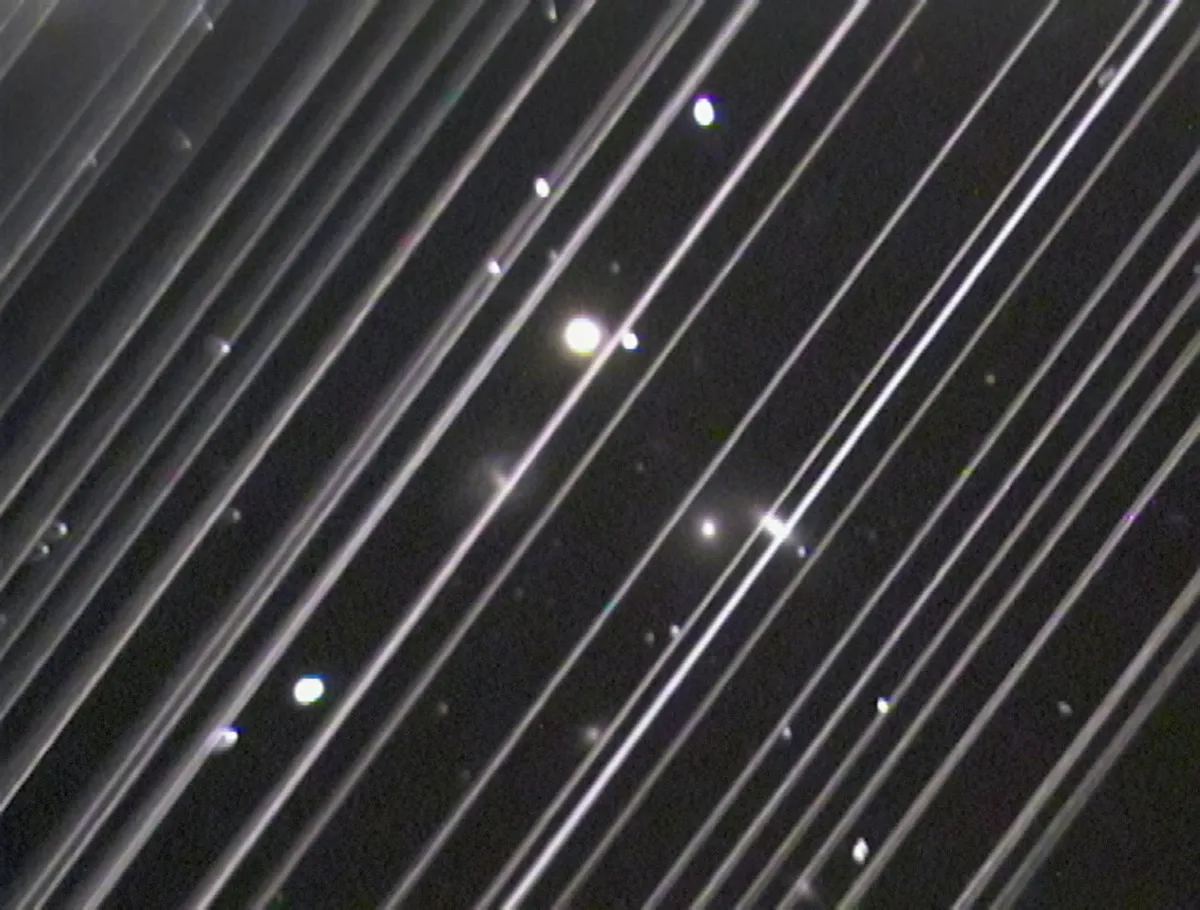
A summary of the findings and actions that have been carried out is presented in a specific IAU Topic.
The focus of this statement has been optical wavelengths. This is not to downplay the effects in the radio and submillimeter ranges, in research. The IAU considers the consequences of mega SatCom worrying. They will have a negative impact on the progress of ground-based, radio, optical, and infrared astronomy and will require diverting human and financial resources from basic research to study and implement mitigation measures.
Attention must be paid to the protection of the uncontaminated view of the night sky from dark places, which should be considered a non-renounceable legacy of humanity.
To mitigate the impacts of SatCom constellations that could interfere with professional and amateur observations, the IAU, in close collaboration with the American Astronomical Society (AAS), will continue to initiate discussions with space agencies and private companies planning to launch and operate SatCom.
The IAU notes that currently there are no agreed international rules or guidelines on the brightness of artificial objects in orbit. Until now it was not considered a priority topic, but it has become relevant. Therefore, IAU will regularly present its findings at the meetings of the United Nations Committee on the Peaceful Uses of Outer Space (COPUOS), bringing to the attention of representatives of the world's Governments the threats of these initiatives.
The IAU emphasizes that technological progress is only possible through parallel advances in scientific knowledge. Satellites could not function or communicate properly without the essential contributions of astronomy and physics. It is in everyone's interest to preserve and support the progress of fundamental science, such as astronomy, celestial mechanics, orbital dynamics, and relativity.
Mega-constellations of LEO Satellites and optical astronomy
One of the sources consulted by the IAU, referenced in its statement, is Patrick Seitzer (University of Michigan, AAS) who in his presentation "Mega-Constellations of LEO Satellites and Optical Astronomy" says several interesting things, namely:
For a place like CTIO (Cerro Tololo Inter-American Observatory) in Chile, at the end of September 2019, with 18207 objects orbiting Earth in public catalogs, about 600-700 are visible during dark hours. It is clear that the hours and their quantity depend on latitude and time of year.
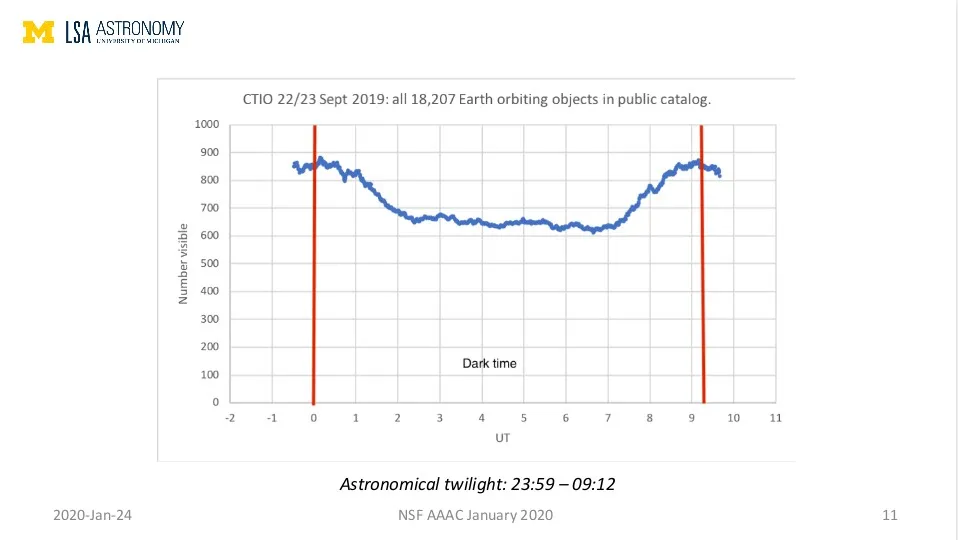
And he asks: If currently between 600 and 700 objects are visible during the night, why worry about another 100-200 added by new mega-constellations?
Answer: Because of their brightness! The new satellites can be brighter than 99% of all objects currently in orbit.
Now, about 200 objects can be seen with the naked eye (not all at the same time). By the end of 2020, SpaceX will add another 1,584 and the population of visible satellites will increase 9x.
Simulations of Initial Starlink Constellation
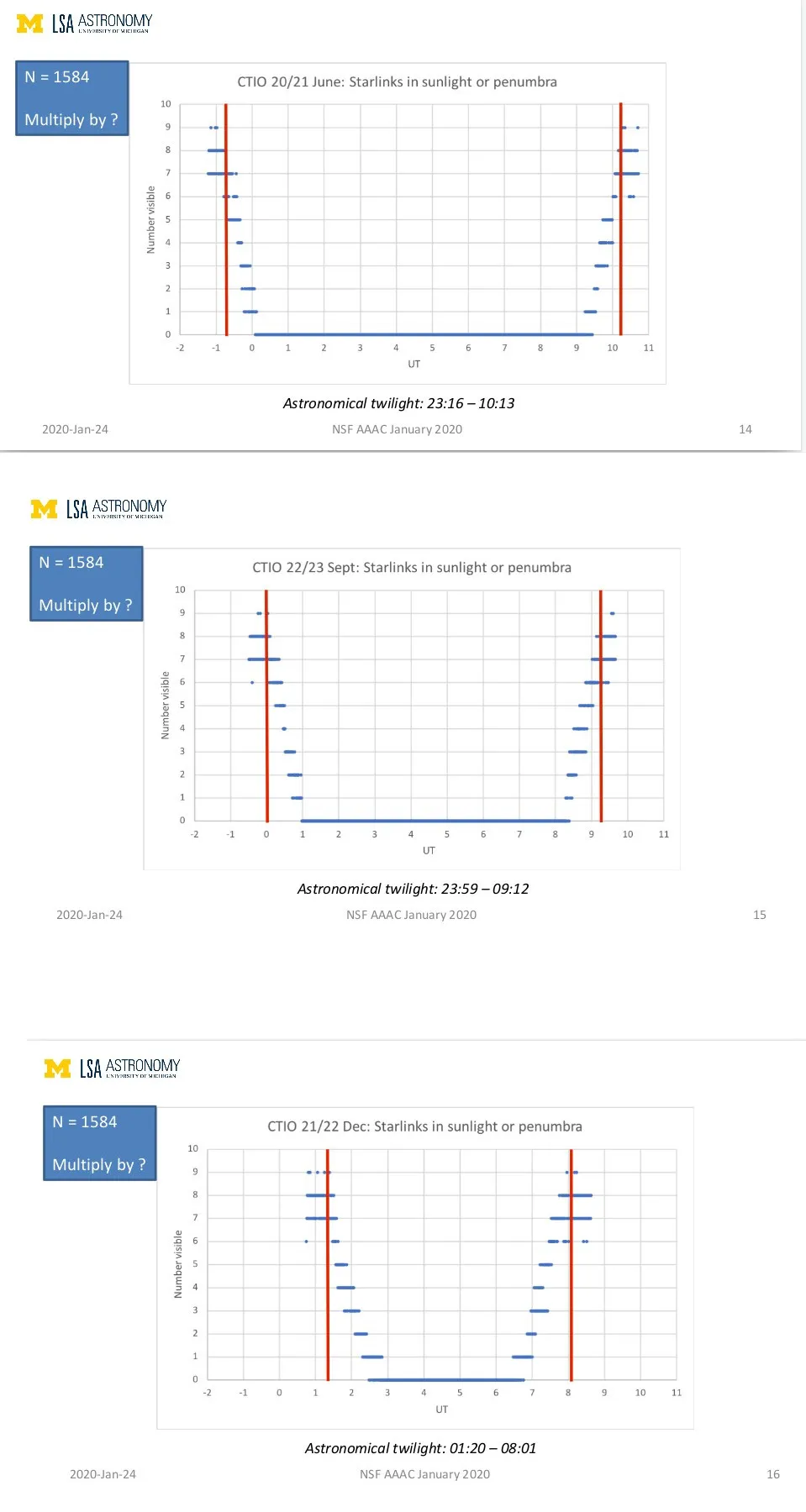
Three nights of initial visibility analysis of all 1,584 satellites at 550 km (LEO orbit):
-June 20/21 2019, longest night of the year in Chile.
-September 22/23 2019, Equinox.
-December 21/22: shortest night of the year in Chile.
Computed from evening nautical twilight (Sun at -12 degrees) until morning nautical twilight.
Temporal range in 36-second windows, much smaller than the graph resolution. Therefore, the solid lines are not such, but very close points. At 550km, observed Starlinks have 5th Visual Magnitude.
Graphs for the three periods:
Conclusions:
As expected for Low Earth Orbit (LEO) satellites, Starlinks at 550km are visible only at the beginning and end of the night.
Concern: throughout the year, there is a significant number of bright Starlinks after evening astronomical twilight and before morning twilight.
If the initial Starlink constellation of 1,584 @ 550 km were the only one to be launched, astronomers could handle that. But with other mega-constellations being launched, by how much would that number have to be multiplied?
The future in LEO
The 1,584 Starlinks are the beginning.
-SpaceX: 12,000? 42,000? at 550 km.
-Amazon: 3,236 at 590 km.
-OneWeb: initially 700, would grow to 1,980. At 1,200 km (V ~ 8th)
The visibility of the Amazon constellation depends on design and surface treatment.
OneWeb are not visible, but saturate detectors.
SpaceX committed to reducing brightness. The DarkSats launched in January, in position by the end of February 2020.
Probably the second generation Starlinks will not be visible to the naked eye.
Mega-constellations in LEO are arriving and fast.
New satellites are brighter. Could be mitigated with design and treatment.
A small fraction of the total are visible.
The "strings of pearls" do not represent the final state, but can be a real challenge to optical astronomy if many launches occur in a short time.
A limited increase in launches can be handled. But how many will come?
Who launches what, when, where?
Sources and related links
- Understanding the Impact of Satellite Constellations on Astronomy
https://www.iau.org/news/pressreleases/detail/iau2001/ - IAU Theme: Satellite Constellations
https://www.iau.org/public/themes/satellite-constellations/
Hainaut, Olivier (ESO), 2020, On the impact of satellite mega-constellations on astronomical observations, submitted for publication in Astronomy & Astrophysics.
Seitzer, Pat (University of Michigan), 2020, Presentation to the US National Science Foundation Astronomy and Astrophysics Advisory Committee https://www.nsf.gov/attachments/299316/public/12_Satellite_Constellations_and_Astronomy-Pat_Seitzer.pdf
Galadí-Enríquez, David (Calar Alto Observatory), 2020, Geometric simulation of the visibility of Starlink satellite constellation from ground-based optical observatories: LSST as a case study, progress report, private communication.
About the images
Images:
ann19035a: Credit: Victoria Girgis/Lowell Observatory.
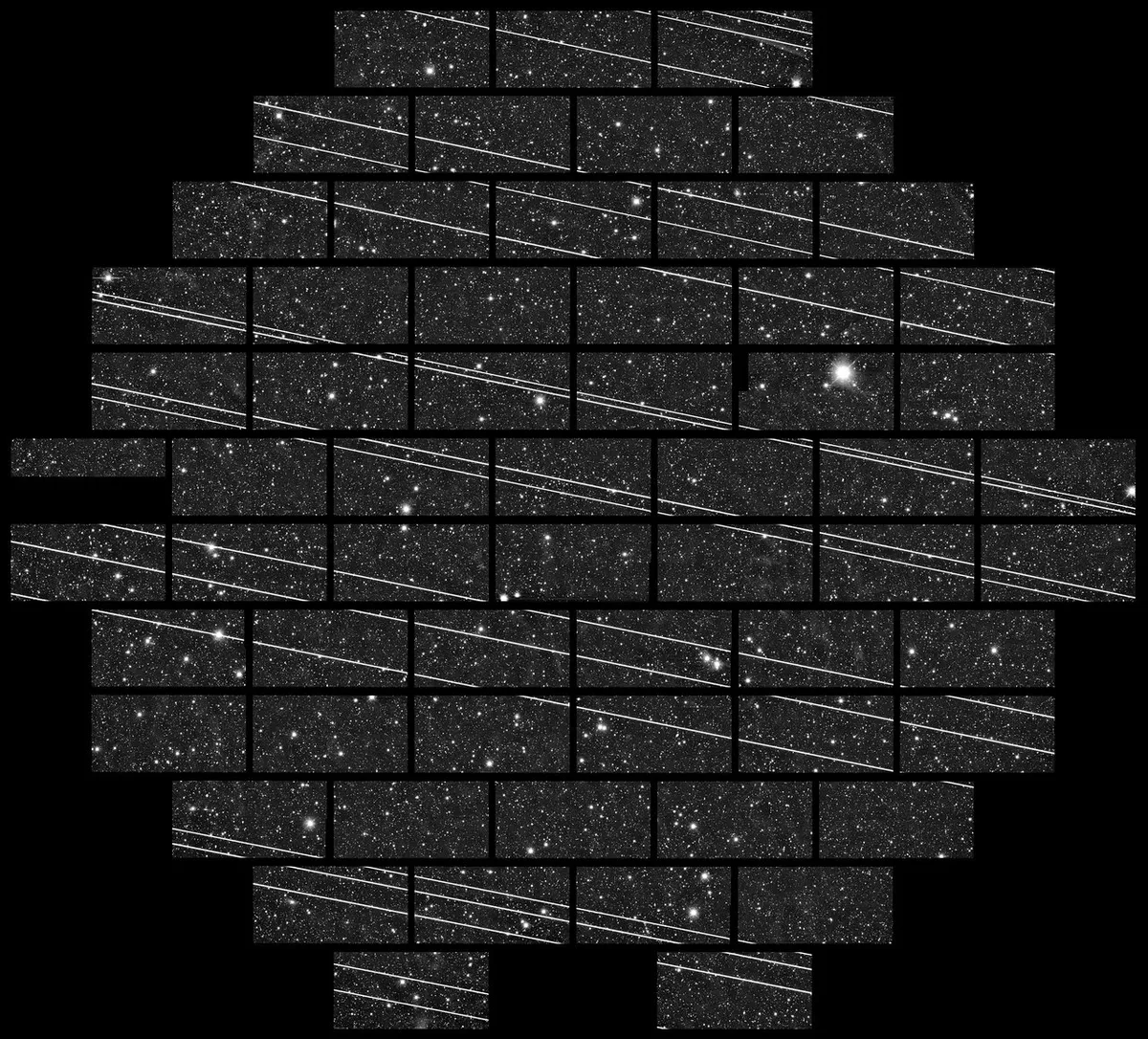
iau2001a, initial image: Observations with DECam (made by astronomers Clara Martínez-Vázquez and Cliff Johnson) on the 4-m Blanco telescope at CTIO showing at least 19 satellite trails from Starlink across 333 seconds of exposure. Note that, one week after launch, the clustering effects of the satellites is more pronounced than when the satellites reach their final orbit. The jumps in the trails are due to jumps between the camera's CCD chips.
Credit: NSF’s National Optical-Infrared Astronomy Research Laboratory/CTIO/AURA/DELVE.
Seitzer01 and 02-04: Credit: Seitzer, Pat (University of Michigan), 2020, Presentation to the US National Science Foundation Astronomy and Astrophysics Advisory Committee.