If stars had eyelids, how long would a stellar blink last?
When exactly do you mean?
See I've already waited too long
And all my hope is gone
The Smiths - How Soon Is Now?
Sometimes it is said that stars blink or twinkle. Neruda said they "shiver". Twinkling means something that turns on and off intermittently. Why would it also be called blinking or winking, if stars don't have eyes? What do eyes have to do with turning on and off?
Let's suppose that stars were eyes that emit light and that they had eyelids. When closing them, the light would diminish. So we would see that the light of the stars turns on and off, as indeed happens with variable stars.
That blinking is a product of starlight passing through Earth's atmosphere. But it is not that blinking I want to refer to here, but to the idea that a blink or wink lasts a short time. We say this to refer to human things, but sometimes we extrapolate it to things that are not.
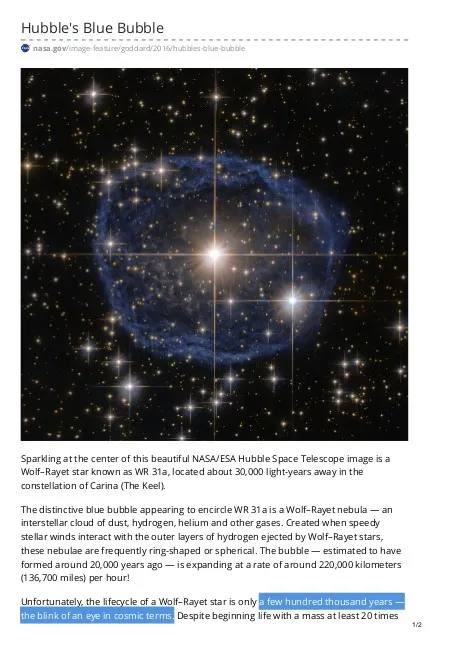
For example: In 2016, NASA published a photo of WR 31a, a Wolf-Rayet star. And the release said: "Unfortunately, the lifecycle of a Wolf-Rayet star is only a few hundred thousand years, the blink of an eye in cosmic terms".
So, it seems, a cosmic blink would be equivalent to hundreds of thousands of years. Is that correct? Actually, it's a way of saying that that timescale is a short span compared to others, larger ones. But since we are not giraffes, we can do a calculation to know how long a stellar blink would last.
THE HUMAN BLINK AS A HUMAN UNIT OF MEASUREMENT
According to certain information sources consulted, adults blink an average of 5 times per minute. That is the blink frequency. And they do so at a rate of 400 milliseconds each time, that is the duration of the blink. For practical purposes, we could change that last value to 500 ms, since that way we can say that 1 blink = 1/2 second, since 1 second equals 1000 ms.
A curious calculation with these data is that, then, an adult keeps their eyes closed, while awake, 5 times of 0.5s per minute, that is, 2.5 s/min. In proportion, it's 4%. Don't blink much when crossing the street or driving a car!
Sometimes we say that something lasts a short time, "the time it takes to blink", as NASA said in that release, because indeed half a second is short. Short compared to what?
Well, we can compare a blink with the duration of human life. Let's say an average person lives to 80 years (* see aside).
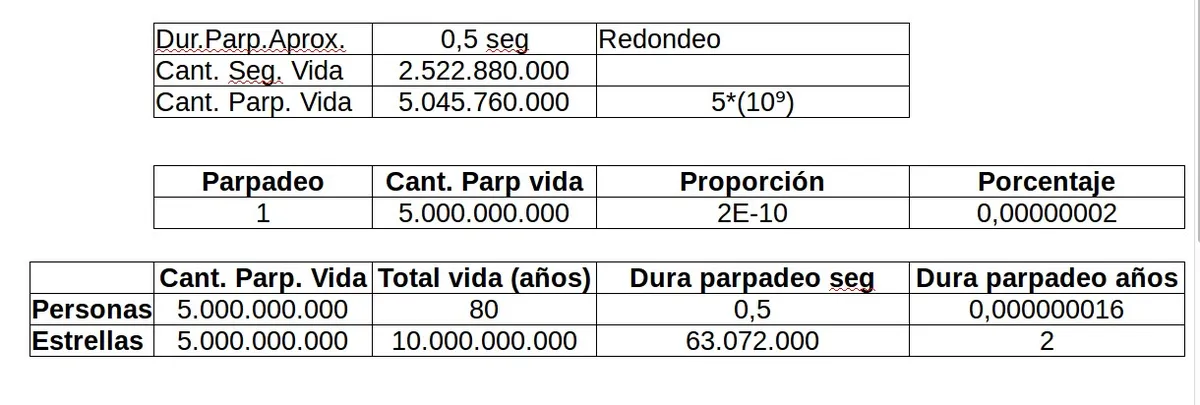
80 years are 2,522,880,000 seconds. We live 2.5 x 10^9 seconds per lifetime. Two thousand five hundred million.
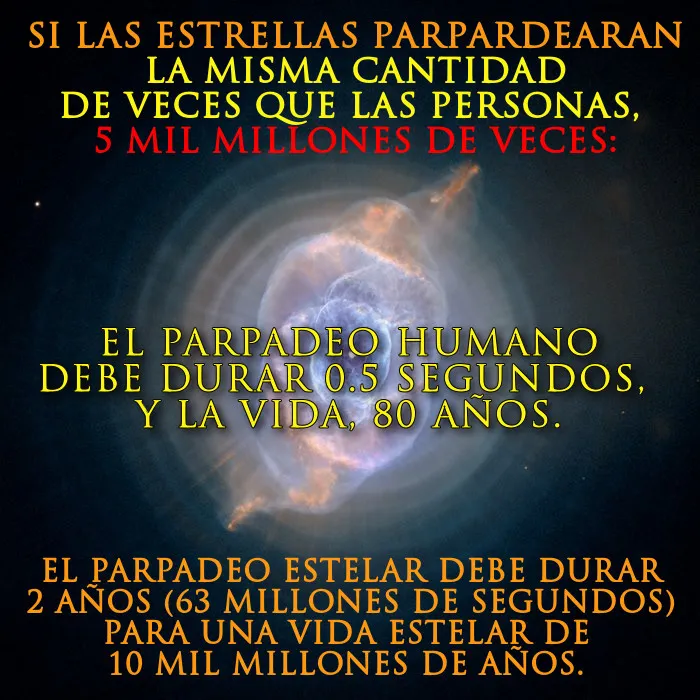
But we said that each blink is half a second. Therefore, if we use the duration (not the frequency) of the blink as a unit of measurement, human lifetime equals 5 billion blinks, since we said that blinks are double the seconds, because they last half.
This means that a single blink is very little, since it is a fraction 1/5x10^9. In decimals: 0.0000000002. In percentage, a blink represents 0.00000002% of human lifetime.
THE HUMAN BLINK AS A STELLAR UNIT OF MEASUREMENT
Now we can extrapolate this unit of measurement (the duration of the blink) to think: how long would a stellar blink last?
The proportion arises from relating the duration of a blink to human lifetime, the age.
Stars have longer lives, so their blink should be much greater than ours. How much is a "blink" for a star, in time?
A star like our Sun has an average lifespan of almost 10 billion years. If we apply the same previous percentage (0.00000002%) to 10 billion years, a stellar blink should last 2 years.
Does it seem little? Think that between your eyelids closing and opening involuntarily only half a second passes. Now think how it would be if that duration were 2 years?
That's why, 2 years in the life of a star is...almost nothing. Or almost as much as a blink lasts in human life.
According to NASA, hundreds of thousands of years is a blink in the cosmic scale. It is evident that the phrase was used in a general way, to account for the fact that hundreds of thousands of years is little compared to other cosmic times.
But we can do the calculation: If a star lives 10 billion years, any process that lasts only 100 thousand years will have a duration of 0.001% of the life of a star like our Sun. But for people, a blink is much less than that.
In short: the blink, in people, is a small amount of time (in seconds) that, multiplied by 5 billion (the number of blinks), gives the human lifetime, about 80 years.
The blink in stars, then, must also be a small amount of time (in years) that, multiplied by 5 billion, yields the stellar lifetime, about 10 billion years. Ergo, that amount must be 2.
To explain it another way: if people were blinking permanently, we could do it about 5 billion times per lifetime (assuming we live 80 years and each blink lasts 0.5 seconds).
If a star like the Sun blinked the same number of times, given its life cycle, each blink should last 2 years.
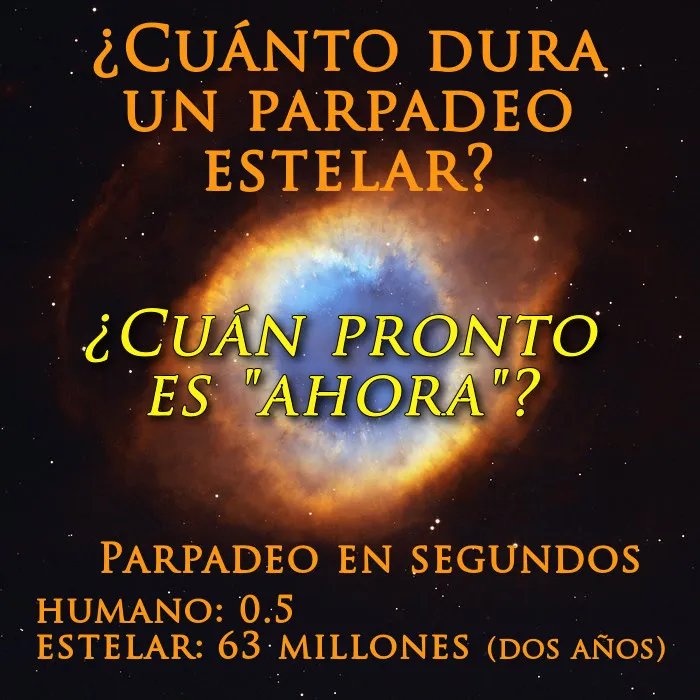
In comparison, a stellar blink is 63 million seconds (which equals 2 years), while for people, a blink lasts 0.000000016 years (which equals half a second).
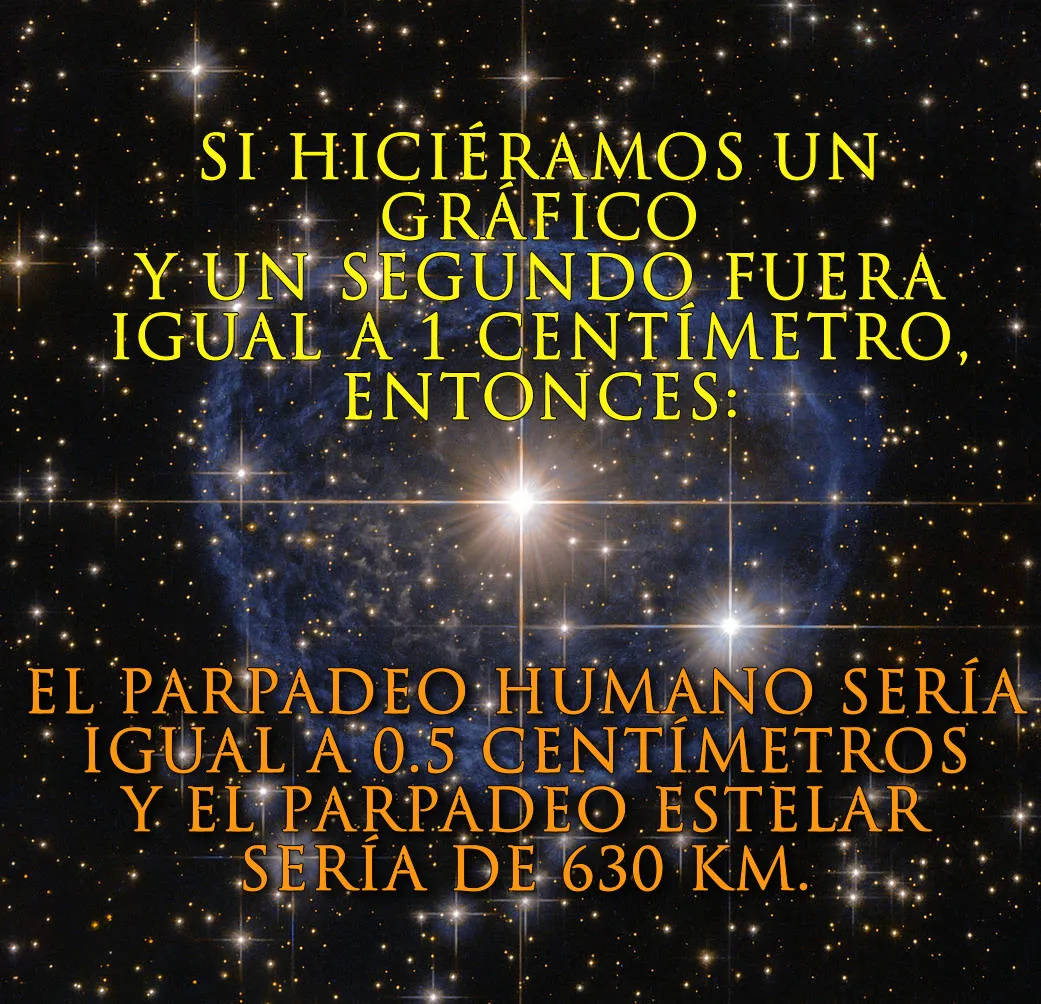
Think how we could graph this difference. Suppose half a second were equal to half a centimeter, then 63 million seconds would be 63 million centimeters, that is, 630 km.
By the way, if a star is more massive, like Betelgeuse, its lifetime is much shorter than our Sun, therefore, its "blink" must be smaller. In other cases, for less massive stars, having longer lives, their blink will be greater.
Given what has been said, when astronomers talk about the life of stars and say that something will happen imminently, one might wonder: how soon is now?
THE AVERAGE PERSON DOES NOT EXIST. THE AVERAGE STAR DOESN'T EITHER.
If we think that an average person is 1.70m tall, it is perfectly possible that we find that there are millions of people with that exact height. The same if we use other variables like weight, hair color, foot size, arm length, etc. For each of these variables we can calculate an average among a large number of inhabitants and then we could find that there are "average people" for each of these variables separately.
But now, let's combine all the variables to describe an average person.
An assumption: Height: 1.68; Weight: 73 kg; Eye color: Brown; Hair color: black; Arm length: 1.1 m; Foot length: 30 cm; distance between eyes: 2 cm; distance between ears: 12 cm; neck diameter: 10 cm; etc.
So we want to know if there actually exists any person who meets all these requirements. We can do this:
First we look for people who have the first requirement, the average height. Then, only among these, we look for those who also have the second requirement. Then, only among those, the ones who possess the third. And so on.
As is logical, at each step, the number of people will decrease. If the number of variables to consider is large, it is highly likely that finally, the result will be zero. That is, that there is no person who has all the average measurements. That is, the "average person" will not exist.
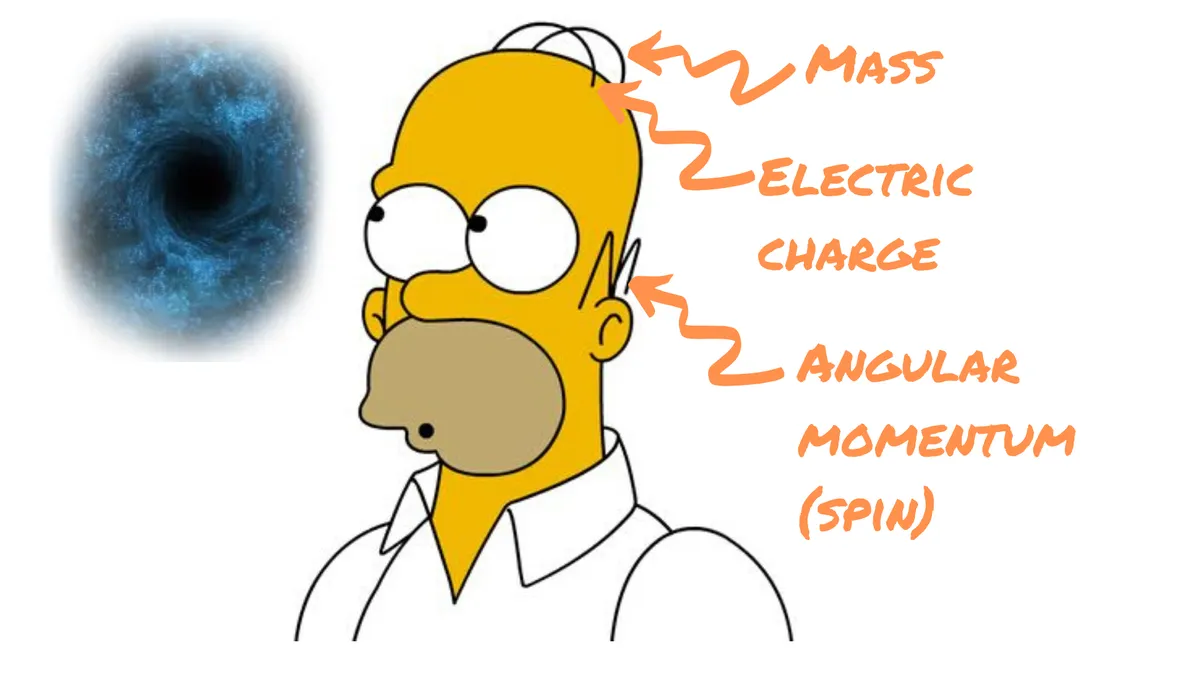
We could say the same about stars. If only the average mass is calculated, we will surely find "(mass) average stars", but finding "the" average star would imply finding at least one star that possesses all the average values. There are more stars than people (and than grains of sand), but if the number of variables to consider is sufficiently large, there will also be no "average stars".
The case of black holes is different. Since by the No-Hair Theorem, a black hole admits only three characteristics. So it is indeed possible to find "the average black hole". We should ask the Uruguayans from Cuarteto de Nos to write a song titled "Lo malo de tener tres pelos". I would buy the album without blinking.😉
Sources and related links
- NASA: Hubble's Blue Bubble
https://www.nasa.gov/image-feature/goddard/2016/hubbles-blue-bubble - Does The Average Person Exist?
https://www.youtube.com/watch?v=NbiveCNBOxk - No-Hair Theorem
https://es.wikipedia.org/wiki/Teorema_de_no_pelo - How extreme Black Holes defy the ‘no-hair theorem’
https://medium.com/predict/how-extreme-black-holes-defy-the-no-hair-theorem-ee6ca73b4506 - Cuarteto de Nos - The Bad Thing About Being Good (with lyrics)
https://www.youtube.com/watch?v=wDBIg2vBDVk - Parpadeo - EL PLAN DE LA MARIPOSA
https://www.youtube.com/watch?v=zbIxSiz8W_k - The Smiths: How Soon Is Now?
https://www.youtube.com/watch?v=OztC_7nkAd8
About the images
Helix Nebula
NASA, NOAO, ESA, the Hubble Helix Nebula Team, M. Meixner (STScI), and T.A. Rector (NRAO).
Cat Eye Nebula
ESA, NASA, HEIC and The Hubble Heritage Team (STScI/AURA)
WR31a: ESA/Hubble & NASA, Acknowledgement: Judy Schmidt.
Matt Groening and Fox Broadcasting