The total solar eclipse in Chile/Argentina will be the big event of the year. Also the transit of Mercury. IAU celebrates 100 years. China, India, and Israel, to the Moon.
Solar Eclipses
January 6: Partial eclipse, visible in Asia and the Pacific.
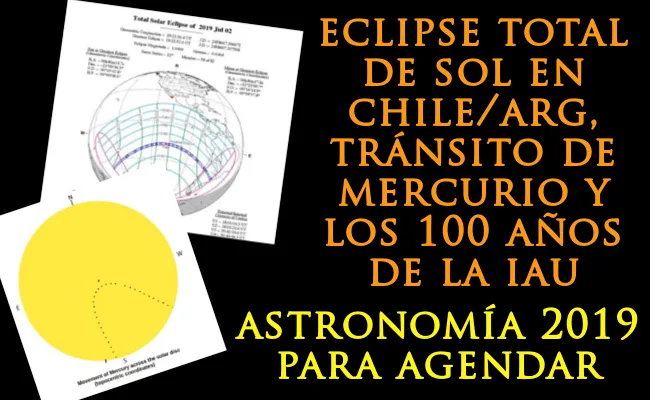
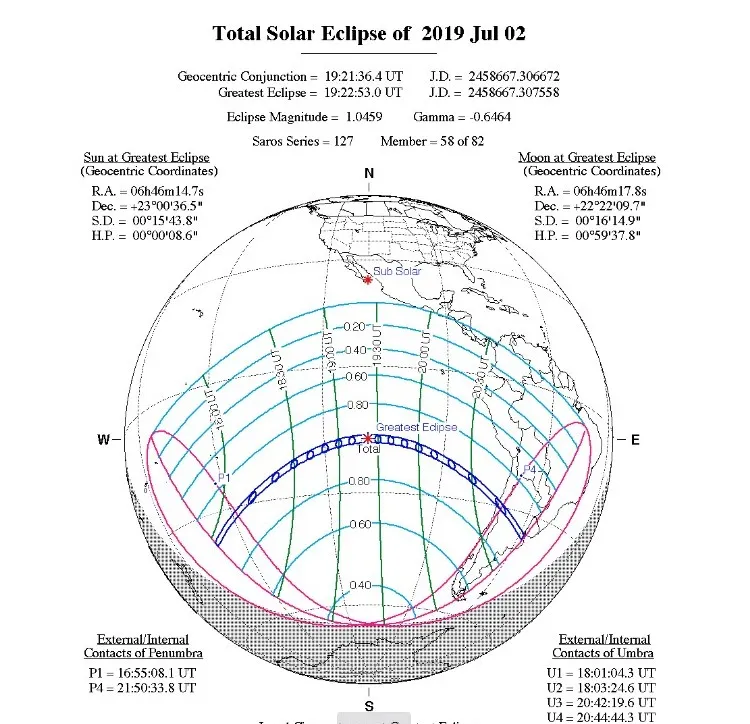
July 2: Total eclipse, visible in Chile and Argentina.
The best of the eclipse, its maximum point, will occur with the Sun over the South Pacific. Inhabitants and tourists in Chile and Argentina will be able to observe the last part of the eclipse, around 21:00 UTC, 18:00 local time. The magnitude will be 1.046. Magnitude is the fraction of the Sun's diameter obscured by the Moon. In total eclipses the magnitude will be greater than or equal to 1. For comparison, the eclipse seen in the United States in 2017 had a similar magnitude.
December 26: Annular eclipse visible from Asia and Oceania.
Lunar Eclipses
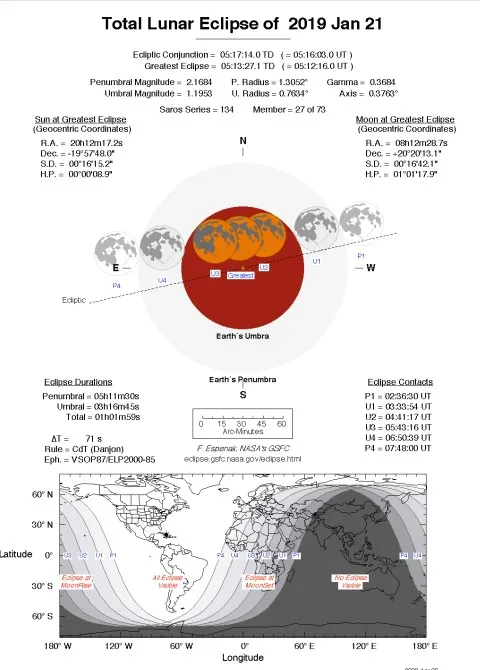
January 20-21: Total eclipse, visible from all of the Americas, while in Europe and Asia it will be seen partially. The best will be seen around 5:00 UTC, 2:00 local time. Magnitude: 1.195.
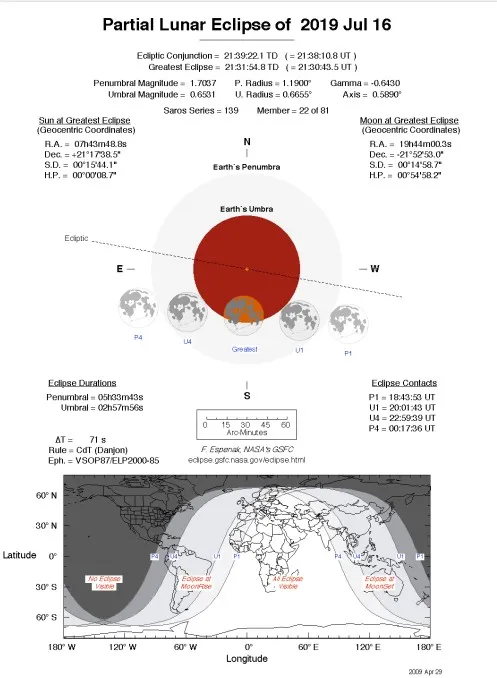
July 16: Partial. The entire phenomenon will be seen in Africa and part of Europe. In South America the final part will be seen, as the Moon sets, around 20:00 UTC. Magnitude: 0.653.
Transit of Mercury
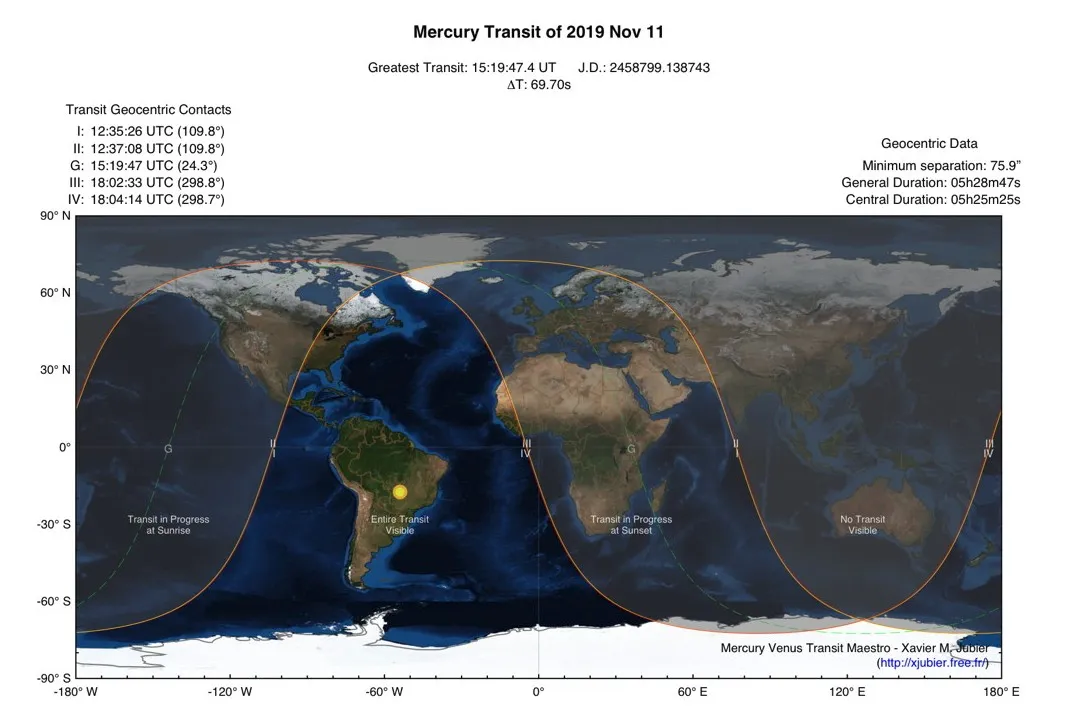
On November 11, at 15:20 UTC, the planet closest to the Sun will transit the star with a separation of just 76". According to Fred Espenak's calculations, the Sun from Buenos Aires will have an altitude of 72º at maximum, 12:20 local time.
There will be no other transit of Mercury until 2032.
Venus, which was seen transiting in 2012, will not transit again until 2117.
Source: NASA Eclipse, by Fred Espenak, NASA/GSFC.
https://eclipse.gsfc.nasa.gov/eclipse.html
Map of the Transit of Mercury and calculator, by Xavier M. Jubier.
http://xjubier.free.fr/en/site_pages/transits/ToM_2019.html
SPACE MISSIONS
New Horizons
On January 1, New Horizons is expected to fly by the Kuiper Belt object 2014 MU69.
ISRO Chandrayaan-2
At the end of January, the Indian probe Chandrayaan-2 would be launched, which has an orbiter and a descent module to reach the Moon and conduct topography and mineral studies.
https://nssdc.gsfc.nasa.gov/nmc/spacecraft/display.action?id=CHANDRYN2
SpaceIL
During January, this Israeli probe would also be launched to the Moon.
http://www.spaceil.com/mission/
Chang'e 5
It would be launched at the end of the year to bring samples from the Moon.
Lunar exploration timeline
On this page you can see missions to the Moon from the last century:
https://nssdc.gsfc.nasa.gov/planetary/lunar/lunartimeline.html
Boeing and SpaceX will conduct test and demonstration missions during the year, some will be crewed and will make headlines.
SAOCOM
SAOCOM 1B would be launched: The central objective of the SAOCOM Earth Observation satellites is the measurement of soil moisture and applications in emergencies, such as detection of hydrocarbon spills at sea and monitoring of water coverage during floods. It is a project developed in collaboration with the Italian Space Agency (ASI) and integrates operationally, together with the Italian COSMO-SkyMed satellites, the SIASGE (Italian-Argentine System of Satellites for Emergency Management).
SAOCOM at CONAE http://www.conae.gov.ar/index.php/espanol/misiones-satelitales/saocom/objetivos
SpaceX Falcon 9 launches with SAOCOM 1A and nails first West Coast landing https://www.nasaspaceflight.com/2018/10/spacex-falcon-9-saocom-1a-launch-west-coast-landing/
Meteor showers
May, 6-7: Eta Aquariids from late April to late May, with peak between May 6 and 7.
August, 12-13: Perseids, from mid-July to mid-August.
November, 17-18: Leonids, during November.
December 13-14 Geminids, from early to late month.
Astronomy Calendar of Celestial Events for Calendar Year 2019 http://www.seasky.org/astronomy/astronomy-calendar-2019.html

IAU100
The International Astronomical Union celebrates its 100 years with a large number of events to be held throughout 2019 on all continents.
https://www.iau-100.org/
NOC Argentina
http://sion.frm.utn.edu.ar/NOC-Argentina/index.php/proyectos-iau-100/