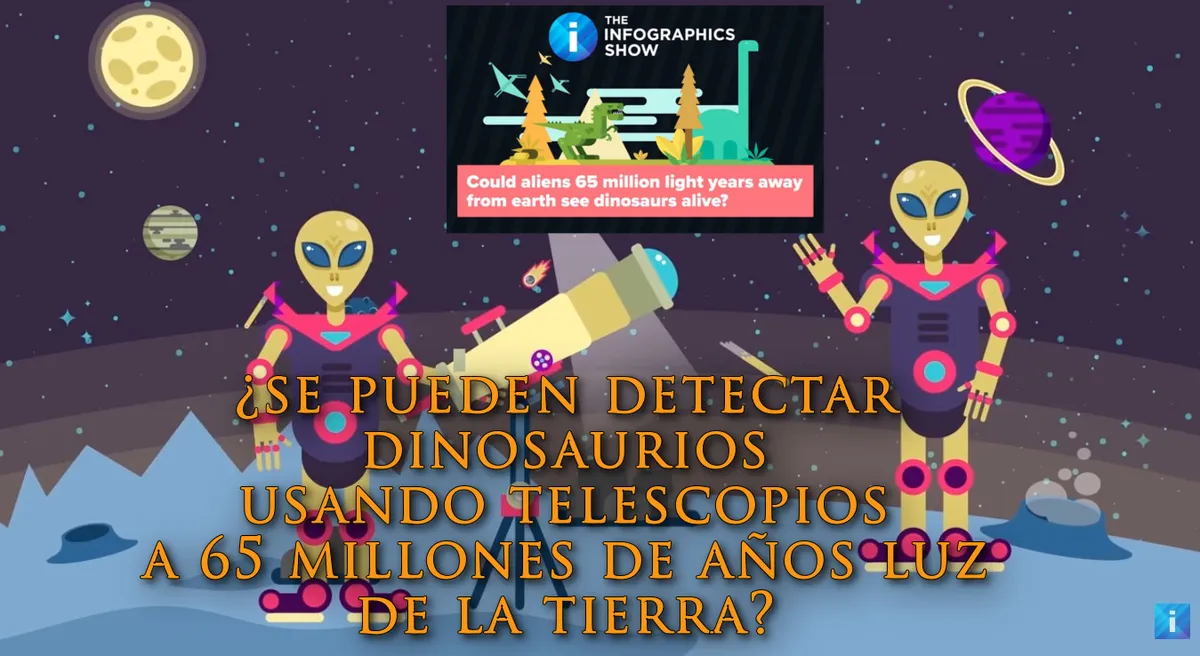
If we always observe the past, would a civilization 65 million light-years from Earth be observing dinosaurs?
We always observe the past. Not only in astronomy, but also in everyday life. The only -remarkable- difference between astronomy and daily life in this aspect is the scale. In everyday life it seems that when we turn a light switch, photons are emitted from the lamp immediately. However, there is a time difference between one action and the other, but it is imperceptible since the speed of light is very high in relation to the very short distance between the switch and the lamp.
It is worth stopping here to explain that human beings are quantized, that is, we cannot perceive any amount of stimuli through our senses, but certain discrete amounts. That is why it seems to us that no time passes between pressing a key and the light turning on. But time does pass.
This should no longer need explanation. This situation recurs every time a phenomenon occurs, such as novae and supernovae. Currently, there is talk of the possibility of Betelgeuse collapsing in that way. As stated, if the explosion is observed or detected now, it is because it happened before, since the star is more than 600 light-years away. This distance measurement implies a distance equal to that traveled by light during 600 years. Therefore, the event recorded by us now had to travel that distance in that time before reaching us.
OBSERVING DINOSAURS FROM A DISTANCE
This same thing can be thought of in reverse. If another world, located 65 million light-years away, had an advanced civilization that uses telescopes and were looking towards Earth, what would they see? They would see our world as it was 65 million years ago, because the sunlight reflected from Earth takes that long to reach a world at that distance. What those aliens would detect now would be light that left Earth 65 million years ago. Does that imply they would be seeing dinosaurs?
No, you cannot see dinosaurs with telescopes. These instruments are designed to observe luminous objects (that emit light or reflect it) that are VERY LARGE, at great distances. They are not useful for observing SMALL things at great distances. But how large or small is large or small?
Actually, telescopes collect light and, unless a camera or CCD device is used, they do not store images. Therefore, the "power" of a telescope lies in detecting a certain amount of light, its capability is not expressed in terms of distances. Despite this, a calculation can be made to relate the amount of light to distances, since the farther away an object is, the smaller it will appear and the same happens with light. That is, a very luminous source seen up close will appear less luminous at a distance, with a certain proportion.
It is possible to calculate relative sizes based on the "angular diameter" and the resolution of a telescope. Angular diameter is the relationship between the actual size and the distance. The same angular size can mean two things: that an object is close and small or that it is far away and very large.
Example: an angular size of 10/30 will be equal to one of 100/300, although in the first case, it would be an object of size 10 and distance 30; and in the second, an object of size 100 and distance 300. That is, the first object is smaller than the second, but it is closer, in the same proportion (0.33). It is worth clarifying that in both cases the same units of measurement must be used and that this is valid as long as the distance is much greater than the size. The result is expressed in radians, which can be converted to degrees, minutes, and seconds.
On other occasions, I explained here why the Hubble Space Telescope cannot observe the footprints of the astronauts on the Moon. It is because Hubble's resolution is very good for observing very large objects (like galaxies) located very far away, but not for observing very small objects, very close. The astronauts' footprints are too small in relation to the distance to the Moon. The same happens with dinosaurs. One must keep in mind what was said in the previous paragraph: the same units of measurement must be used, therefore, for the size of the footprints as for the distance to the Moon. If the distance is measured in kilometers, the footprints also, in which case it will be a very small number.
To understand it simply: our eyes have a certain resolution. With this resolution we can see very large and very distant objects, for example, we can observe the Obelisk of Buenos Aires from several hundred meters away or Aconcagua from kilometers away. And we can also see smaller objects, but closer, for example, a fly a few meters away, but we cannot detect a fly hundreds of meters away.
Of course, then, this depends on the resolution of telescopes. To observe dinosaurs 65 million light-years away, one would need a telescope with a primary mirror with a very small resolution, that is, one that can "resolve" objects with a very small angular size. The resolution depends on the diameter of the primary mirror: the larger the mirror diameter, the better the resolution, that is, smaller. Such a mirror would have to be larger than the Solar System. As if that weren't enough, mirrors deform with size, due to gravity.
OPTICAL INTERFEROMETRY
But one could apply the technique of very long baseline interferometry, like the one used to photograph the black hole in 2019. However, it is a radio astronomy technique. It would imply that such a civilization builds several radio telescopes at a great distance from each other, but all 65 million light-years from Earth and they must be synchronized. But they would observe that which emits radio waves.
What if we do the same, but with optical instruments? Astronomer Antoine Émile Henry Labeyrie proposed a "Hypertelescope" that would be a fleet of optical instruments acting together. This way they could have a smaller resolution and a larger light-collecting area, particularly if it is possible to put an array of those instruments located at a great distance into orbit around Earth. However, this idea is still in its infancy. It would require several tons of money.
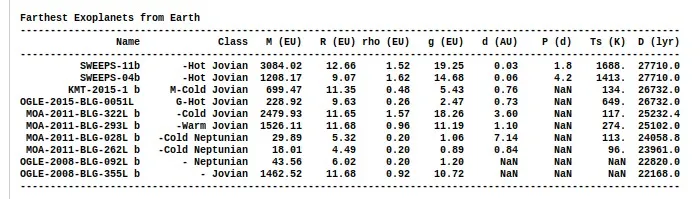
It's worth thinking about anyway, since objects that are so far unobservable could be observed; in particular, images of exoplanets could be made to know if there is life there. That implies a very small resolution, since planets orbiting other stars—but within the Milky Way—are very small given their great distance. It's a stellar scale. Observing oceans or mountains would imply having an unprecedented resolution.
But what is proposed here is to observe a planet like Earth at 65 million light-years, which is a galactic scale, no longer stellar. The galaxy closest to Earth is Andromeda, at almost 3 million light-years away. [The Magellanic Clouds, closer, are considered "satellite galaxies"].
In comparison, the photo of the black hole from April 2019 is of a galaxy (M87) at 55 million light-years. The distance is within the range of 65 million light-years, but it is a radio image, the object has 6 billion times the mass of our Sun and the event horizon was about 40 billion km in diameter, while Earth's diameter is only 12,000 km.
COMPARISONS AND CALCULATIONS
The angular size of the Moon and the Sun is half a degree, about 30'.
Let's do some math to feel more human:
According to Wikipedia, Betelgeuse has a diameter of 1,642,000,000 km and is located 642 light-years away.
Sirius, the brightest star, is a double system. Sirius A has an approximate diameter of 2.4 million km and is located 8.6 light-years away. According to the online encyclopedia, the star of Orion has an angular diameter of 0.06", while the brightest star in the sky, in Canis Major, has an angular diameter of 0.005. How to know if it's true?

Procedure:
We use a spreadsheet, that's what they're for. We have to use the same unit of measurement for diameter and length. We convert everything to km.
To convert from light-years to km we multiply by 9.46 x 10^12 (9,460,000,000,000).
We call the diameter d and the Distance D. We divide d/D. The result is expressed in radians. To convert from radians to degrees we multiply by 57.29. To convert from degrees to minutes, we multiply by 60. To convert from minutes to seconds, we also multiply by 60. Done.
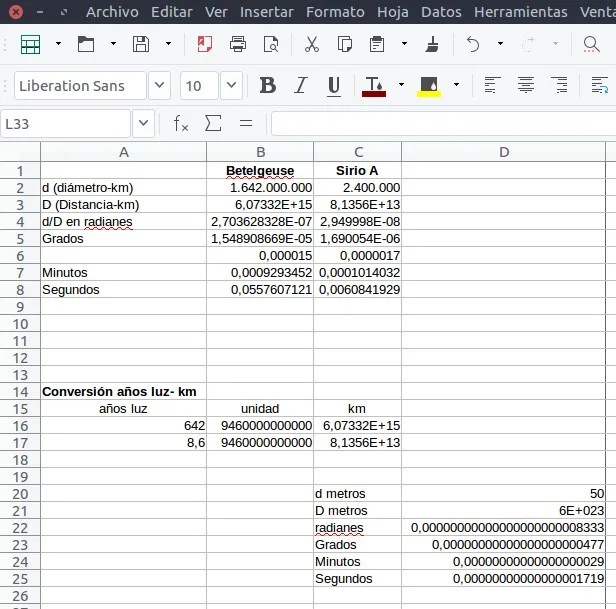
Suppose a large dinosaur was about 50 meters tall. And let's say, just to think, that it also had a diameter of 50 meters. These are length measurements. The distance, also: how many meters are 65 million light-years?
6e+23m (approx), which means a 6 followed by 23 zeros: 600,000,000,000,000,000,000,000 meters.
The angular diameter then is 50 divided by that huge number.
CONCLUSION
It is theoretically possible, but for now it is technically impossible with current human technology. Even the mere idea of the hypertelescope falls short, since one of the objectives of such a proposal is to search for life on exoplanets, but within our galaxy.
The technical problem is the resolution, in terms of angular diameter. An incredibly small resolution would be needed, since we are talking about a planet (relatively small compared to a star) located at a very great distance.
I have overlooked other considerations, but they should be considered, if the case arises, such as the planet's albedo, its closeness to the star, Rayleigh scattering, etc.
Although the question sounds far-fetched, it is worth answering, since it can be used to address some astronomical concepts. It also serves to make it clear that, in the meantime, it is not possible to detect life from Earth on other planets (not even in the Solar System) using telescopes. That is why it is vital to send probes to moons of Jupiter or Saturn where there could be microorganisms.
Detecting life on planets outside the solar system, for now, is not possible, since spacecraft cannot be sent either, due to the great distance even to the star closest to the Sun, given that with the accelerations achieved to date, such a trip would take thousands of years.
For that very reason, detecting intelligent life on other worlds makes no sense by sending spacecraft. If we are intelligent, we send radio signals. I suppose the "ancient aliens" didn't get the memo.
Sources and related links
- Question on Quora
https://es.quora.com/Los-cient%C3%ADficos-afirman-que-si-un-extraterrestre-a-65-millones-de-a%C3%B1os-luz-de-distancia-ve-la-Tierra-a-trav%C3%A9s-de-un-telescopio-poderoso-puede-ver-dinosaurios-C%C3%B3mo-puede-ser-posible - Could Aliens 65 Million Light Years Away from Earth See Dinosaurs Alive?
https://youtu.be/SbXNmVsp_t8 - HEC: Top 10 Exoplanets
http://phl.upr.edu/projects/habitable-exoplanets-catalog/top10 - Very large baseline optical astronomy
https://www.nextbigfuture.com/2016/08/very-large-baseline-optical-astronomy.html - Forget Space Travel: Build This Telescope
https://www.huffpost.com/entry/forget-space-travel-build_b_5691353 - Intensity interferometry: Optical imaging with kilometer baselines
Dainis Dravins
arXiv:1607.03490 [astro-ph.IM]
DOI : 10.1117/12.2234130
https://arxiv.org/abs/1607.03490 - The Far Future of Exoplanet Direct Characterization
https://www.liebertpub.com/doi/pdf/10.1089/ast.2009.0371 - Detecting the Glint of Starlight on the Oceans of Distant Planets
D.M. Williams, E. Gaidos
arXiv:0801.1852 [astro-ph]
DOI: 10.1016/j.icarus.2008.01.002
https://arxiv.org/abs/0801.1852 - Hypertelescope Optical Observatory
http://hypertelescope.org/fiches-techniques/documents/hypertelescope-optical-observatory/ - Antoine Émile Henry Labeyrie
https://en.wikipedia.org/wiki/Antoine_%C3%89mile_Henry_Labeyrie#Hypertelescope - Wikipedia: Angular diameter
https://es.wikipedia.org/wiki/Di%C3%A1metro_angular
About the images
Screenshot of YouTube video images from the channel The infographics Show.
Screenshot from Wikipedia.