Online course starting in June.
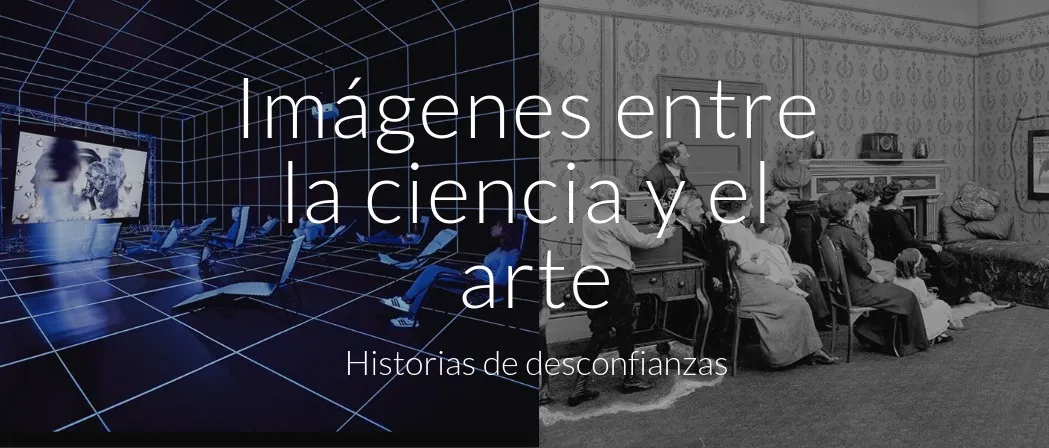
This course offers an overview of image creation devices in the sciences and the arts. During the 19th century, scientific practices multiplied drawings, engravings, lithographs, and photos of catalogs of flora, fauna, anatomy, and celestial maps. Contemporaneously, optical toys that preceded the cinematograph were all the rage, which in turn renewed the tension about the role of moving images. With the emergence of the historical figure of the spectator, we will explore reflections about the subject who appreciates beauty in 19th-century museums. We will advance into its redefinition towards the 21st century by considering modes of representation and their margins, multi-screen projections, binary code in the constitution of synthetic images, the role of technical devices in generating new sensory maps and interactive experiences that reconfigure the contemporary image market. We will close with debates on the current circulation of scientific images in art, public entertainment, and social disciplining.
The course is organized into four weekly meetings lasting 90 minutes each. The proposal is introductory and anyone with an interest in the topic can participate, with no prior knowledge required.
Contents
Class 1. Between the camera obscura and photography: Post-Impressionism and abstract art, a history of aesthetics between science and art.
Class 2. Optical toys: movement as illusion, from geometric vision to physiological vision in Goethe, the man who walked in color.
Class 3. Scientific instruments: history of the division of labor between technicians, scientists, and artists.
Class 4. New technologies: the cinematographic device leaves the cinema and enters the museum, from the technical image to the synthetic image, the circulation of the scientific image in contemporary art.
Instructors
Marina Rieznik holds a Ph.D. from UBA specializing in history; she is an associate researcher at CONICET; at the Institute for Studies on Science and Technology of UNQ and at the Gino Germani Institute of UBA. She has taught regular and competitive courses on the history of science in undergraduate or graduate programs at UBA, in the faculties of Social Sciences, Philosophy and Letters, and Exact and Natural Sciences, as well as in the Master's program in Science, Technology and Society at UNQ. Invited professor at the Seminar on Technoscientific Thought at UNTREF. She has directed several projects for the National Agency for Scientific and Technological Promotion. She has given talks, classes, and lectures internationally: at the University of Lorraine in France, at the Institute of Aesthetic Studies and the Ph.D. program in Philosophy of Science at UNAM in Mexico, at the Museum of Astronomy in Rio de Janeiro, and at the Ibero-American Institute in Berlin. She co-coordinates the Group on History and Epistemology of Cartographies and Technical Images at UBA. She researches topics related to the history of science and scientific images. She has published over fifty works including books, book chapters, conference publications, and articles.
Laura Esteras is an editor, motion graphics artist specialized in 2D animation and compositing, having produced over a thousand audiovisual pieces for film, advertising, TV programs, and social media. She was in charge of the Postproduction Coordination for the Presidency of the Nation for over a decade, before starting to work freelance for Google, Techint, Tenaris, Mercado Libre, among other companies. She studied in the Psychology program at the University of Buenos Aires. She was responsible for developing the syllabus for the course 'Synthetic Image Techniques' in the Arts and Technology program at the Virtual University of Quilmes, focused on the theory of movement and its intersection with audiovisual arts, in a journey through various traditional and digital animation techniques. She currently works as an invited professor at the Seminar on Technoscientific Thought at UNTREF. Her current research area is the intersection between the history of perception psychology and the moving image; from its beginnings, with optical toys, to the contemporary synthetic image.
Format, days and times
During the quarantine, courses are conducted via teleconferencing platforms with small groups to ensure participation. The use of cameras is optional for participants.
The start of the course is subject to forming a minimum group, and the day and time will be finalized based on the preferences indicated by interested parties in the pre-registration form.
Information and registration https://www.xcursus.com.ar/imagenes