Blue Lurkers are low-mass blue straggler stars, hidden in HR diagrams that can be discovered through rotation.
Let's say a woman gives birth to quintuplets. One of the babies is named Estrella. The girls are the same age, they are twin sisters, and it is logical to expect them all to go through the same stages at the same time. However, after several years, Estrella is still in elementary school, while her 4 sisters are in college.
Those who don't know the story might think that Estrella is younger than the others or that she rejuvenated as if she had found the fountain of youth. Others might consider that Estrella is the same age, but is lagging behind.
Will you believe me if I tell you that the real reason Estrella is lagging behind is that she gained weight? She's not the only one. Another one of her sisters also gained weight, but less.
It sounds strange for people, but not for stars. Let's talk about blue straggler stars, which, in jargon, are called Blue Straggler Stars or BSS.
Most of these stars are found in globular clusters. These are groups of stars gravitationally bound, co-moving, that were born almost at the same time, from the same cloud of interstellar matter. Therefore, they are sisters, they are the same age. However, some appear younger than the rest. It's because they are blue. Young stars are blue, hotter, and older ones are red, less hot.
A new investigation focuses on the deceptive sisters of the stragglers, which have been called Lurkers, hidden. But first we must understand what happens with BSS.
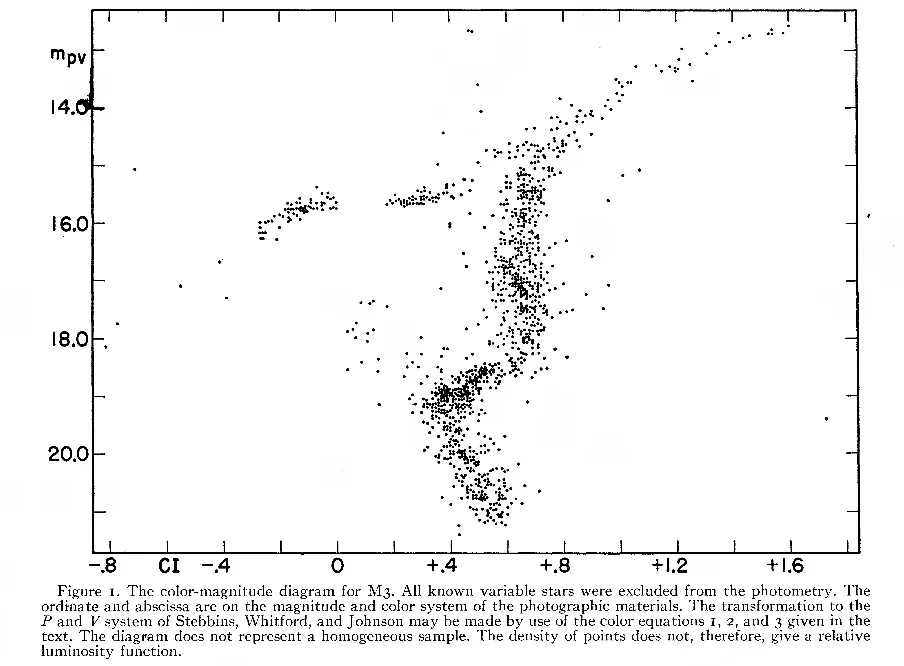
To analyze a globular cluster, a tool very used for decades are HR diagrams or color-magnitude diagrams. Blue stragglers have been known since 1953 when Allan Sandage created an HR chart of cluster M3, in the galactic halo. HR diagrams plot absolute magnitude versus color-temperature of a stellar population and the location of the "hook" or break point of the main sequence is used to determine the age of the cluster.
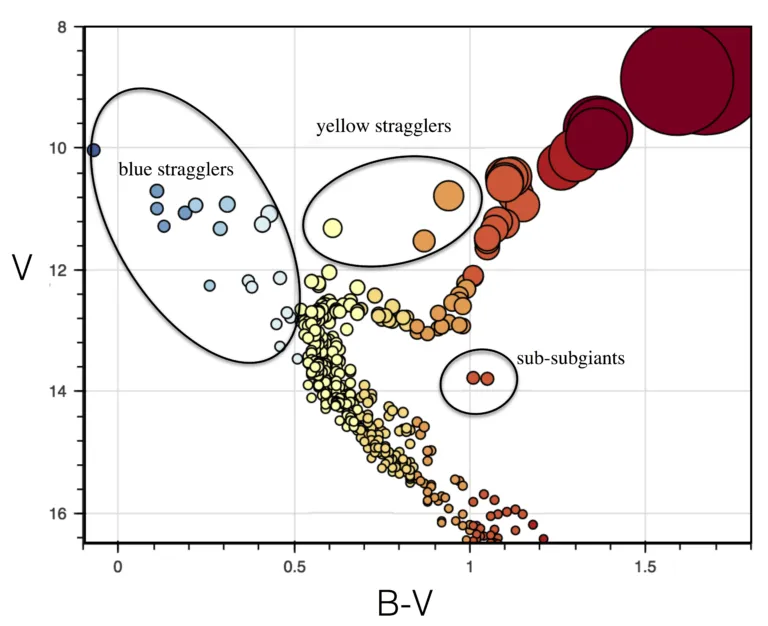
Stars go through a sequence of phases throughout their evolution, known as the Main Sequence. But not all. Some are more exotic. Massive and very luminous stars leave that sequence before those of lower mass, redder ones. The "break point", where the stars lose the path and leave the sequence, is the "turn-off" and coincides in the graphs with a curve or hook. Thus, the fewer blues there are in the main sequence, the older the cluster. Figure 1 shows the diagram for M67.
Most of the stars in the cluster follow this zigzagging path that makes a turn or "hook". Above it are blue stragglers (BSS).
The discovery of these stars in the graphs drew attention and it was speculated that perhaps they were "stowaway" stars, from other regions, captured by an older cluster. But that is not the case. The secret of their youth is stellar interaction.
BSS are found in very dense clusters. It is logical then to assume that, due to such density, it is more likely that several stars interact, either by merging binary stars, by the transfer of matter between binaries, or by collisions. By acquiring more matter through any of these mechanisms, they become bluer. If they were already massive originally, the final combination makes them extreme, taking them into the BSS regime.
THE HIDDEN BSS
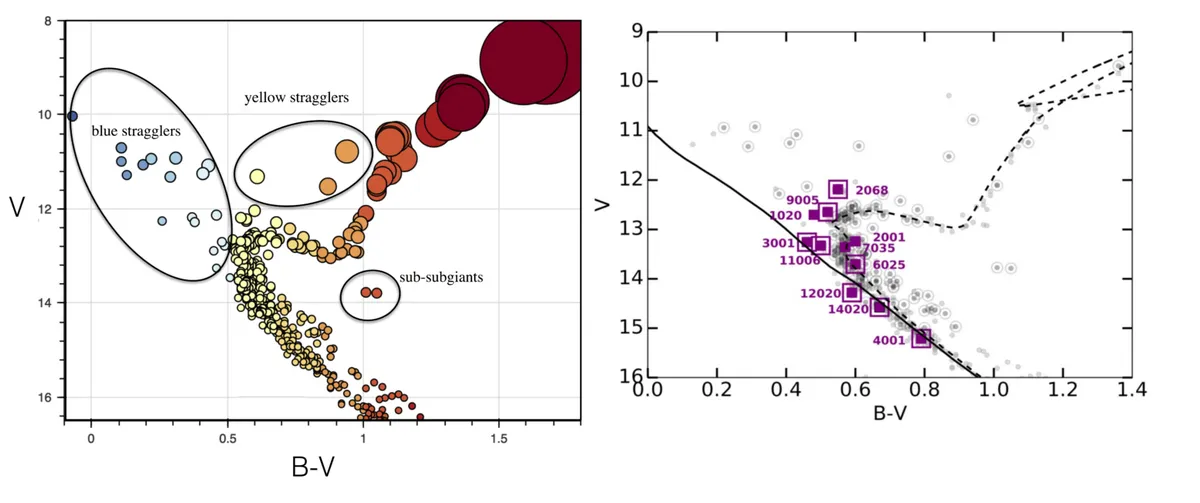
Blue Lurkers are low-mass BSS. That is, two stars of low initial mass interact to form another star of intermediate mass. Thus, the combination mixes or hides with the main sequence stars, as seen in figure 2.
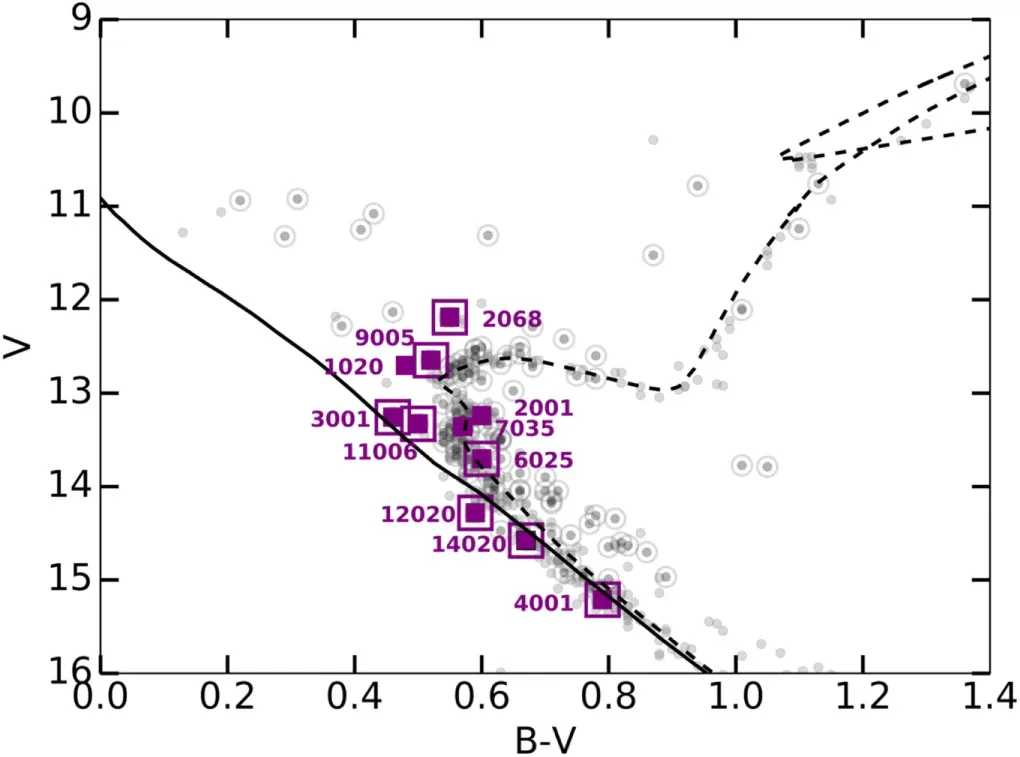
If this type of star cannot be identified by its position in the diagrams, how to do it? The researchers thought of a good solution: rotation. Rotation becomes slower with age, regardless of the initial angular momentum. BSS lurkers do it faster than stars in the same region in the diagrams, due to their interaction. Thus, by studying rotation rates in a sample with stars of similar masses and ages, these stragglers and hidden ones that are also fast cosmic spinning tops can be detected.
Stars like our Sun (in age), in M67, have rotation rates between 20 and 30 days. The authors of the paper, however, found 11 members with rotation periods shorter than 15 days, as if they were younger, but they reside in the same region of the graph. Freeze!
Measuring rotation
To measure rotation, astronomers used two methods: first they looked at the periodicity in light curves sampled by the Kepler mission (the second light sample or K2). For that they created Lomb-Scargle periodograms using the Vartools software. Stars have darker regions, due to their magnetic field. These regions cause the brightness to vary, although it can also change due to other processes such as planetary transit, pulsations, or a binary companion.
The other method is to look for signs in the spectrum. Stars in rapid rotation exhibit broader lines (due to the Doppler effect) which translate into projected radial velocity measurements (vsini).
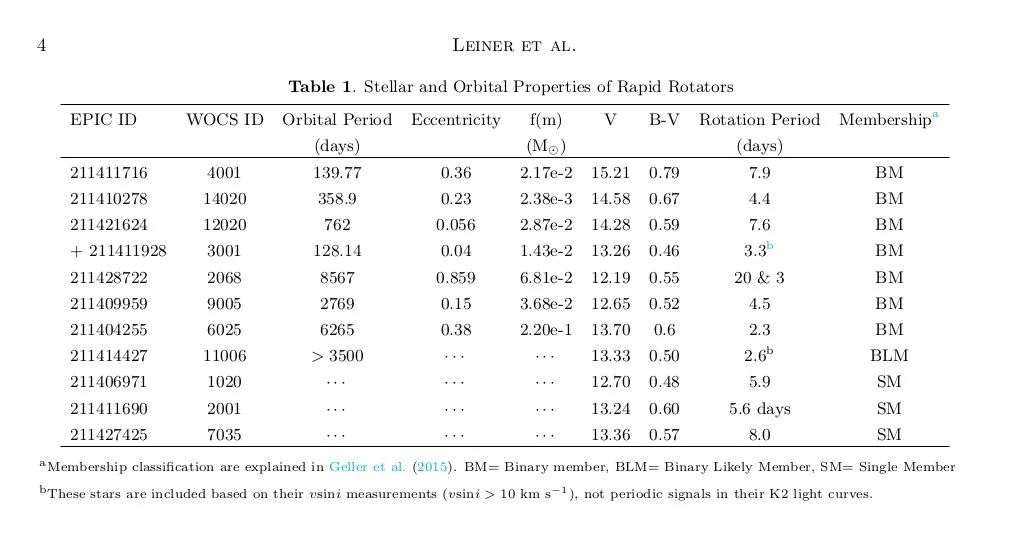
Thus, astronomer Emily Leiner and her colleagues found 11 rapidly rotating stars among 400 main sequence stars in M67, which implies a rate of almost 3% of low-mass blue stragglers or lurkers.
Of the 11, two stars in the sample were selected using vsini and 9 with K2 light curves. Of those 9, 5 are very secure detections of rapid rotation, while the remaining ones are less secure, as the authors indicate.
Table 1 lists these 11 objects. Identifiers from two surveys, orbital period in days, eccentricity, solar mass, B-V index, rotation period in days, and finally whether they are members of a binary or single system are indicated.
It is interesting how they use rotation speeds as a proxy (indirect indicator) of stellar age: gyrochronology. The method has been subject to criticism at other times due to its lack of calibration, for various reasons. However, it is a good idea. With future missions like TESS (already launched by NASA, in operation, with extended mission approved) and PLATO (European mission planned for 2026), the field of study looks promising.
And it must be true. After spinning on a merry-go-round, we feel younger...
Sources and related links
Blue Lurkers: Hidden Blue Stragglers on the M67 Main Sequence Identified from their Kepler/K2 Rotation Periods
Emily Leiner, Robert D. Mathieu, Andrew Vanderburg, Natalie M. Gosnell, Jeffrey C. Smith arXiv:1904.02169 [astro-ph.SR]
https://arxiv.org/abs/1904.02169
Blue Lurkers and Blue Stragglers: Rapidly-Rotating Stars and their Fountain of Youth, by Catherine Manea https://astrobites.org/2020/05/20/blue-lurkers-and-blue-stragglers-rapidly-rotating-stars-and-their-fountain-of-youth/
The color-magnitude diagram for the globular cluster M 3.
Sandage, A. R.
Astronomical Journal, Vol. 58, p. 61-75 (1953)
DOI: 10.1086/106822
1953AJ.....58...61S https://ui.adsabs.harvard.edu/abs/1953AJ.....58...61S/abstract
NASA TESS https://heasarc.gsfc.nasa.gov/docs/tess/objectives.html
Understanding the Lomb-Scargle Periodogram
Jacob T. VanderPlas arXiv:1703.09824 [astro-ph.IM]
https://arxiv.org/abs/1703.09824
The VARTOOLS Light Curve Analysis Program https://www.astro.princeton.edu/~jhartman/vartools.html
ESA PLATO https://sci.esa.int/web/plato/
About the images
Figure 1: from Emily Leiner's website https://sites.northwestern.edu/emilyleiner/research/
Figure 2 and Table: Leiner et al (2020).
CMD M3: Sandage, AJ, 1953.