Notes for beginners in times of physical isolation.
Reader Oscar, from Neuquén, asks me what courses I can recommend to learn astronomy. I will answer him with this post, as the question may be of general interest.
As the poet said: "Caminante no hay camino, se hace camino al andar". Astronomy is a science with many branches and some may interest us more than others. We can divide it between the theoretical part (astrophysics) and the observational part. The theory covers from the Solar System, star formation, classification by spectral type, main sequence, exotic objects. Globular clusters. Development and evolution of galaxies. Interstellar medium. Cosmology. The observational part can include types of telescopes, angular size, constellations, coordinate systems, celestial maps. Astrophotography.
So each person must walk the path to evaluate which topics are of greatest interest to them and which are not so much. In my view, it is highly recommended to start with the history of astronomy, which covers all topics. In times of isolation, there are several options:
-Online courses
-Use of telescopes on the internet
-Beginner e-books
-Educational videos-series on platforms
ONLINE COURSES
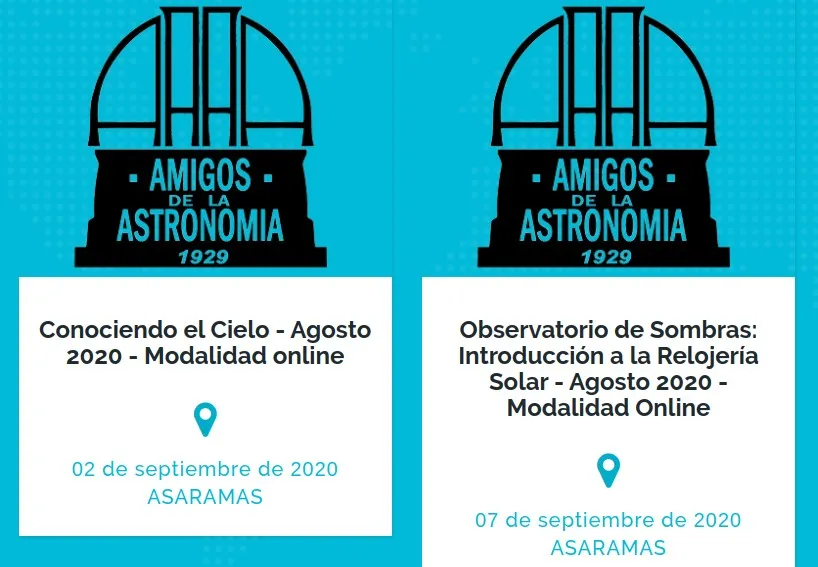
In Argentina, the Asociación Argentina Amigos de la Astronomía (ASARAMAS) informs me of several virtual courses. It is preferable to visit their website and make any necessary inquiries from there. Virtual courses in general may require a video camera, but it should not be exclusive. In the case of ASARAMAS, their in-person courses did not require prior knowledge (except for those with prerequisites).
Furthermore, the Association is currently holding virtual conferences, highly recommended and educational.
There are some more demanding courses with certificates, like the Universidad Internacional de Valencia (VIU), but they have requirements of previous higher education and/or an entrance exam.
TELESCOPES ON THE INTERNET
The best-known online platform is Slooh.com, which I commented on at the time in a post on the subject. In that post I also indicated other options. It is in English.
E-BOOKS
There are several beginner astronomy books, but their availability in each country and in electronic format may vary. In general, any book, even books from several decades ago, will work, as the basic information has not changed. To get an idea:
Books from the 1950s will not talk much about Big Bang cosmology or the Cosmic Microwave Background or moon landings.
Books prior to the 1990s will not talk about exoplanets or the accelerated expansion of the Universe.
In books prior to 2006, Pluto will be considered a planet and not a dwarf planet.
But all those books will use Kepler's and Newton's Laws, which are still valid today.
Paper books (they may also have an electronic edition)
Crónicas del cielo y la Tierra - Mariano Ribas
Astronomía para chicos y no tan chicos, Diego Galperin
Cielito Lindo - Astronomia A Simple Vista, Elsa Rosenvasser
El Big Bang, Dr. Alejandro Gangui
Supernovas - Dra. Gloria Dubner
La Física Cuántica - Dr. Juan Pablo Paz
Diccionario de astronomía, Ian Ridpath
The collection A Stroll Through the Cosmos, which was distributed through newspaper stands, can be obtained on some e-commerce platform in Argentina.
All books by Carl Sagan and the History of Science by Isaac Asimov are good reads. Also all the books in the collection Ciencia que ladra, from Ed. Siglo XXI.
In the Books tag of this blog, notes about different books I commented on previously are compiled.
VIDEOS AND SERIES
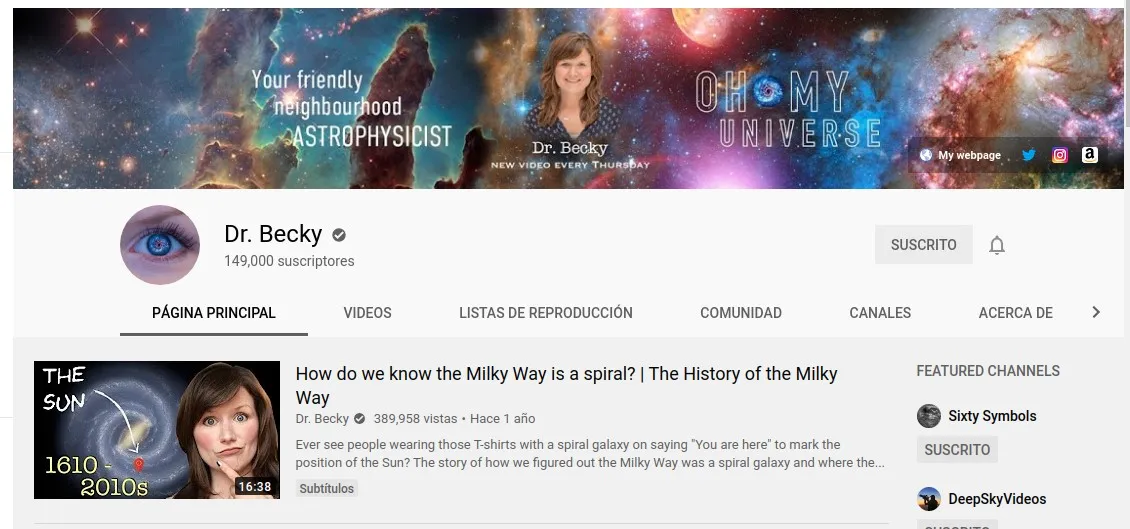
There are some channels by Spanish-speaking YouTubers and others in English, with subtitles, very good. As an indication, I point out some interesting channels:
Sabine Hossenfelder; Physics Girl; PBS Space Time; Up and Atom; Dr. Becky; DeepSkyVideos; El Robot de Platón; La gata de Schrödinger; QuantumFracture, Veritasium, among others.
Cosmos series
Both the original by Carl Sagan and the two seasons of its new version can be found on some documentary website (see links below). I do not recommend, however, series like the one presented and produced by Morgan Freeman.
SOCIAL NETWORKS
On Facebook there are groups of people who connect on different topics. Social interaction can be very good, despite the physical distancing. And, when the pandemic passes, it is always advisable to get in touch with local groups, astronomy clubs, to share experiences, look through telescopes, and make friends.
PLANETARIUMS
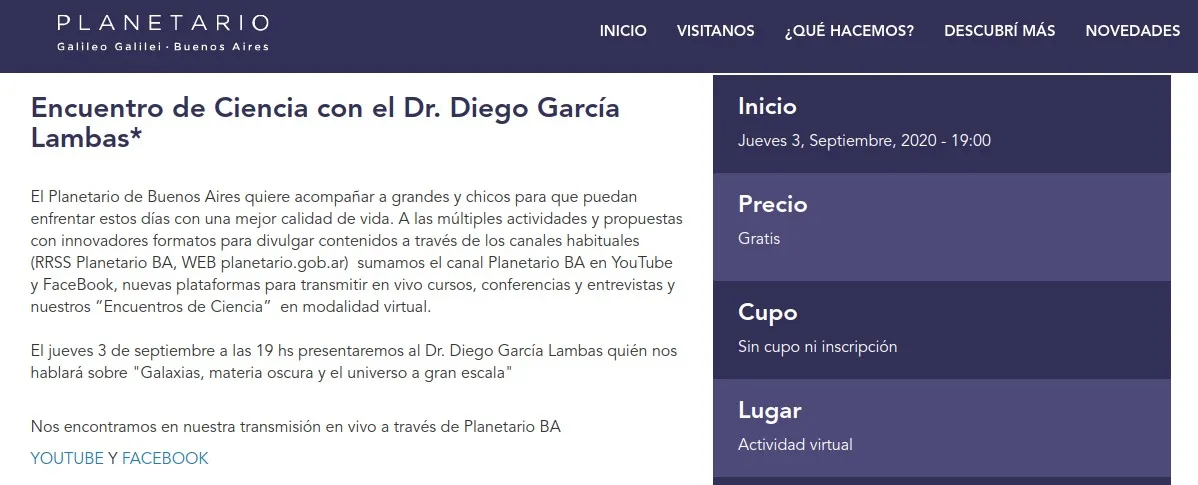
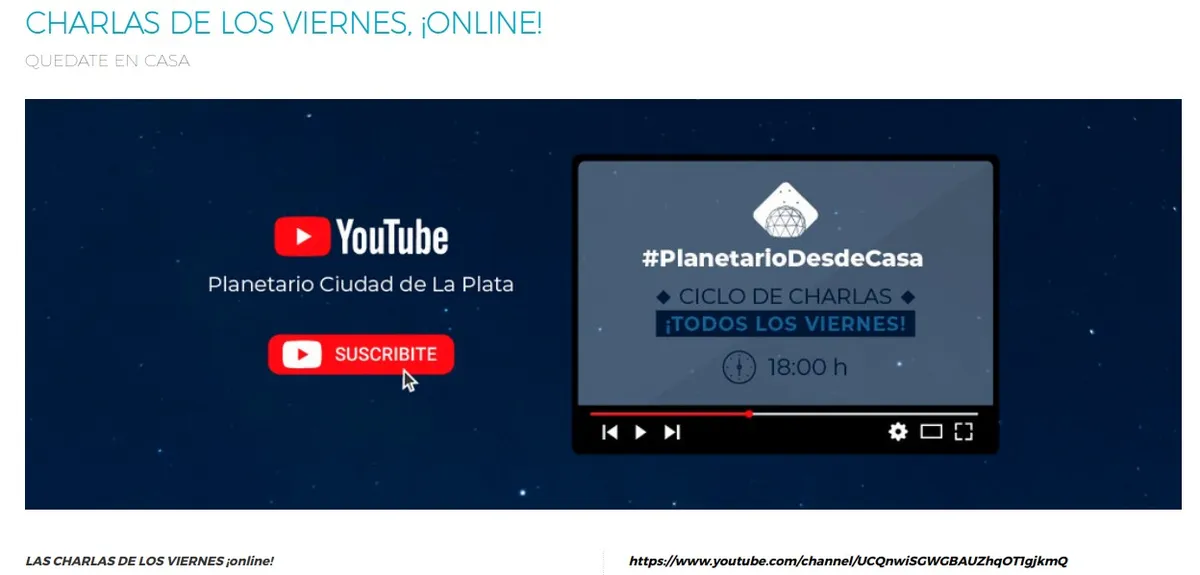
The Galileo Galilei in CABA is doing internet broadcasts of astronomy conferences. The next one announced will be on 9/3. At the Ciudad de La Plata, they hold the traditional Friday Talks, on Youtube.
Sources and related links
- ASARAMAS
http://amigosdelaastronomia.org/ - Planetario Galileo Galilei
https://planetario.buenosaires.gob.ar/ - Planetario Ciudad de La Plata
http://planetario.unlp.edu.ar/ - Maestría Oficial en Astronomía y Astrofísica
https://www.universidadviu.com/maestria-universitaria-en-astronomia-astrofisica/ - Documania TV
https://www.documaniatv.com/
About the images
Screenshots of the mentioned sites.