It will be dismantled due to the structural risks it has suffered since August from the breakage of two cables.

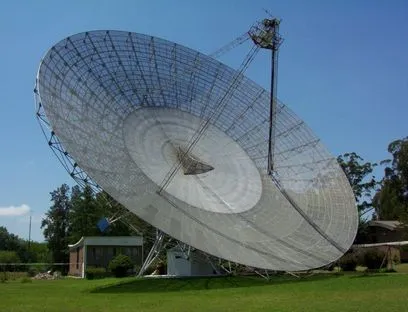
In an official statement, the NSF (National Science Foundation, of the USA) announced yesterday that they will begin plans to dismantle the radio telescope with the 305-meter antenna that, for 57 years, served as a world-class resource for radio astronomy.
The decision is made, they explained, by following the recommendations of engineers upon finding that the structural damage suffered in recent months cannot be stabilized without risk to construction workers and facility staff. It was found that the instrument is in danger of a catastrophic failure and its cables are no longer capable of supporting the loads for which they were designed. Furthermore, they state that any attempt at repair would put workers' lives at risk and that, even if repairs were carried out, there would be problems with long-term stability.
"NSF prioritizes the safety of workers, Observatory staff, and visitors, which makes this decision necessary, although unfortunate", said director Sethuraman Panchanathan.
Engineers have examined the radio telescope since August, when one of the support cables broke. NSF authorized the University of Central Florida (UCF), which manages the facility, to take reasonable steps and use available funds to resolve the issue. Engineers designed and were about to implement a stabilization of the structure of the auxiliary cable system. While they were waiting to receive two replacement cables, as well as two temporary ones, a main cable also broke on the same tower, on November 6. With the stress from the second failure, engineers concluded that the remaining cables are probably weaker than expected.
Plans focus on dismantling the antenna, but preserving other facilities such as LIDAR and the visitor center. Some operations such as the analysis and cataloging of data collected with the telescope will continue. UCF secured cloud storage in 2019 and will migrate servers out of the affected area.
NSF recognizes the cultural and economic significance the Observatory has had so far for Puerto Rico and plans to work with that country's government to use the Observatory's resources for educational purposes.
Engineering summary
The Arecibo Observatory consists of a 305-meter antenna with a 900-ton platform suspended 137 meters high via cables connected to three towers. On August 10, 2020, an auxiliary cable failed by slipping out of its support on one of the towers. Work was underway on its possible repair with spare cables when a main cable from the same tower broke on November 6.
Subsequently, engineers found that this 3-inch main cable broke at approximately 60% of what should have been its minimum breaking strength during a period of calm weather, increasing the possibility that other cables are weaker than expected.
Inspections found breaks in more cables and evidence of slippage in other auxiliary cable supports, added during the 1990s when weight was added to the instrument platform.
Arecibo in popular culture
The radio telescope appeared in films, such as GoldenEye (Martin Campbell, 1995) and in Contact (Robert Zemeckis, 1997).
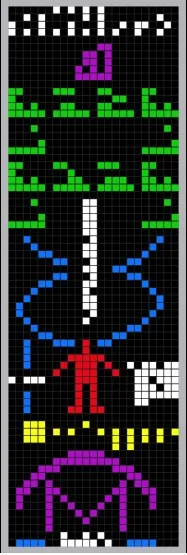
In 1974 (on November 16) a message was sent toward the globular cluster M13 and the data collected with the instrument is used in the SETI@home project.
It has been an iconic radio telescope in the search for extraterrestrial intelligent life that was not immune to the vagaries of weather and gravity. A shame it could not be repaired. Interestingly, in the city of Arecibo, there is a community called "Buenos Aires"☉
Sources and related links
- NSF begins planning for decommissioning of Arecibo Observatory’s 305-meter telescope due to safety concerns
https://www.nsf.gov/news/news_summ.jsp?cntn_id=301674 - Arecibo Observatory Telescope to be Decommissioned After Second Cable Break
https://www.ucf.edu/news/arecibo-observatory-telescope-to-be-decommissioned-after-second-cable-break/
About the images
Photo Credit: UCF
Message Image: Wikimedia: Arecibo Message. Colors were added to highlight the different parts. The original message does not contain color information.