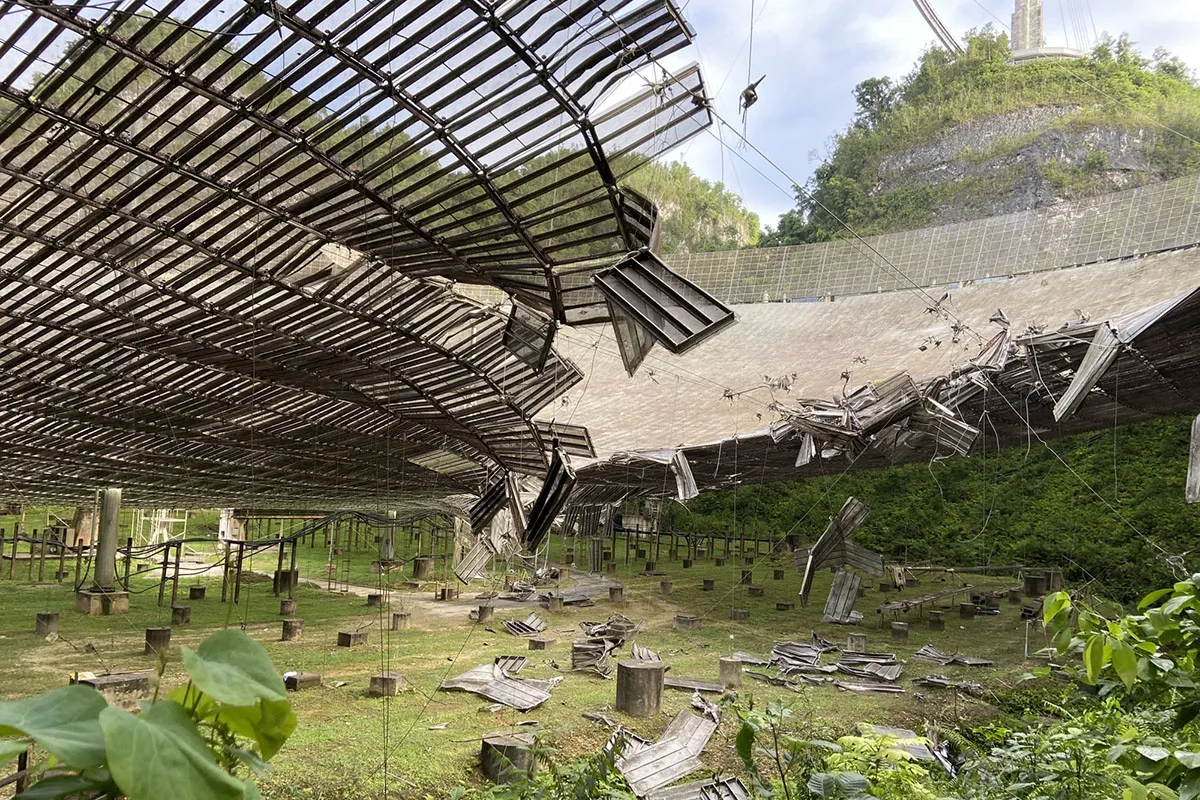
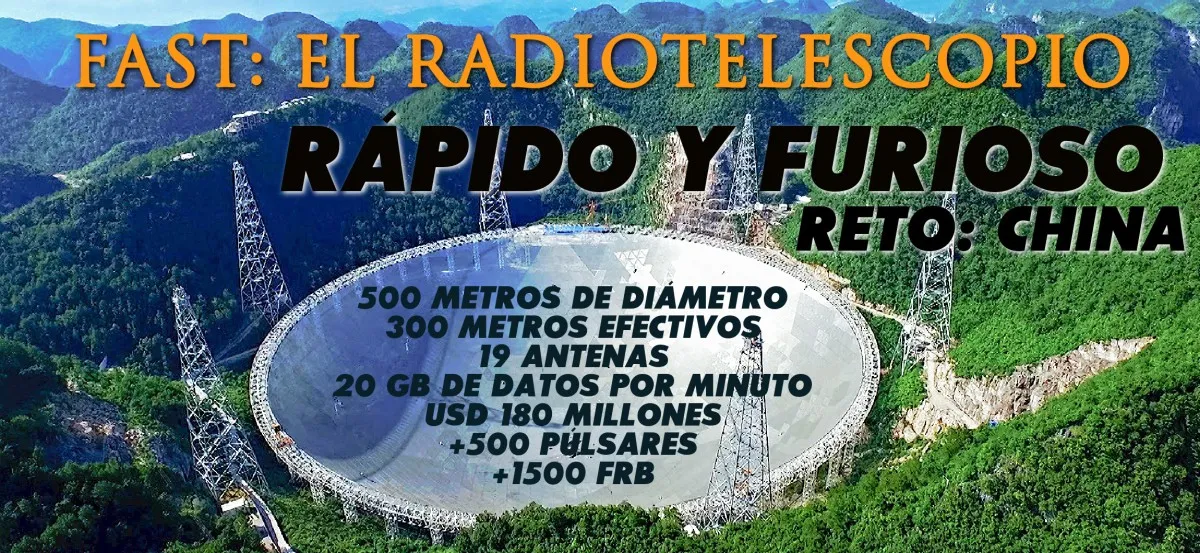
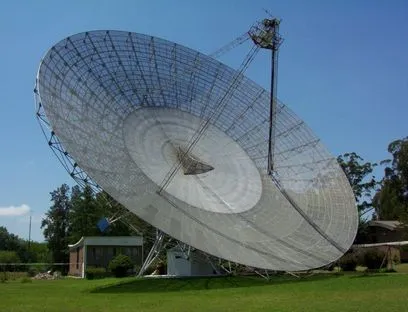
It's not a new idea, but it's gaining strength again: lunar radio astronomy.
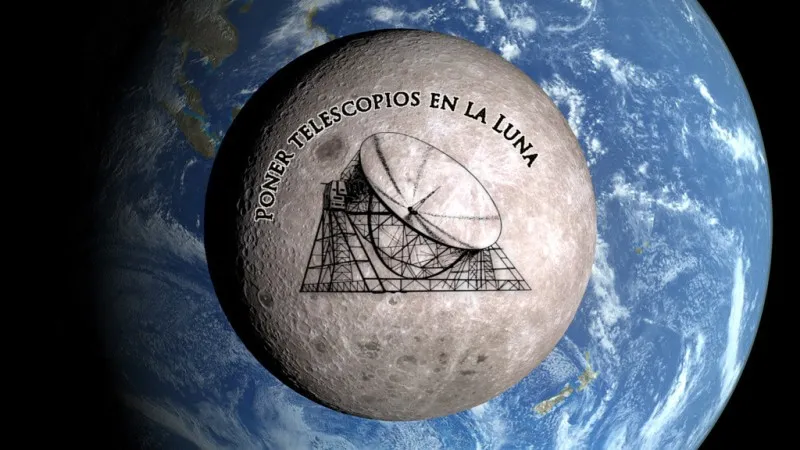
In an article published in Nature, astronomer Joseph Silk considers that the plans to return to the Moon are getting serious, not only because of Donald Trump's recent announcement, but also because of the aspirations of Europe and China. But, similarly to what was said on this blog recently, those plans are more economic (private business) than scientific.
So he makes a proposal: A lunar radio telescope on the far side of the Moon. Surface radio telescopes find a lot of interference from the electromagnetic pollution of human activity and the Earth's ionosphere blocks the longer waves. Low radio frequencies would be a good way to study the imprints of the Big Bang.
The study of the cosmic microwave background radiation has been very useful for understanding the early universe, for which, according to Silk, it is necessary to observe the building blocks of galaxies: the hydrogen clouds.
In 1944 astronomer Hendrik van de Hulst theorized a way to detect interstellar atomic hydrogen based on the change in atoms at the frequency of 1420.4 MHz, a wavelength of 21.1 centimeters. This method is widely used today. The same principle could be used to map distant hydrogen clouds because cosmic inflation would have left its mark with small perturbations in the distribution of clouds.
These distant signals are stretched by the expansion of the Universe to frequencies lower than 30 MHz with the difficulties of detecting these signals from the surface.
Verifying or falsifying inflation theories would be very important because they are part of the standard cosmological model.
Silk adds that infrared telescopes could be built in cold craters near the lunar south pole. Without an atmosphere to absorb radiation and block signals, lunar telescopes would achieve very sharp images of exoplanets and the oldest galaxies. The astronomer dares to say, moreover, that the cost of these telescopes would not be more than 5% of other planned lunar operations.
I think it's a proposal that should be seriously studied. The plans to carry out mining on our only natural satellite will benefit the same ones as always, those who already do mining on Earth, and lunar tourism will be for the rich. The possibility of establishing bases on the Moon is, for now, more fiction than science, not only because new technologies would have to be developed and difficulties overcome, but mainly because there is no clear scientific objective in such an undertaking.
Just as on the International Space Station there are astronauts who go to perform experiments and then return, there could also be regular expeditions to the Moon to operate, maintain and repair the telescopes, even though they could also be operated remotely. There would be several things to think about, such as ways to protect the equipment from cosmic and solar radiation, the most suitable location, and other technical aspects such as energy storage.
Jillian Scudder, an astronomer at the University of Victoria, published an analysis on the topic in Forbes, adding that there is already a UV telescope on the Moon left by the Chinese in 2013 with the Chang'e 3 probe, but left on the near side of the Moon to facilitate communication.
The Moon is an ideal place to put telescopes, but not of any type, considering the temperatures. Optical telescopes would have a lot of sunlight for two weeks, with high temperatures.
Therefore, like Silk, she concludes that the best class of telescopes for the Moon are radio telescopes, also considering the communication issue. The latter is very important: one possibility is to place a satellite around the Moon that functions as a link between the lunar telescopes and Earth.
It is necessary for the scientific community, particularly the astronomical one, to develop plans because, sooner or later, the powers will settle on the Moon and it is preferable that they do so with scientific plans that improve the understanding of all humanity and not just extract benefits for a few.
Sources and related links
- 18-Months Operation of Lunar-based Ultraviolet Telescope: A Highly Stable Photometric Performance
Wang et al (2015)
arXiv:1510.01435 [astro-ph.IM]
https://arxiv.org/abs/1510.01435 - NATURE: Put telescopes on the far side of the Moon, by Joseph Silk
https://www.nature.com/articles/d41586-017-08941-8 - FORBES: Could We Put A Telescope On The Far Side Of The Moon?, by Jillian Scudder
https://www.forbes.com/sites/jillianscudder/2017/08/24/astroquizzical-moon-telescope/#2bcba0f92437
About the images
Credit: NASA Ernie Wright (USRA)
https://svs.gsfc.nasa.gov/11747
Openclipart: https://openclipart.org/detail/275005/radiotelescope