A copy of "Te lo resumo así nomás", astro-ph version.
Astrobites published an article about Journal Clubs. What is that?
A large part of the time that professional astronomers dedicate to their work is used to read new articles published in science journals, called Journals. Given that the time dedicated to this purpose is a lot, sometimes reading groups are formed, that is, groups of astronomy-undergraduate students who get together to share the reading of new papers.
The idea is that each group will have some cut of the object of study or syllabus, and then each member of that "Club" reads an article on their own. On the day of the meeting, each individual tells in their own words what the article they read is about. And the rest do the same. In this way, instead of everyone reading everything, the task is divided.
In the Astrobites article they say that, acontrario sensu, Journal Clubs could be a waste of time instead of a saving of effort, but that this can be avoided with some tips they give.
In previous notes on the graduate student astronomy site, they offer suggestions on how to read papers. Science is so specialized that an article on planetary astronomy or galactic morphology contains jargon+methods that only the professionals who dedicate themselves to that métier use. So not only do laypeople end up spinning like a top when reading a paper, but also the scientists themselves.
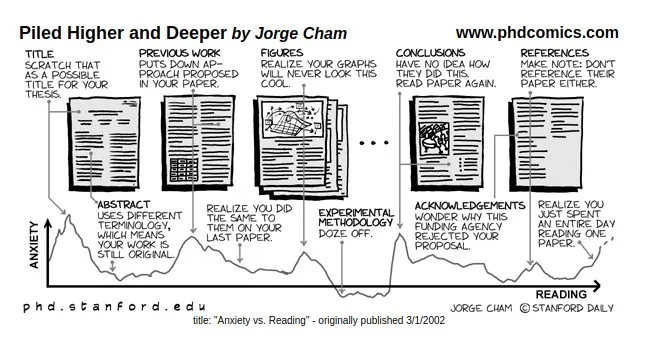
However, it is also not necessary to understand each and every part of a paper to know what it is about. In the web comic strip PhD Comics by Jorge Cham, the vignette "Anxiety vs. Reading" was published in 2002. It says: "Conclusions. You have no idea how they did this. Read the paper again." And it also indicates at the end: "You realize you wasted the whole day reading just one paper."
With this context...Would an "Te lo resumo así nomás" astro-ph version be so far-fetched?
Astro-ph is a tag or label used in the digital repository ArXiv to indicate astrophysics articles. The papers hosted there are called "drafts" or "preprints" which literally mean "drafts" or "pre-prints". They are articles as they were submitted to a journal (or not submitted) before they are published, that is, prior to peer review. Given that the review system can take a long time, researchers chose to pre-publish their work before the process finishes. It is a way to avoid someone beating them to the punch with a discovery.
"Te lo resumo así nomás" is a YouTube channel that summarizes the content of a movie or series.
Therefore, combining both things would imply a summary of the works published in the most important astronomy journals + ArXiv preprints, although done by people who know, like advanced undergraduate and graduate students.
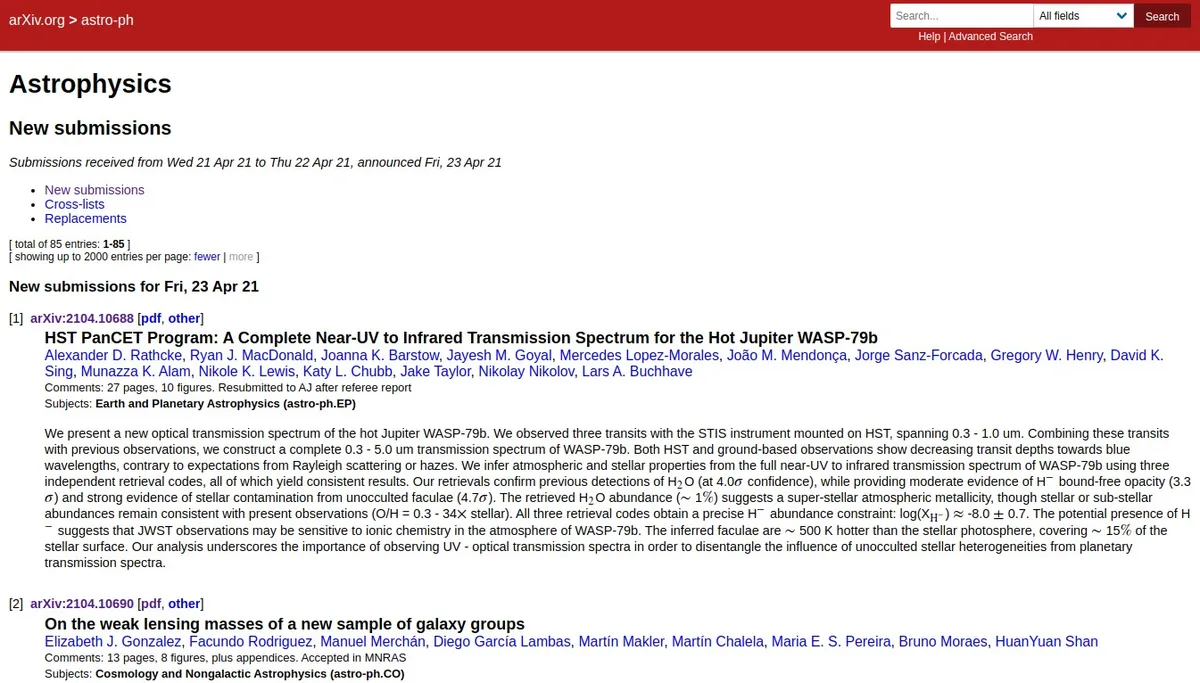
The first problem with doing this is that a lot is published. For today, Friday, April 23, there are 85 publications in astro-ph. It is true that this includes replacements, that is, previously published articles, updated with a new version. If we discard those replacements, there are 48.
The cut of the syllabus can be done, in the case of ArXiv, using specific tags: Earth and Planetary Astrophysics (astro-ph.EP); Cosmology and Nongalactic Astrophysics (astro-ph.CO); etc.
ArXiv is not the only digital repository. A very famous and used one is NASA ADS (Astrophysics Data System).
Searching and finding the appropriate articles for the topic of interest, new, for each day-week or desired frequency, is already a small job. But after finding the papers, they will have to be read.
There are some series on cable TV, like "Secretos de la NASA" on Discovery Channel that, although based on professional research, is made with a sensationalist criterion, like almost all TV.
On online video platforms, like Netflix, there are a few docu-series on astronomy (and many more on pseudoscience). There are other specific documentary platforms. Perhaps one could think of an online platform for scientific content that could include a weekly astro-ph. That is, a summary of the published works (not exclusively on ArXiv). This same thing can be done on YouTube channels.
The term "Astroflix" has already been appropriated by astrology, unfortunately. But one could use "Astrophlix" which sounds the same and includes the ph.
We are, increasingly, an audiovisual society. We must not neglect the fact that we got here thanks to reading and writing. It is not about stopping reading, but about concentrating our cognitive effort more efficiently. But...Would it have commercial viability?
As Michael Penn says: "I think this is a good place to stop."☉
PS: Did you notice that in one of the images there is a recently published paper by astronomers from Córdoba?
Sources and related links
- Anxiety vs. Reading
http://phdcomics.com/comics/archive.php?comicid=287 - Journal Articles in Astronomy
https://astrobites.org/2011/04/19/journal-articles-in-astronomy/ - How to successfully start and run a journal club
https://astrobites.org/2021/04/23/how-to-start-a-journal-club/ - NASA ADS
https://ui.adsabs.harvard.edu/ - Answering viewer questions.
https://www.youtube.com/watch?v=hBRv5nZzkz4&ab_channel=MichaelPenn
About the images
Screenshot of YouTube channel TLRAN and ADS logo.
Vignette: Jorge Cham - PhD Comics.