Reflections on astronomy and the internet in these times.
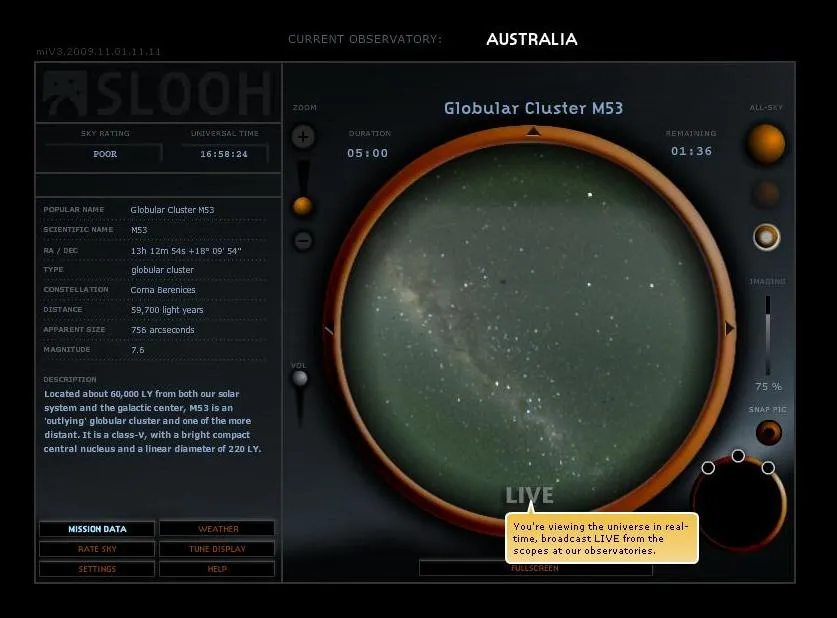
A reader sent me this question via the blog's Facebook page as a message. It took me a week to think of some answer and when I finally replied I said I would give the answer in the form of a post. I clarify that I am not referring to astronomy education, nor to sites with multiple resources, but to observing via the internet and, in some cases, TV.
The question is similar to others that some people have been asking themselves for a couple of decades, namely:
-Is journalism on the internet journalism?
-Is TV on the internet TV?
The inclusion of the internet in all these questions leads me to a paper written by a professor at the faculty [1]. In the text, the academic argued (in my words) that the internet had dislodged things to put them in their place. We had believed that television was what was transmitted through television sets, that is, a technological definition of communication, not a social one, in which each medium is defined by its technical characteristics. If that were really the case, now, in the era of "convergence," then we can no longer distinguish one medium from another, given that the technical media are the same: the internet.
If we define astronomy as a social practice that includes both direct observation, with the naked eye, and observation through instruments, of celestial objects, then why wouldn't astronomy on the internet be astronomy?
Note, furthermore, that the way of asking the question is already somewhat contradictory, but let's leave that linguistic issue aside.
It will be said to me that, analogous to the "ontological degradation of Being" in Plato, astronomy on the internet is the shadow of the shadow of the shadow, that is, one more degree of degradation with respect to traditional astronomy. According to Plato, the only real and true, pure and perfect things were the intangible ideas whose imperfect copy was matter. But those imperfect copies in turn had other imperfect copies.
The pure idea of tree the tree the shadow of the tree the photo of the tree the drawing of the tree the diagram of the tree
At each step we would be facing a degradation, a greater degree of imperfection.
To agree with Plato, one would have to agree that perfect, pure, absolute, immutable ideas exist.
Since that is not my case, I cannot agree with the great Greek thinker.
Is a diagram a degradation? Whether it is or not, diagrams or charts are very useful.
"Traditional" observation has been, until the 16th century, simple, with very few instruments. Only at the beginning of the 17th century did the telescope appear. Therefore, we could take an imaginary "journey in time" and ask this same question at that moment: is astronomy by telescope really astronomy?
Today no one would doubt the answer, but perhaps back then they would.
Astronomy on the internet implies no longer observing through the eyepiece of a telescope, but a screen.
Don't professional astronomers do exactly that nowadays?
If the answer to the question were that astronomy on the internet (therefore virtual, therefore, visualization on screens) is NOT really astronomy, then professional astronomy would no longer be astronomy.
It will be said to me that, however, although professional astronomers no longer put their eye to the eyepiece, there are those who do: the technicians, who, with the instructions of the academics, acquire the data that the professionals analyze.
With sites for doing astronomy on the internet, both things can happen: some have technical operators (or are automatic) so the user has almost no control; but others, on the contrary, do allow the user to guide the instrument, remotely.
SELF-CRITICISM
In several posts I have argued here that modernity is not truly modern. At bottom, the problem is the same, that is, I could ask myself: is modernity really modern?
This shows that although one aspect of the problem presented seems to be technological, at bottom, it is not. It is a problem that involves knowing how to discern what is the same from what is different.
I will give another example. There are those who argue that communication only occurs when the meaning the sender gives to their message is the same meaning the receiver gives it. I emphasize: exactly the same meaning. But that NEVER happens.
The consequence is that, starting with myself, we must review our ideas. What follows is a proposal.
THE CONTRADICTIONS
Human relationships are contradictory. Such contradictions occur in reality. When we want to hide such contradictions we want to hide reality.
Modernity is modern, even though it has a bunch of ancient or questionable elements. Modernity is contradictory. By pointing out that therefore modernity is not modern I have tried not to deal with that contradiction. It has been a mistake. The contradiction exists, it is real. Modernity is modern and it is not, at the same time, in different senses.
Communication is contradictory: sometimes we understand each other more, other times less. Communicating is not only the "good" or the "efficient," it is also the opposite.
Journalism is not only what I consider "good journalism," but also what I consider "bad journalism." Recently websites like Clarin.com and lanacion.com published as true the false news that CNN had broadcast pornography. Clarin.com deleted the content from its website, although records remain.
Is journalism based on social media really journalism? The previous example is relevant because the "news" arose from a false tweet that the media took as good, without cross-checking. The media blindly believe a Twitter user, without verifying the information.
This is not new. It is not something that has happened since the internet existed. Journalism based on social media is the SAME as previous journalism in many senses and different in others. The difference is more in form than in content.
Despite this, isn't it also true that the new media on the internet allow us to learn about events more quickly or allow us to share content with more people? And isn't that also an advantage?
Therefore, the internet is a sum of technologies that, in themselves, are neither good nor bad. It depends on how they are used socially, as has always been the case with all technology. And human relationships do not change "essentially" through the incorporation of technologies. There seems to exist in today's social discourse a restoration of Luddism that blames the lack of work on technical progress. It is not a technical problem, it is an economic and political one.
TECHNICAL REPRODUCIBILITY
If we take Walter Benjamin's discourse on the reproducibility of art [2], we could consider that certain technologies distance us from reality as singularity and experience. Theater, for example, implies that each performance, even if the same script is performed on the same stage, will be different. In contrast, in cinema something else happens: the same film is identical in any theater.
With the internet, that is, with virtuality, experience would also be lost, or, to put it better, the experience changes from being active to passive, from being more direct to being more indirect.
Visual amateur astronomy has until now been more direct in that it implies going out to observe, thus making direct contact with the external reality, albeit with the use of instruments like binoculars or telescopes.
Current virtual visual astronomy implies observing a screen, the same screen to "rule us all" (à la Tolkien), but which is also an "individual" screen in our home, as also happens with cinema and TV (Netflix and others). We live in a society not very distant from the one imagined by Bradbury in "Fahrenheit 451"[3].
Conversely, note should be taken of the phenomenon of observing astronomical events via the internet: at the same time that it is an individual experience, it is also collective because it involves "live" broadcasts. Astronomy has always been tele-vision, especially with the telescope, but now even without it on the part of the "users" of instruments transformed into consumers of screens.
The "technical reproducibility" in astronomy had already begun to occur with the motorization of telescopes which, through GoTo mounts, allow operating the instrument via a control so that it moves in the appropriate direction, without the operator having to deal with object recognition or knowledge of coordinates.
Therefore, it could be argued that virtual astronomy (understood this way) would imply an "easiness," a disconnection from reality, a more passive action, less singular and more standardized.
Easiness, however, should not only be looked down upon. Debates in computing about operating systems can be illustrative: just as there are users who want to have more control, for which they also need to have more knowledge about how the software works; others only want to use it and for it to be simple (when the former would be difficult). We could say something similar about operating phones and cameras.
At the same time, a part of the so-called "middle class" rekindles a romance with past technologies (which seems to respond more to boredom, nostalgia, and clearly to a business niche for the well-off).
APOCALYPTICS AND INTEGRATED
Umberto Eco coined these two terms linked to people's attitudes towards new technologies [4].
To place ourselves in either of these two positions implies assuming that technologies are intrinsically good or bad, convenient or not, regardless of the circumstances. If we adopted the apocalyptic (negative) position, we would have to renounce the internet, but also the telescope, which is also a technology. It wouldn't be very "progressive," but rather reactionary.
To assume the opposite, that is, to adopt the integrated (positive) attitude would be to consider that technologies are intrinsically good in themselves, which would also be an uncritical and idealistic stance.
Reality is contradictory. Technologies are a product of human beings who, although they may have been created with some specific intention, can admit various uses. And the uses can be, in fact are, contradictory.
Astronomy via the internet is neither more valuable, nor more valid, nor more real than "traditional" astronomy, and vice versa. It depends on the social use we give to existing technologies and the objectives we have.
On the other hand, professional astronomy is also virtual today, as there are "virtual observatories."
We should then ask ourselves what meaning we want to give to astronomy and what use we make of the available technologies.
OUTREACH: IS MORE LESS?
It seems that the idea still exists in social discourses that the popularization-massification of astronomy seems to add quantity, but subtract quality.
Events like the "supermoon" can be a good example. Many of us think it is an exaggeration that tries to transform something ordinary into something spectacular.
However, I don't believe that popularization-massification is the problem, but rather the mode, that is, how such social practice is carried out in relation to its objectives.
The dissemination of astronomy could be defined in principle as the attempt to reach a large number of people who are not familiar with such practice. This, in itself, is not bad at all. The question is whether that is the only objective.
Therefore, outreach in astronomy can have various aims. Outreach in itself is neither good nor bad. In any case, we could be in favor of giving it one meaning or against giving it another, but in both cases it will be dissemination. (Here we could differentiate between disseminating and popularizing).
The massification of astronomy through new technologies has an objectionable side linked to "false" spectacularity [5].
But it doesn't necessarily have to be that way. Modern astronomy (also ancient) does not have a single social meaning: there are those who want to contemplate the sky as if it were a work of art; there are those who want to understand what they observe (which implies a layer of rationalism); there are those who consider that even amateur astronomy should have a scientific utility (that is, produce sufficiently precise data); etc.
In my view, in any case, astronomy should be a critical practice, which implies not taking things for granted and trying to understand them.
If that is achieved with "virtual astronomy," I see no problem in using new technologies for that purpose.
Is that really necessary? I often come across people who still don't understand how it's possible for the moon to rotate on its own axis and for us to observe only one "face." And the simplest way to explain it is not with a definition (the rotation period is the same as the orbital period), but visually, for example with drawings or videos. That is, with shadows of shadows, with diagrams that, in some cases, are much more useful than other forms of communication.
IS THE MEDIUM THE MESSAGE?
Marshall McLuhan's famous phrase has been used in many ways. In my opinion, it assumes that the intrinsic characteristics of technologies are what determine their social use. However, the social use of media depends on a bidirectional relationship between the sender's objectives and the receiver's expectations. The latter conditions the former. If the blog reader "expects" (that is their expectation) a very simple and short post and I offer them a more complex and longer one, I may have the best intentions, but they will sink into nothingness. Yet, no one is born with expectations. And to the extent that we conform to historically constructed expectations without proposing alternatives, those expectations solidify into traditions. But changing expectations does not depend only on offering different content. They are constructed socially through the educational system, family, and all the institutions of a country. It is no less true that audiences have been underestimated and are not as homogeneous as is sometimes assumed.
CONCLUSION
Therefore, astronomy on the internet is astronomy. It may seem better to us for some things and not so much for others. We cannot become fundamentalists of the blackboard or tablets, regardless of objectives and results.
But we must also consider what the expectations of the population-audiences-publics are. If audiences have an expectation and we want to give astronomy a different meaning, there will be communication and a lot of noise, we will not achieve our objectives.
Therefore, perhaps what needs to be reviewed are the expectations of the audiences. We have become "expectators," spectators with expectations linked to trivial information and spectacle.
Astronomy does not require exaggerations to be grandiloquent.
Is it necessary to lie to tell the truth? Sometimes, yes. Explaining an atom as a miniature solar system can be a useful step in understanding what an atom is, but it is an idea that has been surpassed and is now considered false. Similarly, we could pose the concept of the "celestial sphere."
In both cases, however, there will be a didactic and critical attitude that is absent in many mass discourses.
At the same time, large portions of the world's population live in urban centers polluted by light pollution and smog and with the obligation to work schedules that can greatly limit our material possibilities of going out to observe under dark skies.
It also happens that we want to know things now, for free, and without effort (and in HD, please). If the media tell us what the supermoon is, why bother thinking if it's really like that? The internet says it, it must be true, seems to be the motto of late modernity, even for those who "preach" the opposite (as I indicated above about the fake CNN news).
That's why, deep down, the issue is whether we want to think critically about reality or not. Whether we use this or that technology will be important, but secondary. The importance lies in knowing if with such media we can achieve our objectives.
Isn't modernity supposed to necessarily imply a critical attitude, à la Galileo, on any topic?
It is supposed. But reality is different. We are modern even if we act differently because modernity is contradictory. And astronomy, as a social practice, is not outside social contradictions.
Sources and related links
[1] AVATARES de la comunicación y la cultura, No. 2. ISSN 1853-5925. August 2011
A SOCIAL DEFINITION OF MEDIA (The aging of its technological versions)
José Luis Petris and Rolando Martínez Mendoza*
http://ppct.caicyt.gov.ar/index.php/avatares/article/view/2242
[2] The Work of Art in the Age of Mechanical Reproduction, Walter Benjamin.
[3] No es 1984, es Fahrenheit 451, By Jose Carlos León | 20.06.2013 http://www.cookingideas.es/no-es-1984-es-farenheit-451-20130620.html
[4] Umberto Eco. Apocalípticos e integrados. Barcelona: Lumen. 1965
[5] The frequency of the unrepeatable in astronomy http://www.noticiasdelcosmos.com/2016/06/la-frecuencia-de-lo-irrepetible-en.html
Telescopes to use via the internet http://www.noticiasdelcosmos.com/2010/04/telescopios-para-usar-por-internet.html
About the images
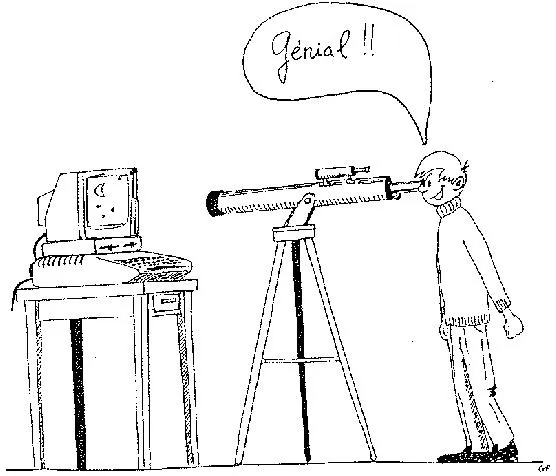
Drawing by Georges Paturel in INTERNET SERVICES FOR PROFESSIONAL ASTRONOMY, Heinz Andernach https://ned.ipac.caltech.edu/level5/Andernach/Ander_contents.html