Response to a reader about mainstream vs. alternative science.

A reader from Colombia writes to me to say that after reading the blog he came to the conclusion that I only endorse "mainstream" ideas, that is, the dominant scientific ideas, those with the supposed greatest consensus; and that therefore I reject alternative ideas. Although he says it in his own words (with many spelling mistakes), he almost accuses me of being an "agent of the U.S. Embassy."
In particular, the person writing to me points out my adherence to the dominant ideas about:
1-The Big Bang
2-The Moon landing
3-The denial of UFOs as ET spacecraft.
This is not the first time I have received an email of this nature, although it is not usual either. But if in these years there have been at least 3 emails saying something similar, it is logical to assume that there must be more people who think the same, without saying it. I think it's time to write down a response.
I-THE STANDARD MODEL
A book that has positively impacted me was "Lonely Hearts of the Cosmos," by Dennis Overbye. In the work, the NY Times journalist recounts on one hand the life of Allan Sandage as Hubble's successor; and on the other, a series of discussions at cosmology congresses about determining the fate of the Universe: whether it would expand forever or begin to contract, everything depended on the Omega parameter.
We could well play with the concept of the juvenile "Choose Your Own Adventure" books. It goes like this: let the reader choose which of these universes you would prefer:
A-An infinitely expanding universe
B-A contracting universe
In my small personal survey, over the years, I find that those who have answered me have chosen the first option and always with the same reason: if the universe expands forever, then life will always exist. Unfortunately, this is false. On the contrary, if the universe expands without ceasing, its "heat death" is guaranteed.
If it contracted, life would not last forever either.
In a static universe, where the Second Law of Thermodynamics exists, the fate will be the same.
Wishing how we want the universe to be is childish, as it has no consequences. We cannot change it. What we can do is try to know how it is, but our desires play no role, except to cloud our judgment.
Therefore, I have no ideological preference regarding whether the universe is this way or that. It's all the same to me, since my desire changes nothing. The Universe doesn't care.
Mainstream or dominant theories were not always so. The Big Bang was an alternative to the Steady State Theory from 1929 until 1964, when the Cosmic Microwave Background (CMB) was discovered.
Similarly, in a Thomas Kuhn fashion, we moved from thinking the Earth was the center of the universe, to then thinking it was the Sun, then the Milky Way, etc.
Theories that are alternative today may perhaps cease to be so and become "normal." Perhaps in a few decades, the dominant place currently held by dark matter theory will be occupied by MOND theory. If dark matter continues to go undiscovered and MOND theory solves some of its problems, perhaps one will be better than the other.
Every theory will always have problems; it's not about finding a perfect alternative, but about finding an alternative that is better. The Lambda CDM model has problems, but the alternatives have more.
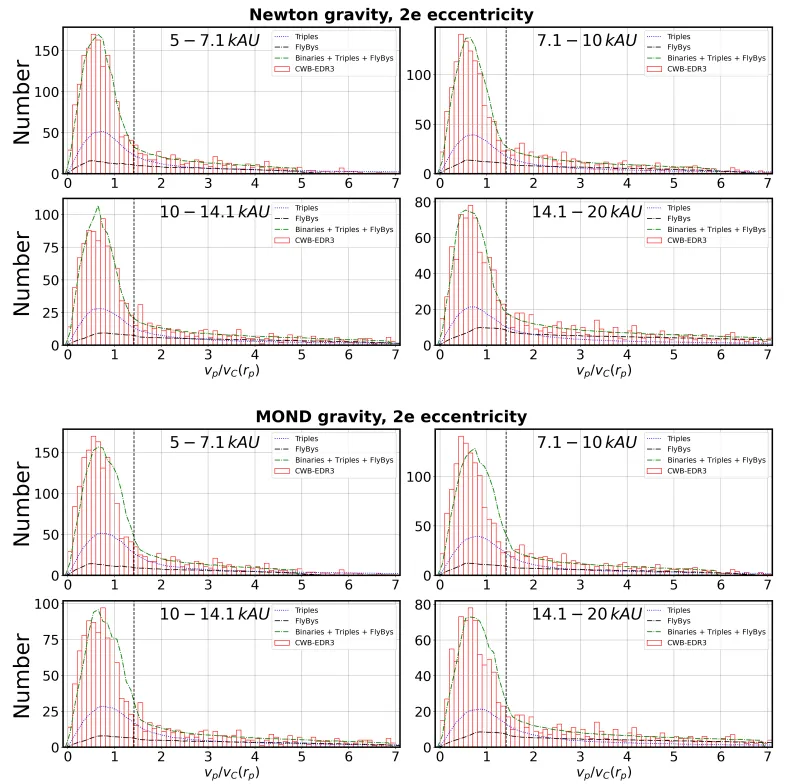
wide binaries, with slightly greater success for the consensus theory. Credit: Pittordis&Sutherland.
Electric plasma theory and the various alternatives to cosmological redshift (z) -including the one proposed by Einstein- have been known for several decades. Halton Arp questioned whether quasar z values were due to cosmic expansion and thought they could be due to other factors such as some scattering effect. It is true that there is no way to measure the distance to quasars and therefore the z value is used as a proxy for distance. Consequently, if the z value is not due (only) to expansion, then perhaps quasars are closer. But that does not invalidate cosmic expansion. The distance to closer galaxies is known using their own methods like the distance ladder (Cepheids, Type Ia supernovae, Tully-Fisher) and it is known that the farther away they are, the greater their z value.
Every so often particle physicists celebrate when they potentially discover a particle that would "break" the standard model. Why? For several reasons: they would become famous, win prizes and prestige, and it would be a way to advance.
The academic-institutional bias
It is true that there is an educational-professional bias: those who made the current theories taught them in universities and their students are now the professors teaching the same. But if I can learn about the existence of alternatives through the internet and books, so can others, right? The lack of funding for alternative research is also true, but as old as the world. The "Galileos" never had too much money, but they managed to make their way anyway.
II-THE APOLLO MISSIONS
What NASA and therefore the United States has said about those missions is verifiable. Why has no other country verified it until now? Because doing so implies spending a lot of money and has two possible outcomes:
A-Finding on the Moon what NASA left, verifying their claims.
B-Finding nothing, revealing a historic worldwide fraud.
If Japan, a country on which the U.S. dropped two nuclear bombs, sent a spacecraft to land on the lunar surface and took photos in the Sea of Tranquility and other Apollo landing regions and did not find what NASA said it left, it would be an event and Japan would be seen as a "Hero of the world" country. But there is a 50% probability that the only thing it would achieve would be to verify NASA's claims, for the sole benefit of the USA. Would the Japanese understand? I don't think so.
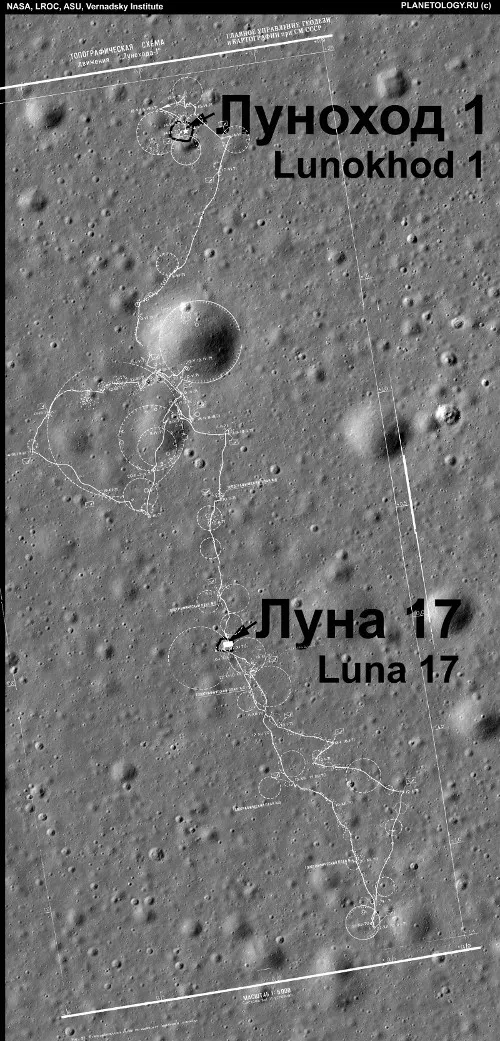
But there are two countries that are in different conditions. In the past, Russia said it had successfully accomplished the Luna 9 mission, which landed in the Ocean of Storms on February 3, 1966. I said it right, 1966! The unmanned probe took photos. The Luna 16 mission achieved the same in September 1970 and the next one, which carried Lunokhod 1, in November of the same year. With the same technology, Russia could have sent the same devices to the landing zones of the Apollo missions and put an end once and for all to all the diatribe about whether the U.S. had arrived or it was a hoax. It had all the political motivations to do so. Why didn't it?
Now, China is in the same conditions. Why doesn't it do it? Is it perhaps a conspiracy between the United States, China and Russia?
End of story.
III-Y KEEP ON WITH THE UFOS
There are few statements from scientific institutions that categorically deny or affirm the potential visit of ET with spaceships. NASA has indeed ruled out that there are "spaceships" from other worlds in photos and videos recorded by the agency. But it neither denies nor affirms anything about the videos, photos and testimonies of people about UFOs. Simply because it cannot. No scientist, neither astronomer nor of any other kind, can with certainty deny or affirm anything about it. There is not enough evidence.
My opinion, reflected in this blog, is not very different, but I go a step further: although I do not deny or affirm with certainty, I assert that the probability that UFOs are ET spaceships is very unlikely. Why?
A. One cannot travel at the speed of light (c).
B. We humans launch spacecraft into space at 60 thousand km/h.
C. 1% of c ~ 10 million km/h. Any civilization that achieves this will be more advanced than ours.
D. The closest trip -between Proxima Centauri and Earth- at 0.01c would take 400 years.
An analogy illustrates what I think about the matter:
I live in an apartment building, sixth floor. The electric doorbell works poorly: I hear the bell, but when I answer, they don't hear me. When they ring the bell I have to go down quickly, before the mailman thinks no one is home and leaves. Many times it happened to me that when I got to the ground floor, the person who rang the bell was no longer there.
Would it be logical to think that the person who rang the bell was a guy I don't know and who came exclusively for that, from Japan?
That would imply that the person traveled to a Japanese airport, took a plane for another 14 hours and then from the airport in Argentina to my home. Total: 16 hours minimum. Significant economic and energy expenditure. And all to arrive, ring the bell and leave within 60 seconds. Is that what an intelligent person would do?
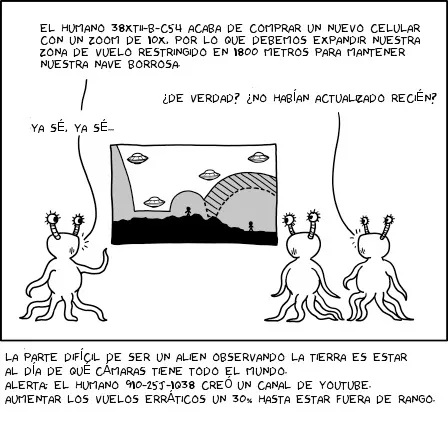
Well, that is supposedly what UFOs do. They come from who knows where, at a speed much greater than what we humans can achieve, which requires an enormous amount of energy and travel time. And they arrive, they barely let themselves be seen at night at the exact distance so that photos from cell phone cameras come out blurry, in front of people who previously believe in UFOs and then they leave, without saying hello. Are they afraid of us? Are they tourists? Are they shy?
Occam's razor says: "It's a story. Cut the crap." I say: "It is unlikely that this is the behavior of an intelligent civilization." It is not what astronomers say, who in general say nothing about it. It is logical that they say nothing. Saying the same as I would be politically incorrect, even if they think it. And not everyone thinks the same.
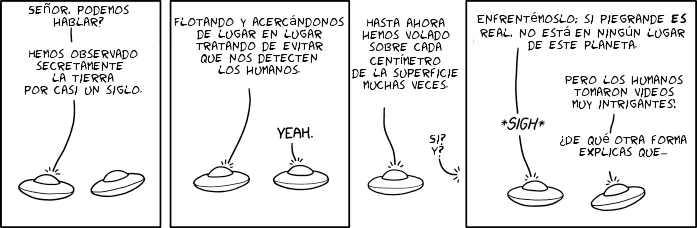
But I don't write this blog to make friends anywhere, that is, to please someone, let alone embassies. I am, as a professor once told me, somewhat parrhesiastic. Perhaps my cat should be named "Diogenes."☉
Sources and related links
- Neither prophets nor wise men: parrhesiasts!
https://www.pagina12.com.ar/diario/psicologia/subnotas/159531-51183-2010-12-30.html - From Lunar Recon. Orbiter, NASA - http://www.planetology.ru/lunokhod1position.php?language=english, Public Domain, https://commons.wikimedia.org/w/index.php?curid=16424866
- Defining Gravity: Can Wide Binaries be a Definitive Test of Modified Newtonian Gravity Theories?
https://astrobites.org/2022/07/23/defining-gravity/ - Pinchaglobismo: the UFOs
https://www.noticiasdelcosmos.com/2022/02/pinchaglobismo-los-ovnis.html
About the images
Graphic from: Wide Binaries from GAIA EDR3: Preference for GR over MOND?
Charalambos Pittordis, Will Sutherland
Alien Mission https://xkcd.com/2573/
Alien Observers https://xkcd.com/2572/