The necessary exercise of telling the truth.

The movie "Don't Look Up" (Adam McKay, 2021) has given us a lot to talk about. Regardless of whether we liked it or not, it put enlarged images under the magnifying glass of parody to that well-known maxim of the media: "Don't let reality ruin a good story." A similar phrase was used in the movie "Sex and the Single Girl" (Richard Quine, 1964).
The topic of UFOs does not admit ideological cracks: it is published as frequently on websites like those of Crónica and La Nación, considered populist and elitist, respectively.


It doesn't matter if what is said is true, nor if it is remotely possible. People read it, click on the web or their cell phone, there is an audience, it generates income. The truth, then, must not interfere with a good business.
However, reporting sighting cases is not bad in itself. The problem is that they leave the feeling that the unidentified objects would be ET spacecraft. This meaning is reinforced by supposed documentaries on cable channels and platforms about the Roswell case and "Ancient Aliens."
But there is another way of thinking: balloon-pricking.
The phrase "to prick the balloon" means: to show that an expectation or hope is false or highly improbable. It's the same thing that MythBusters or legend debunkers do.
I will try here, once again, to exercise balloon-pricking on the topic of UFOs, in a simple way, in a few steps.
Step 1: Probability
A very simple exercise to make something obvious clear.
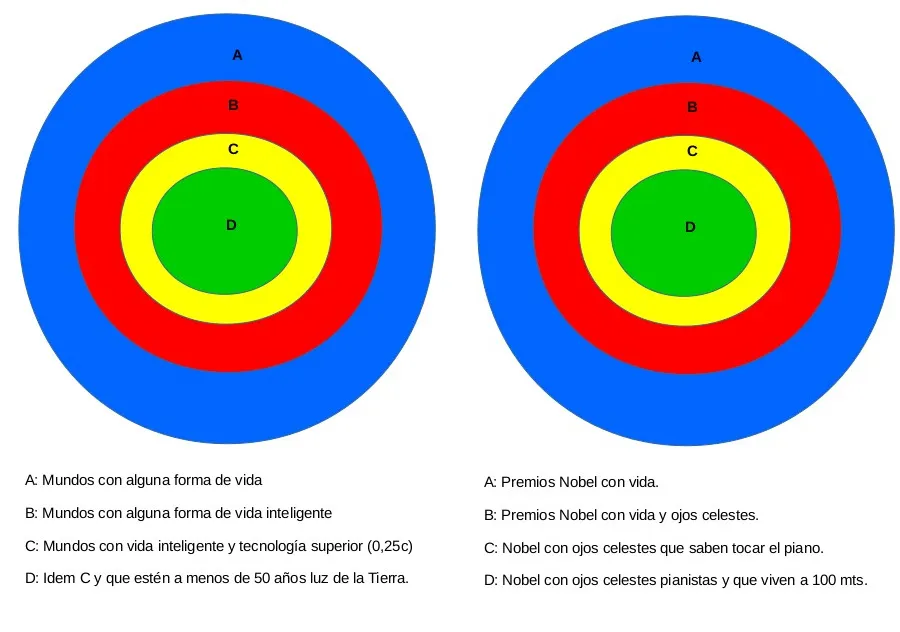
Juan's parents have brown eyes and both are musicians.
Which scenario is more likely?
1-That Juan has brown eyes.
2-That Juan has brown eyes and is a violinist.
It is evident that the correct answer is the first one, since the second implies a smaller subset.
To be clear: of all the people with brown eyes, only a small fraction will be violinists. Therefore, it is more likely that Juan belongs to the larger set than to the subset.

As we add criteria, the subset becomes smaller and therefore less probable. This is what happens with the "UFO hypothesis."
Distance is a restrictive criterion. However, it will be more or less so, in relation to speed. Let's look at both things.
Step 2: Speed
There are different ways to accelerate spacecraft.
The direct way is through rockets, that is, with Newton's Third Law. The momentum the spacecraft will have at the top of a rocket will be maintained in space by Newton's First Law.
Another possibility is to increase that initial speed, using gravitational acceleration when passing very close to planets. That is what NASA's Parker Solar Probe is doing now, which will reach a maximum speed of 800 thousand km/h when it gets closest to the Sun, at perihelion.
Let's use this value as the maximum possible speed for an interstellar journey. This value is, by far, lower than 1% of the speed of light.
As a consequence, any intelligent civilization with technology that allows travel at 1% of the speed of light will be FAR superior to current human civilization. Traveling at 1% of the speed of light implies that the journey will take 100 times longer than if traveling at 100% of that speed.
If a civilization managed to accelerate spacecraft to 25% of the speed of light, then their journeys would take 4 times longer than if traveling at 100% of the speed of light. The speed of light is called "c," but here I will abbreviate it as "VL" [Light Speed].
Step 3: Distances
The Milky Way is 100 thousand light-years in diameter, at least. On this galactic scale, 1000 light-years is one hundredth of the length of the galaxy. That is, it is a short distance in relation to the galaxy.
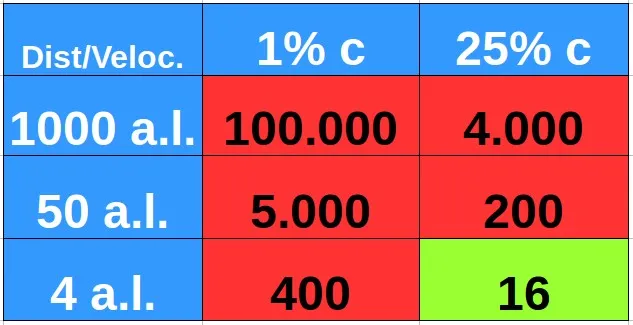
If a civilization lies 1000 light-years from Earth and travels at 1% VL, it will take 100,000 years to make the one-way journey. At 25% VL, it would take 4000 years.
If the distance were 50 light-years, at 1% VL it would take 5000 years and at 25% VL the journey would last 200 years.
If the civilization were 4 light-years away, at 1% VL the journey delay would be 400 years. At 25% VL, 16 years.
Of all the options indicated, only the last one is feasible. Which implies that only if there were an intelligent civilization with technology of at least 25% VL in the star system closest to Earth, would the UFO hypothesis be feasible.
Step 4: Photos and videos
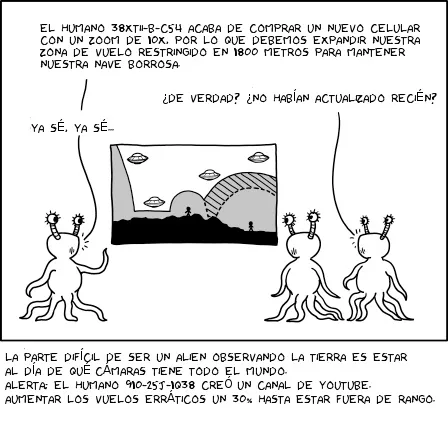
Despite what has been said, someone will ask anyway: But how do you explain the photos and videos of shapes and movements that are impossible to explain?
Let's do a thought experiment: take a photo from a boat at sea, during the day, while a seagull flies. Surely it will be difficult to realize in the photo that there is a bird, since it will come out blurry. The bird moves and our hand shakes the camera.
Now let's do the same, but at night, during a full moon. The sunlight reflected by the Moon is little, and even less the light reflected by the bird. For the camera to achieve the shot we will have to increase the exposure time. This, in turn, makes it more difficult for the shot not to come out blurry.
Now let's repeat the procedure, but with a thermal camera. With these cameras what you get is a heat map, which is not identical to the bird's silhouette. We will hardly be able to recognize the seagull in the photo. It will be an unidentified "strange flying object," but not a spacecraft from another world.
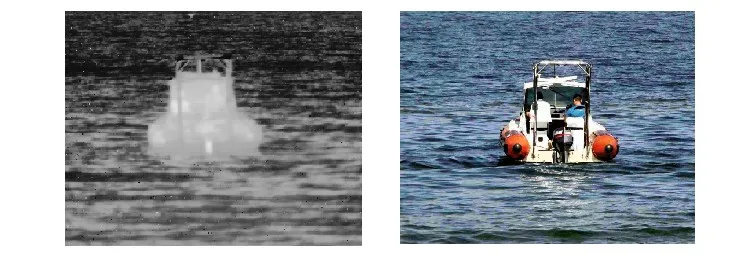
Similarly, it happens with movement. A video of a distant streetlight, at night, without sufficient lighting, without a tripod, will generate blurry images due to the cameraperson's hand shake, naturally or on purpose. And it will be difficult to realize if such movement is from the camera or the object, due to a lack of contextual references. Even more so if an infrared or thermal camera is used.
CONCLUSION
This reasoning does not allow us to conclude that an ET visit is impossible. But it does make it clear that it is very improbable. As improbable as a Nobel Prize winner with blue eyes who plays the piano living less than 100 meters from your house.
The photos, videos, and accounts of "strange" objects in many cases cannot be identified either by their shape or their movement, but that does not mean they are ships from other worlds.
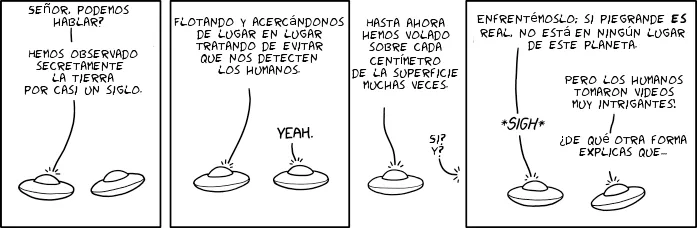
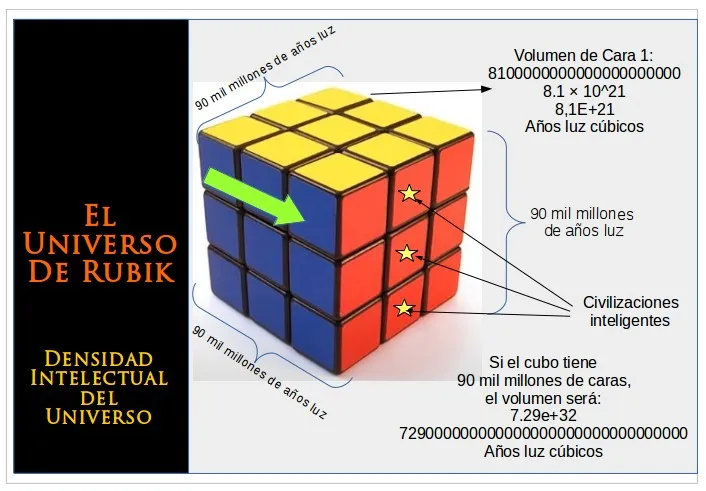
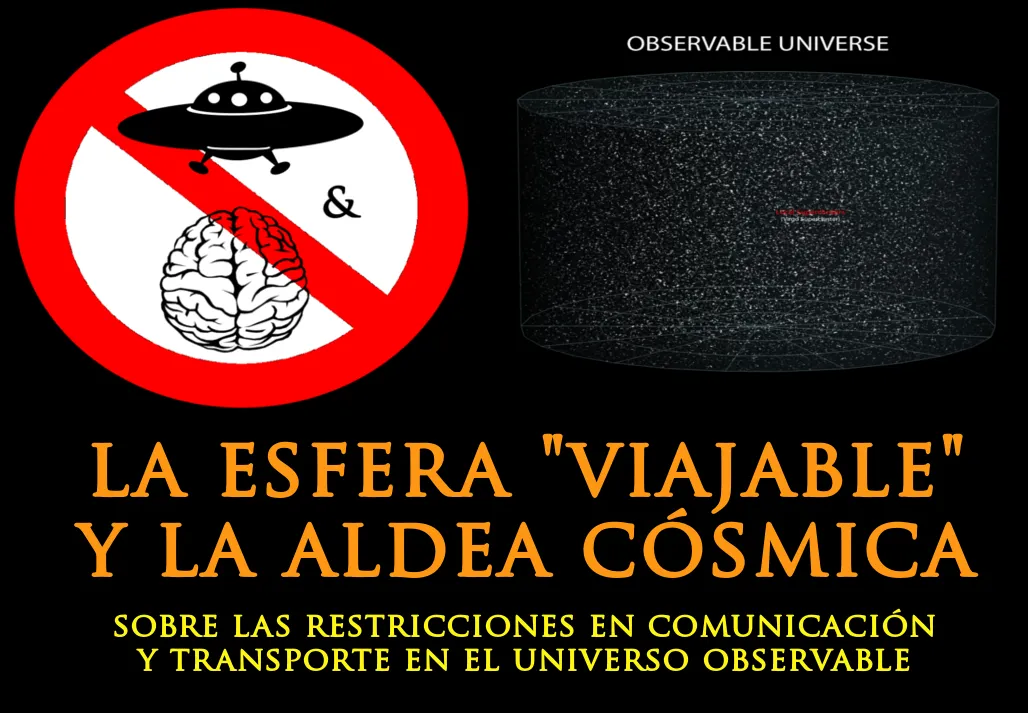
ET visits are improbable because the intellectual density of the universe is low and the travelable sphere is small, even with technologies far more advanced than ours. The universe must be full of intelligent life, but it is very large. Even if one could travel at the speed of light, covering just 1000 light-years would take 1000 years. In short, confinement started long before the coronavirus. It is more feasible and intelligent to send radio signals, which can -inevitably- travel at the speed of light. That is what intelligent civilizations would do, rather than traveling aimlessly. There aren't many reasons to have great hopes. At least, until the next Wow! signal☉
Sources and related links
- Was Juno the fastest spacecraft ever? Only kind of.
https://astronomy.com/news/2016/07/juno-may-not-have-been-the-fastest-spacecraft-ever - Martha Hildebrandt: the meaning of "Pinchar el globo"
https://elcomercio.pe/opinion/habla-culta/martha-hildebrandt-significado-pinchar-globo-277678-noticia - THE ONE HUNDRED NEAREST STAR SYSTEMS
http://web.archive.org/web/20050923194412/http://www.chara.gsu.edu/RECONS/TOP100.htm - https://en.wikipedia.org/wiki/List_of_nearest_bright_stars
By Andrew Z. Colvin - Own work, CC BY-SA 3.0, https://commons.wikimedia.org/w/index.php?curid=14359465 - List of nearest bright stars
https://en.wikipedia.org/wiki/List_of_nearest_bright_stars - Al tun tun
https://expresionesyrefranes.com/2007/04/17/al-tun-tun/
About the images
Alien Mission https://xkcd.com/2573/
Alien Observers https://xkcd.com/2572/
Testing of IR Image Enhancement Algorithm on Maritime Objects https://www.researchgate.net/publication/233864792_Testing_of_IR_Image_Enhancement_Algorithm_on_Maritime_Objects
http://clipart-library.com/clipart/pop-cliparts_3.htm
https://es.wikipedia.org/wiki/Grupo_Local
By Andrew Z. Colvin - Own work, CC BY-SA 3.0, https://commons.wikimedia.org/w/index.php?curid=14358437