Astronomers are already searching for the impossible.
According to NASA Exoplanet Archive there are 5063 confirmed exoplanets as of 7-18-2022. In The Extrasolar Planets Encyclopaedia there are 5119 as of 7-27-2022. In Exoplanets.org there are 3262 confirmed exoplanets as of 2018.
Exoplanets are planets that orbit stars outside the Solar System. They have been detected since the beginning of the 1990s and the number of discoveries increases every year.
Until the 1980s, the detection of exoplanets was an impossible dream. The angular size of planets in orbit around other stars is very small. Despite the difficulty, improvements in techniques and equipment made it possible to discover the faint signals of other distant worlds. Most were detected with the transit method and are giant planets, very close to their stars, which are classified as "hot Jupiters". Smaller planets and/or planets farther from their stars are harder to find.
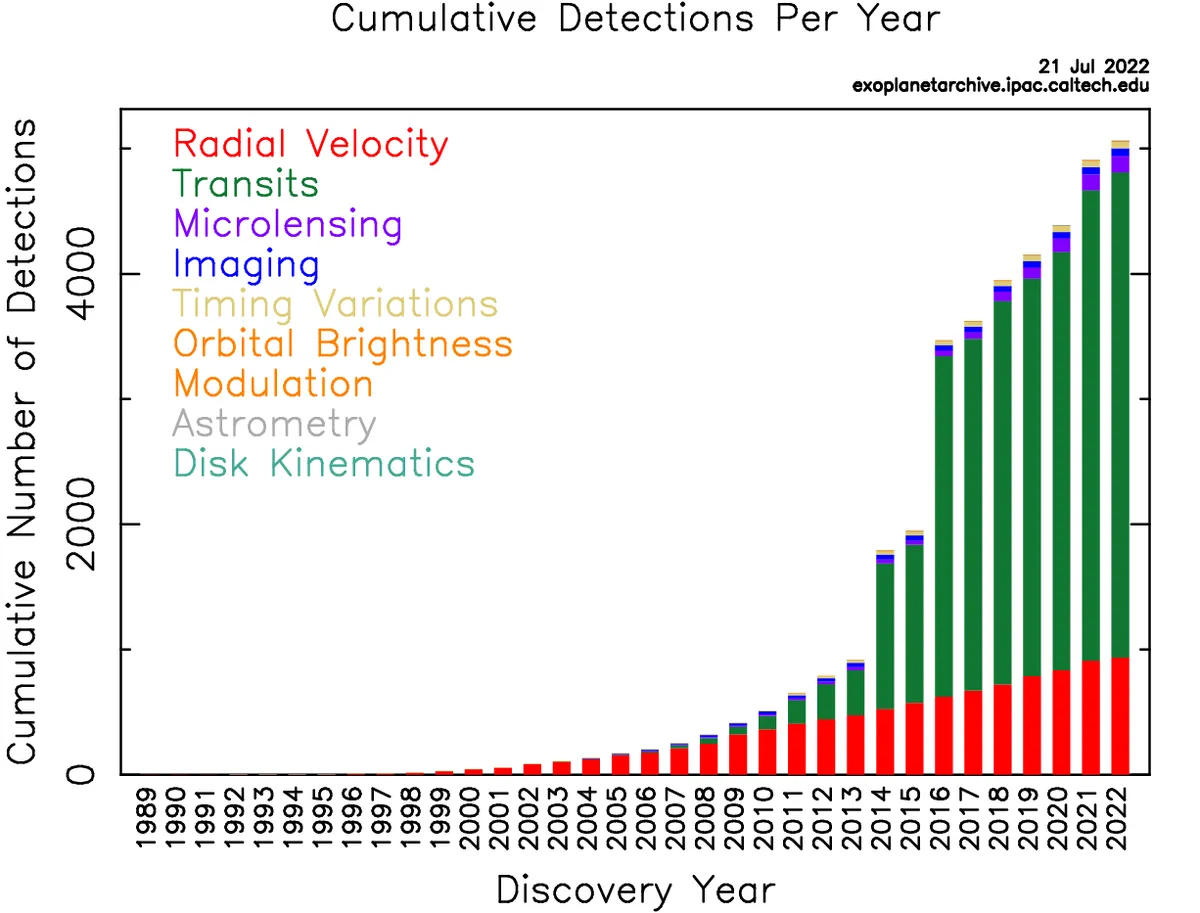
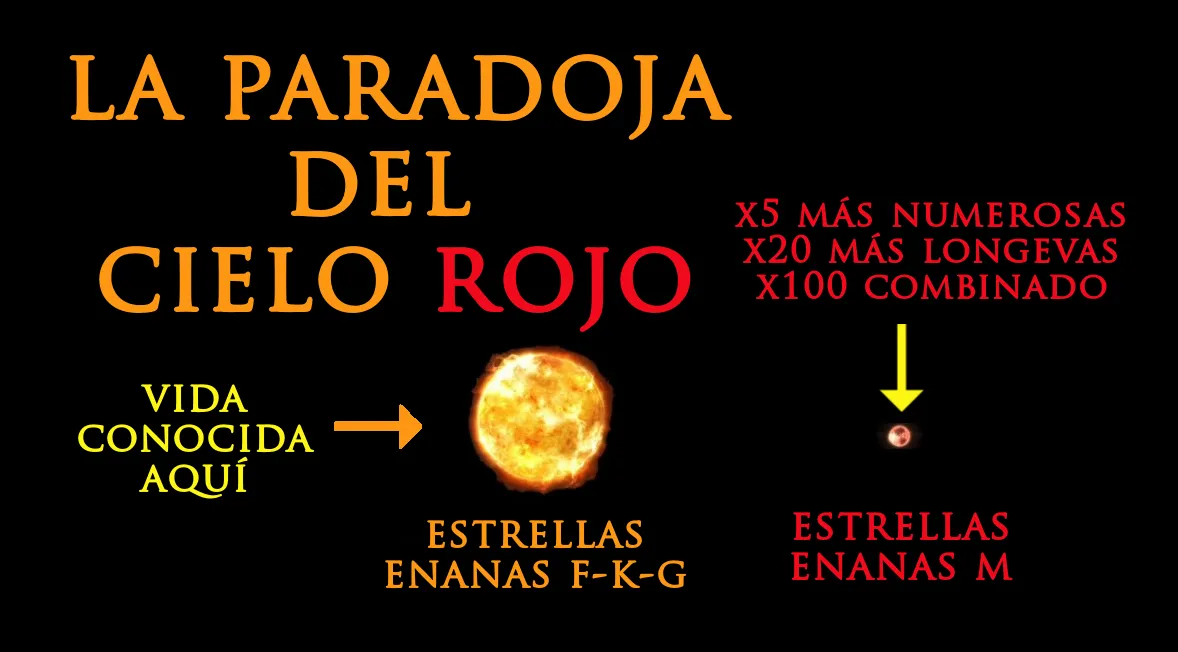
The theory of planet formation is strongly linked to the theory of star formation. In short: for medium-to-large mass stars, the formation of planets around them is almost inevitable. Although in the Milky Way 70% of stars are (red) dwarfs, medium stars -of spectral types F, G, K- must be a gigantic number. Therefore, the 5000 exoplanets would be just the tip of the iceberg.
Having better data on how many planets there are in the Milky Way and what they are like would pave the way to discovering life out there. In our cosmic home, the Solar System, only 1/8 of the planets has intelligent life with developed technology. In fact, so far, only 12.5% of the planets in the Solar System has life: Earth. But this data cannot be extrapolated to the rest of the Galaxy, since data on other planetary systems is still very incomplete. We can well say that, in this field of study, "completeness" is very low. That is, the proportion between discoveries vs. the number of planets that theoretically should exist. In fact, the term "completeness" is used in some published works in astronomy (see below).
Of the ~5000 exoplanets detected so far, the number of them that are extragalactic is zero. A potential discovery outside the Milky Way was announced years ago: exoplanet HIP 134044, but it was later disproven. It is logical that extragalactic exoplanets have not been discovered, since the farther away they are, the smaller their angular size.
Given the above, it may seem improper or premature to start searching for planets outside the galaxy when the "census" in the Milky Way is still so incomplete.
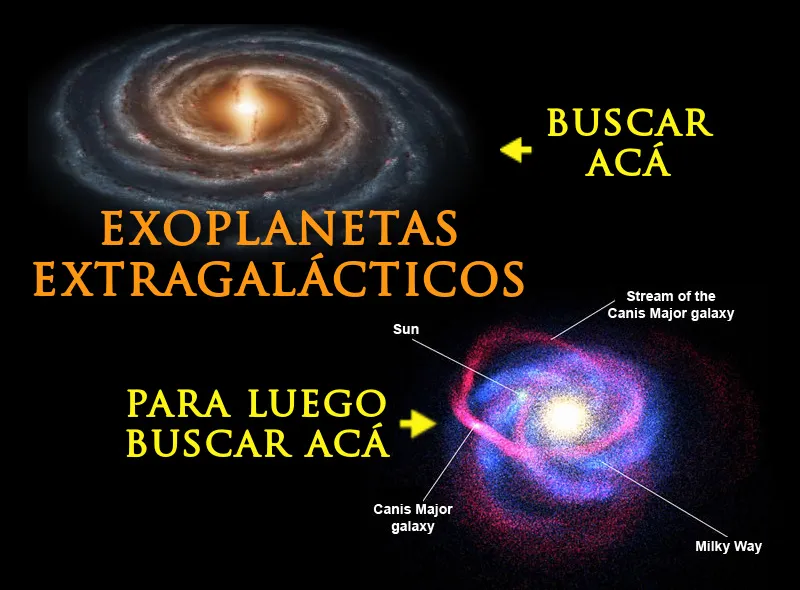
But astronomers know no borders and have begun to search, at least theoretically, for extragalactic exoplanets in...our galaxy. No, it's not a mistake.
THE ORIGIN OF THE MILKY WAY
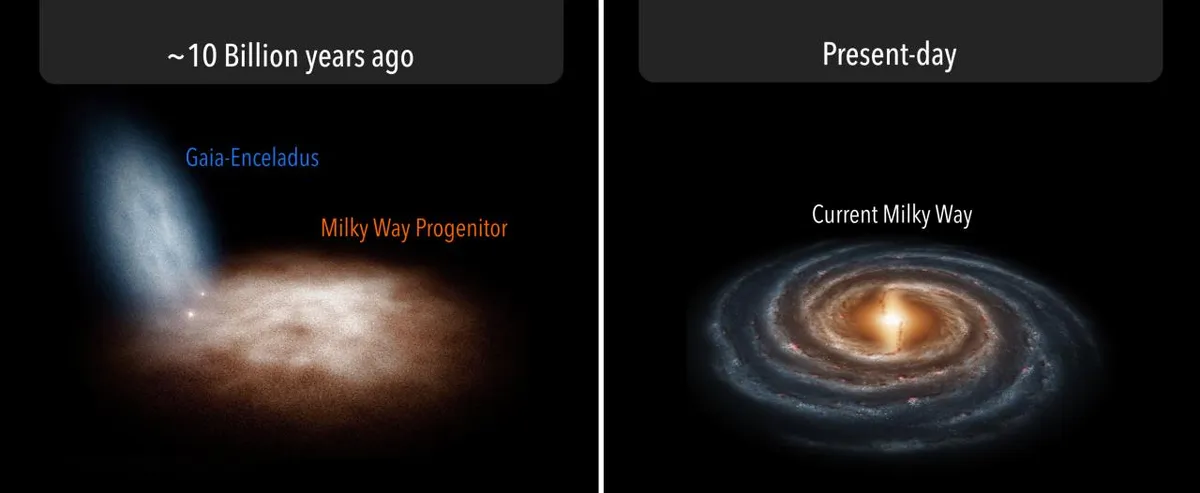
In the halo of our galaxy, the outermost part, resides a population of stars with motions and chemical abundances different from the stars formed here. It is thought that these stars originated in a dwarf galaxy, known as Gaia-Enceladus, which merged with the Milky Way 8 to 11 billion years ago. This is why three authors from Harvard, led by Stephanie Yoshida, published a paper in which they try to find out what proportion of planets there might be among the stars that now form part of the galaxy's halo, but are of extragalactic origin.
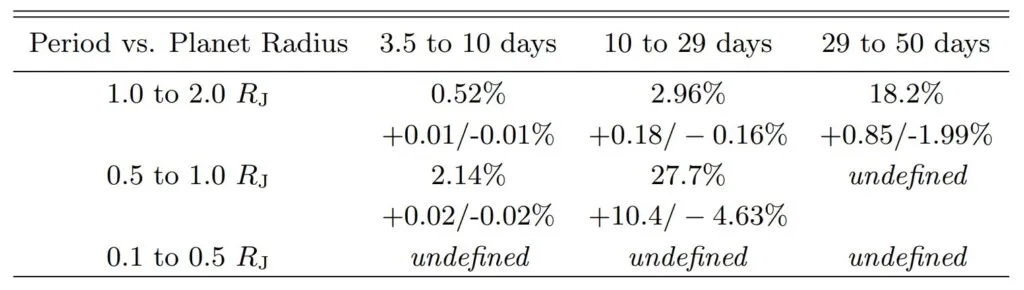
The methods used are quite complex. Suffice it to say that they took data from the Gaia and Tess satellites. A similar study had already been done in 2019 with data from the Kepler probe. In both cases, low-luminosity stars from the red giant branch that could host hot Jupiters were considered. The calculations are not very promising: at most, 0.52% of the stars in the galactic halo should have this type of exoplanet. The good thing is that data from Gaia's third data release plus other studies being done will make possible the task of finding those needles in the cosmic haystack.
Thus, astronomers could take the first step in detecting exoplanets of extragalactic origin, even though they are already part of the Milky Way.
The next step, finding planets outside the galaxy, will be a bit more difficult.
SCALE OF THE PROBLEM
The galaxy closest to ours is the Canis Major Dwarf, at 42,000 light-years from the galactic center, but 25,000 light-years from the Sun.
To give an idea of the scale of the problem, let's do the math:
To round off, let's use a value for the speed of light of 300 thousand km/s.
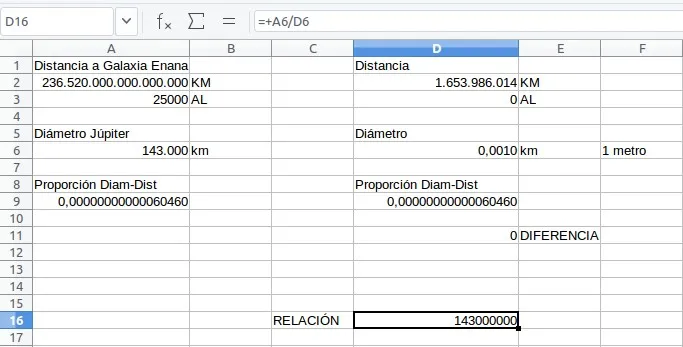
The distance, in km, to the Canis Major Dwarf Galaxy will be: 25000*60*60*24*365=236,520,000,000,000,000 km.
The diameter of Jupiter is 143,000 km.
The diameter-distance ratio is=0.00000000000060460.
The angular size is calculated as an angle, in radians, but we will skip that step since what matters is the size-distance ratio.
Now let's use arithmetic to calculate an equivalent ratio. We know that if we divide numerator and denominator by the same amount, we will achieve the goal.
Let's use an arbitrary value for the new diameter, say 1/1000 km (1 meter).
That implies a relationship with Jupiter's diameter of 143,000,000.
We divide the original distance by that value=1,653,986,014.
Therefore, detecting a planet like Jupiter around a star at the edge of the nearest galaxy, 25 thousand light-years away, is as difficult (size-distance ratio) as finding an object 1 meter across at 1,653 million km, more than 10 times the Earth-Sun distance. Saturn lies at 9.5 AU from the Sun.
To be clear:
Distance Dwarf Galaxy/size Jupiter=0.00000000000060460.
Distance 1653986014/size 0.001 km=0.00000000000060460.
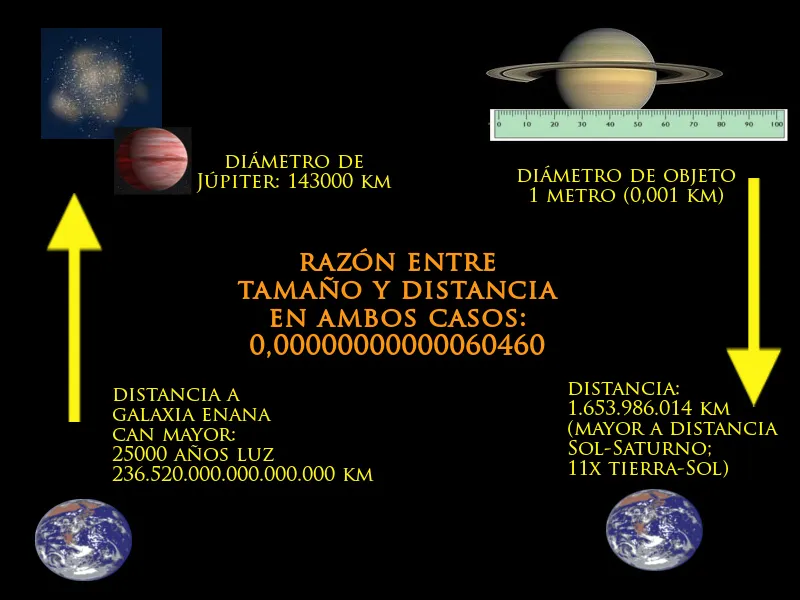
We can conclude that detecting exoplanets in the nearest galaxy, the Canis Major Dwarf, today is a utopia. Although the quasi-impossible is a dog that barks, but does not bite.☉
Sources and related links
- Searching for planets that formed a long time ago in a galaxy not so far away
https://astrobites.org/2022/07/26/extragalactic-origin-halo-star-planet-occurrence/ - Constraining the Planet Occurrence Rate around Halo Stars of Potentially Extragalactic Origin
Stephanie Yoshida, Samuel Grunblatt, Adrian Price-Whelan
https://arxiv.org/abs/2206.13556 - The Birth of the Milky Way Revealed
https://www.iac.es/es/divulgacion/noticias/desvelado-el-nacimiento-de-la-lactea - Exoplanets.org
http://exoplanets.org/ - The Extrasolar Planets Encyclopaedia
http://exoplanet.eu/ - NASA Exoplanet Archive
https://exoplanetarchive.ipac.caltech.edu/index.html - What is the completeness of an observation and how do I calculate it?
https://astronomy.stackexchange.com/questions/41044/what-is-the-completeness-of-an-observation-and-how-do-i-calculate-it
About the images
The Closest Galaxy: Canis Major Dwarf https://apod.nasa.gov/apod/ap071104.html
Illustration Credit & Copyright: R. Ibata (Strasbourg Observatory, ULP) et al., 2MASS, NASA