The importance of that programming language in astronomical research.
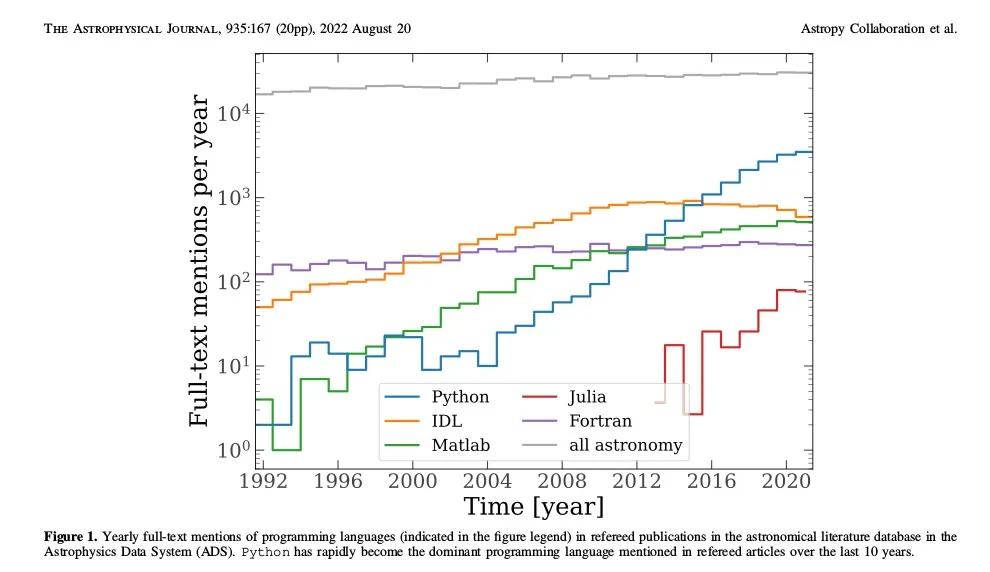
Anyone would say the most used instrument by astronomers is the telescope. But if we base it on the amount of time used, perhaps it's the computer. To process and analyze data, scientists create, use, and modify software. The most cited language in peer-reviewed publications in the 1990s was Fortran. A decade later, IDL took the lead. Then, Python usurped that position.
In 2013, a network of collaborators revealed a library whose purpose was to easily handle routine tasks in astronomical research, such as manipulating and transforming coordinates: it was called Astropy.
In August of this year, a team of more than 100 members published the third paper in the Astropy series with details of the latest version 5.0. The team includes two Argentines: Sebastian Gurovich (IATE-OAC-UNC-CONICET) and Gabriel Perren (IALP-CONICET-UNLP).
The reasons for Python's rise are that it is a high-level, interpreted language, which is scalable, with efficient runtime, focused on ease of reading and use, as well as interoperable with other languages. The combination of voluntary and professional efforts generated an ecosystem of software packages for a wide variety of utilities.
In this graph we can see the evolution in the use of different programming languages according to citations in journals in the Astrophysics Data System (ADS) database.
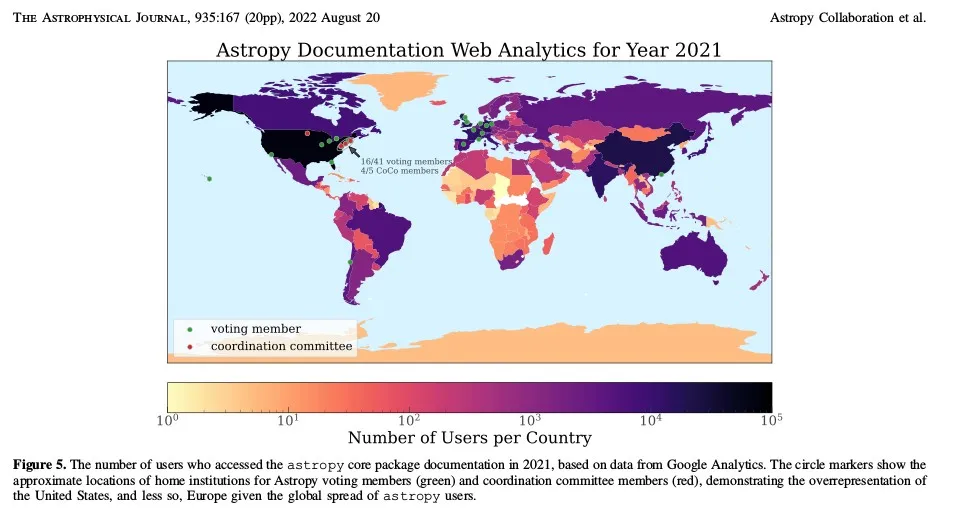
Here we see in this map the number of users who accessed the Astropy package documentation in 2021, based on Google Analytics data.
In the paper in question, the collaboration members point out the challenges of having libraries sufficiently precise and that enable the use of previous versions, as well as the commitment to outreach and teaching about the use of this package and the need for funds to ensure the project's maintenance.
In a world increasingly globalized by communications, with a standardized and computerized international science, it is almost a common-sense requirement to have open-source libraries for scientific research that facilitate tasks.
That said: it's not enough to write > print(‘Hello World’) to discover exoplanets!☉
Sources and related links
- “The Astropy Project: Sustaining and Growing a Community-oriented Open-source Project and the Latest Major Release (v5.0) of the Core Package,” The Astropy Collaboration et al 2022 ApJ 935 167 doi:10.3847/1538-4357/ac7c74
https://iopscience.iop.org/article/10.3847/1538-4357/ac7c74 - Software Updates: The Latest from the Astropy Project
https://aasnova.org/2022/09/30/software-updates/ - Astropy.org
https://www.astropy.org/
About the images
Credit: Astropy Collaboration.