Trigonometric stellar parallax, step by step.
Several methods are used to calculate distances in astronomy. The set is called the "Cosmic distance ladder".
The set of methods can be illustrated with this scheme:
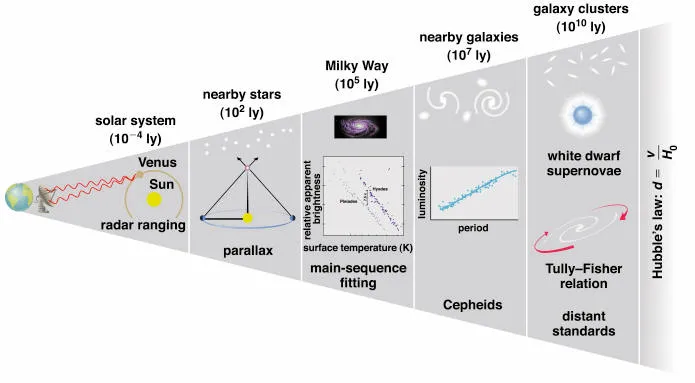
Here we will explain the first of those rungs. However, it is somewhat misleading to say it is really the first rung, since we will start from a given datum: the distance to the Sun. For this reason, distances to the Sun or the Moon could be considered the first steps. The distance to the Moon has been calculated since the times of Aristarchus of Samos and Ptolemy, using lunar eclipses. The distance to the Sun was calculated using the transit of Venus. They are two good stories we will tell on another occasion. For this case, we will take for granted that we already know that the semi-major axis of Earth's orbit (the distance to the Sun) is ~150 million km.
PARALLAX
One way to approach this term is with a simple example.

We put our index finger in front of our nose and look at it with one eye, alternating between the right and the left. It will give us the sensation that the finger moves, although we know it does not. This apparent movement of the finger is because we observe it from two different points of view (places), since our eyes are separated.
The apparent movement will be greater, the greater the separation between the points of view. And it will be smaller, the greater the distance to the object.
With a bit of trigonometry, if we know the angle to an object and the distance between the observations, we can calculate the distance. Let's see how:
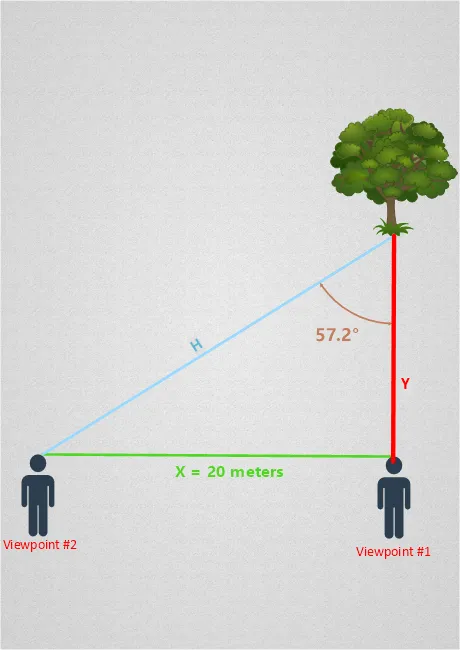
In this illustration we see two people (or the same one at two different times) separated by a certain distance x. Let's suppose we know that distance is 20m. Since it is a right triangle, then:
The tangent of the angle is equal to the side opposite that angle (x, in this case) over the adjacent side (y).
Therefore, Tan (angle)=20/y. If we know the angle is 57º, then
Y=20/Tan(57). Which implies that Y=13m, which is the distance to the first point of view.
To calculate the distance to the other point of view, the Pythagorean Theorem can be used.
STELLAR PARALLAX
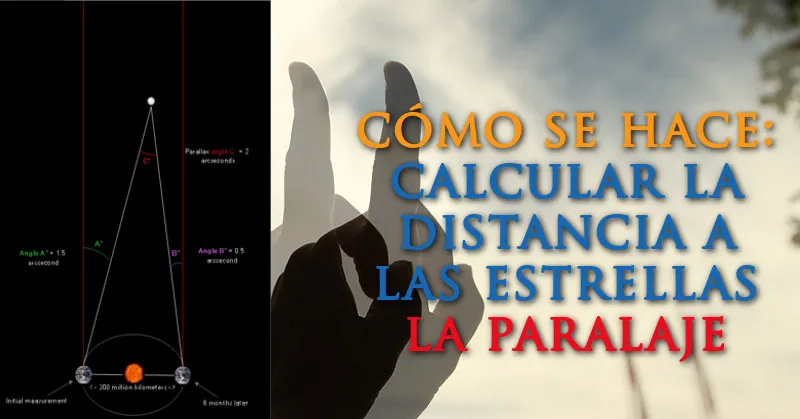
Let's say we look at two stars at night. One will be a reference star, the other will be the one whose distance we want to measure. We measure that the distance between both stars is 1.5 arcseconds, for example.
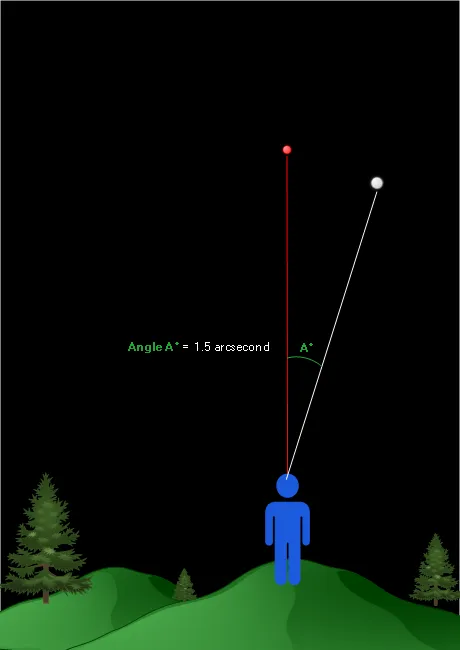
Now we must measure again, but from the greatest possible distance. For that, since the Earth moves around the Sun, we wait 6 months. The planet will be on the opposite side of its orbit, the greatest distance we can achieve without leaving the ground. We measure again and it will give us another value, say 0.5 arcseconds.
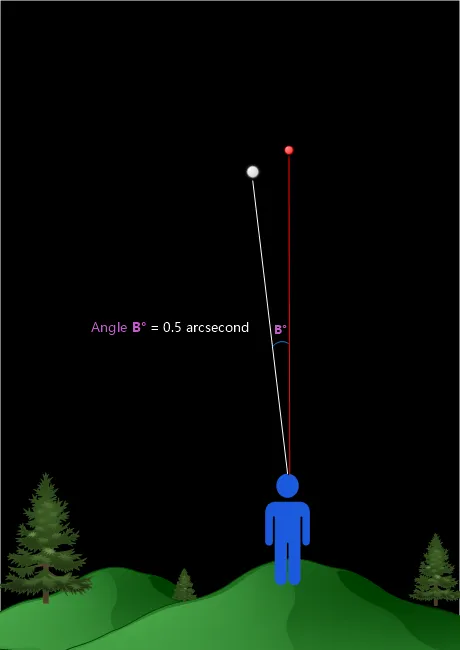
Then we would have this scenario:
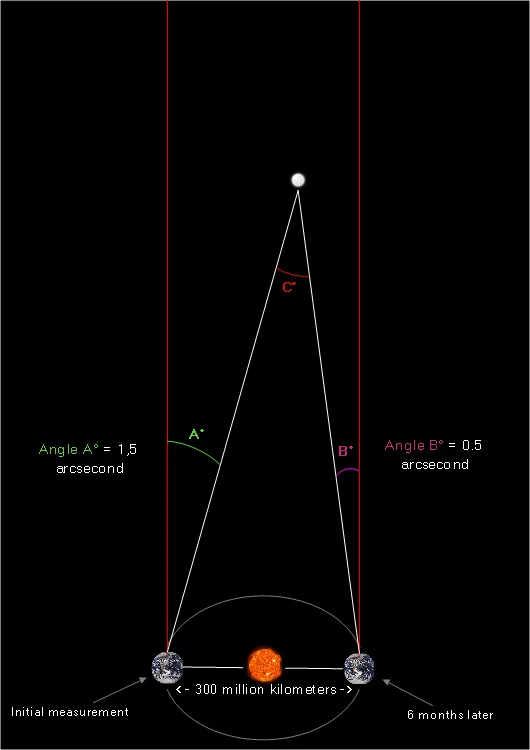
We would have the measurement to the star in question at two different places in space, we would know the Earth-Sun distance. What we want to know is how much angle C measures.
If the object in question, which in this example is the white object, we saw it on one side of the reference object first, and on the other side later, then we add both angles and we will have the value of angle C.
If the object in question is on the same side in both observations, we subtract the smaller angle from the larger angle.
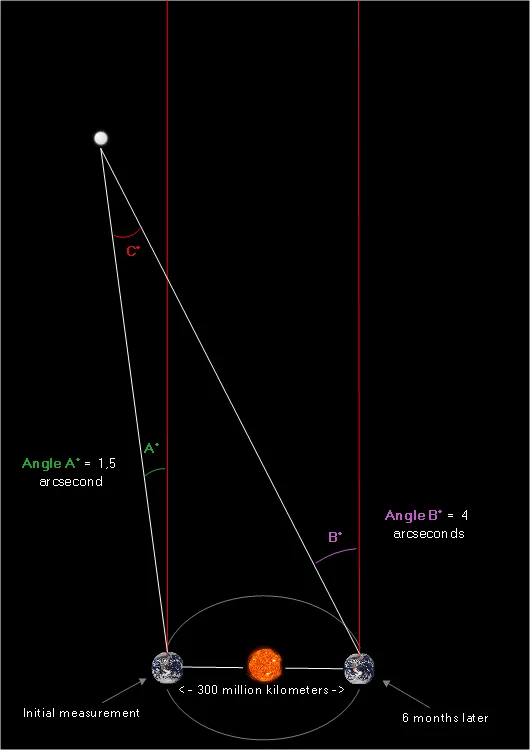
It could be the case that the angle on both occasions is EQUAL. In that case, subtracting will give zero. This is because since stars can be very far away and the apparent change in movement is smaller the farther the object is, then the angle will be so small that we cannot measure it.
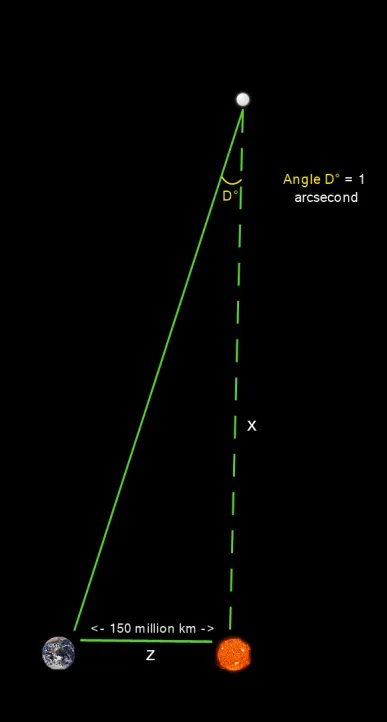
Now we must consider that with these observations the scenario is that of an isosceles triangle, which by the Law of Symmetry, when divided in two, leaves us with two right triangles. Angle D is half of angle C and the distance to the star is the dotted line, which we will call X.
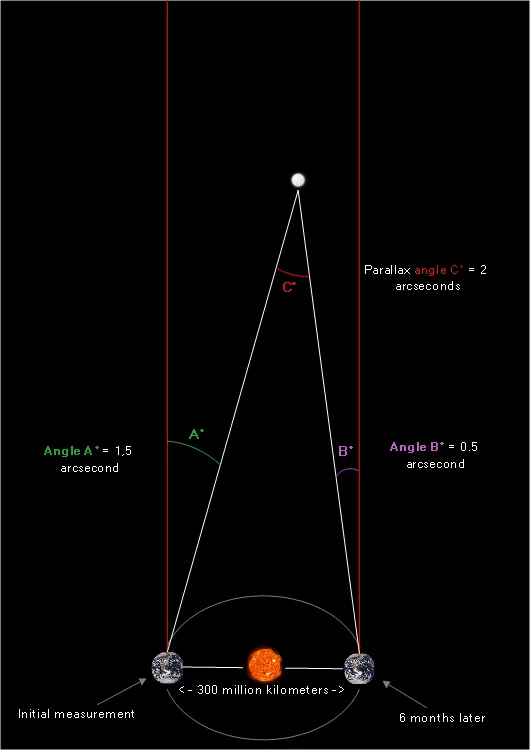
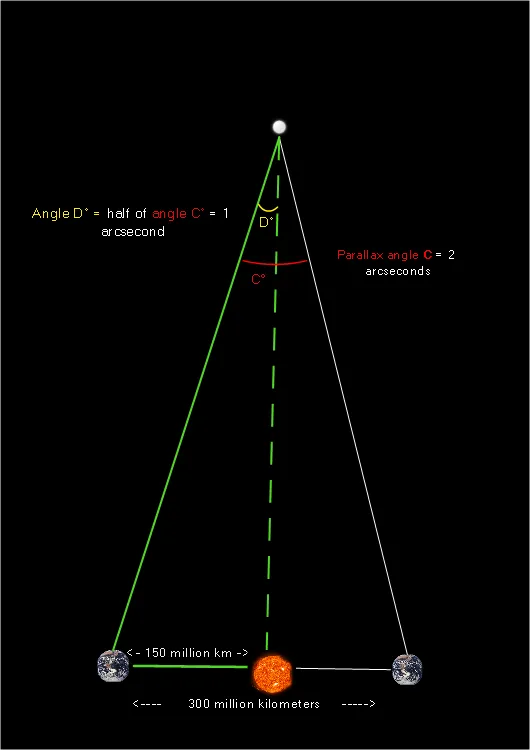
As said before, the tangent of D is equal to the opposite side Z over the adjacent side X. D is 1 arcsecond, since it is half of C.
1 arcsecond is 1/3600 degrees, therefore:
Tan (1/3600)= 150,000,000 km/X
X= 150,000,000/tan(1/3600)
X=3.1x10^13 km.
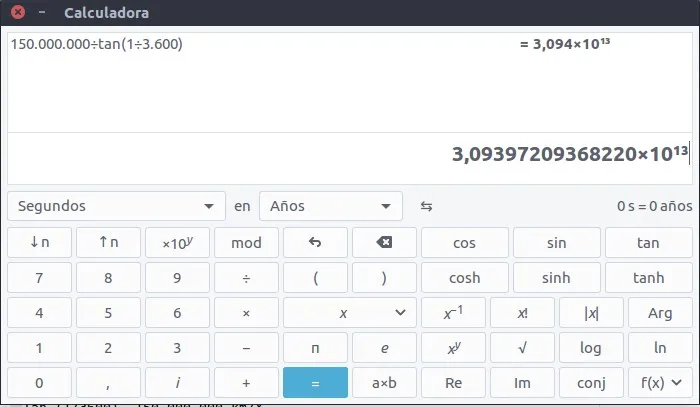
This distance is equivalent to 3.26 light-years. And that is a parsec. This unit of measurement comes from this: it is the distance at which an object would be whose parallax angle is 1 arcsecond. THERE IS NO object that has that distance to Earth. The closest star to the Solar System is 4.3 light-years away, that is 1.34 parsecs.
HOW ANGLES ARE MEASURED
In antiquity, astronomers used instruments like sextants. Currently, angular distance is done by taking photographs with CCD cameras which, using software and known data, allows measuring the desired angle.
On the other hand, satellites like Gaia and Hipparcos have mapped the sky with precision astrometry.
IS THE PARALLAX ANGLE D OR C/2?
Depending on the textbook or reference bibliography, both may appear as answers. On a NASA site it is indicated that the parallax angle is what we call C here, but when calculating, they divide by 2 astronomical units, which is the same as dividing C.☉
Sources and related links
- How astronomers measure distance to stars using parallax
http://referenceframe.net/astronomy/how-astronomers-measure-distance-to-stars-using-parallax/ - Calculation of the Distance to the Sun with a Transit of Mercury or Venus
https://es.wikibooks.org/wiki/C%C3%A1lculo_de_un_Eclipse_Solar_y_Lunar._Ocultaci%C3%B3n_y_Tr%C3%A1nsito/Tr%C3%A1nsito/Definici%C3%B3n_de_Tr%C3%A1nsito - A new Method of determining the Parallax of the Sun, or his Distance from the Earth
https://eclipse.gsfc.nasa.gov/transit/HalleyParallax.html - A HISTORY OF ASTROMETRY - PART I MAPPING THE SKY FROM ANCIENT TO PRE-MODERN TIMES
https://sci.esa.int/web/gaia/-/53196-the-oldest-sky-maps - The Venus Transit 2004
https://www.eso.org/public/outreach/eduoff/vt-2004/Education/EduSheet2.html - The Parallax Angle -- How Astronomers Use Angular Measurement to Compute Distances in Space
https://www2.jpl.nasa.gov/teachers/attachments/parallax.html
About the images
Credits: Referenceframe.net; Brit Cruise.