Astrochica, the young astronomer from the Instituto de Astrofísica de La Plata (IALP - CONICET/UNLP) who, through the Instagram profile @astrochica.ialp, brings the skies and their stars closer to young people, invites the general public to tour an exhibit full of activities about the work of astronomy in the country as part of La Noche de la Ciencia Argentina.
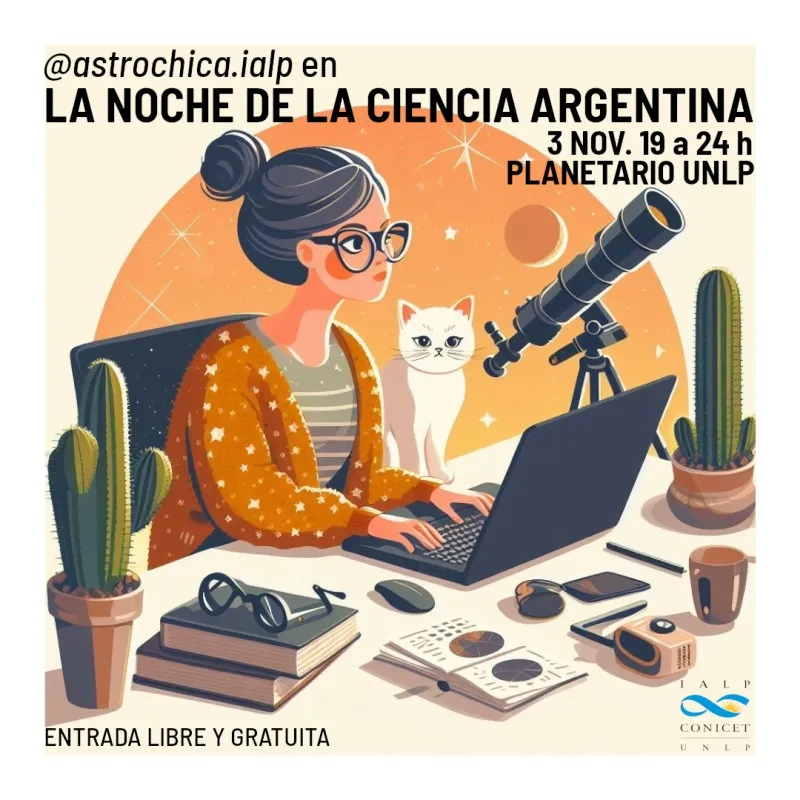
The event is on Friday, November 3, from 19 to 24 h, at the Planetario de la Universidad Nacional de La Plata, in the heart of the La Plata forest, with free admission.
In the city of diagonals, since its foundation, the La Plata astronomical observatory has been developing a rich research activity in the astronomical field. A plethora of students have passed through its classrooms and continued their careers as researchers, and today it buzzes with activity more than ever. The La Noche de la Ciencia Argentina event, promoted by the Ministerio de Ciencia, Tecnología e Innovación de la Nación, is the perfect opportunity for curious children, young people with questions about their future, and the general public to learn firsthand about the research conducted behind the doors of the institutes, laboratories, and groups that coexist on the grounds of the Facultad de Ciencias Astronómicas y Geofísicas, through talks, workshops, stands, projections, guided tours, and observation.
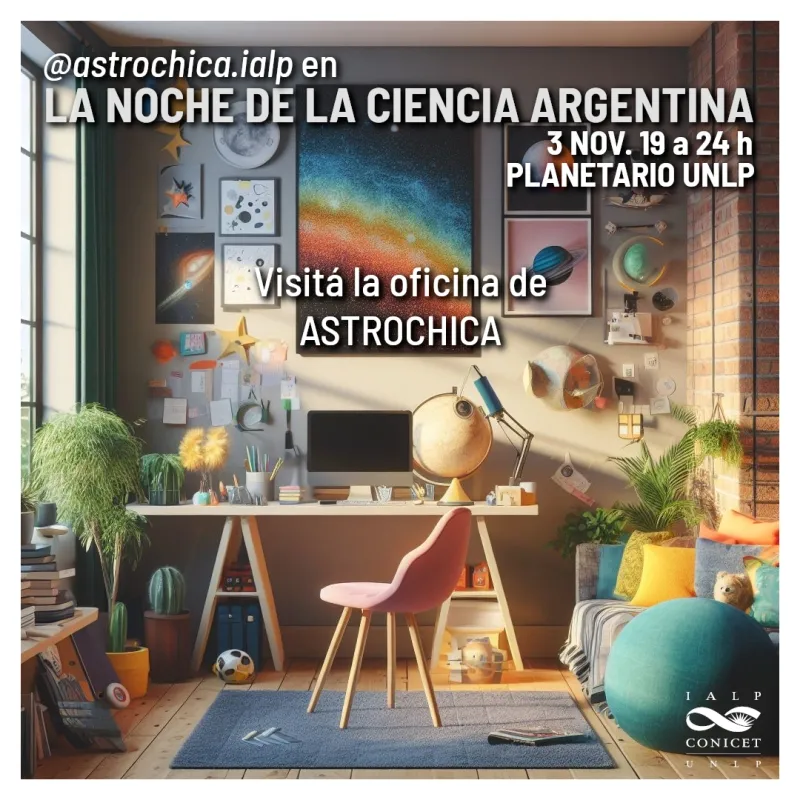
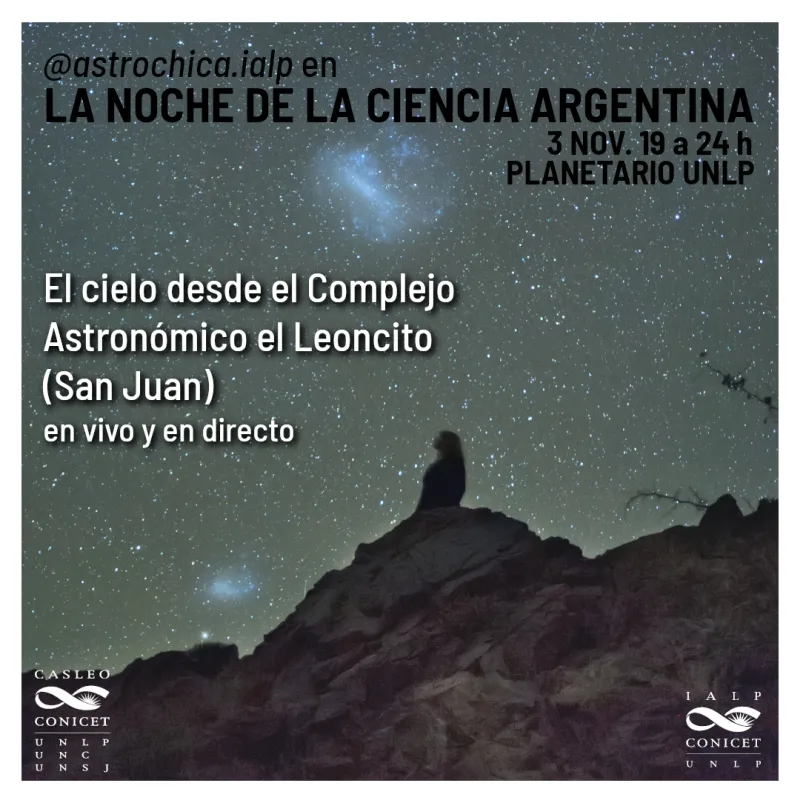
In particular, among the exhibit's activities, you will be able to visit Astrochica's office, rummage through her notebooks, papers, even her computer! and observe, live and direct, the remote transmission of the impressive San Juan night sky from the Complejo Astronómico El Leoncito (CASLEO) where the country's largest telescope is installed. The young astronomer, along with other researchers from the institute, will be available to answer all the public's questions.
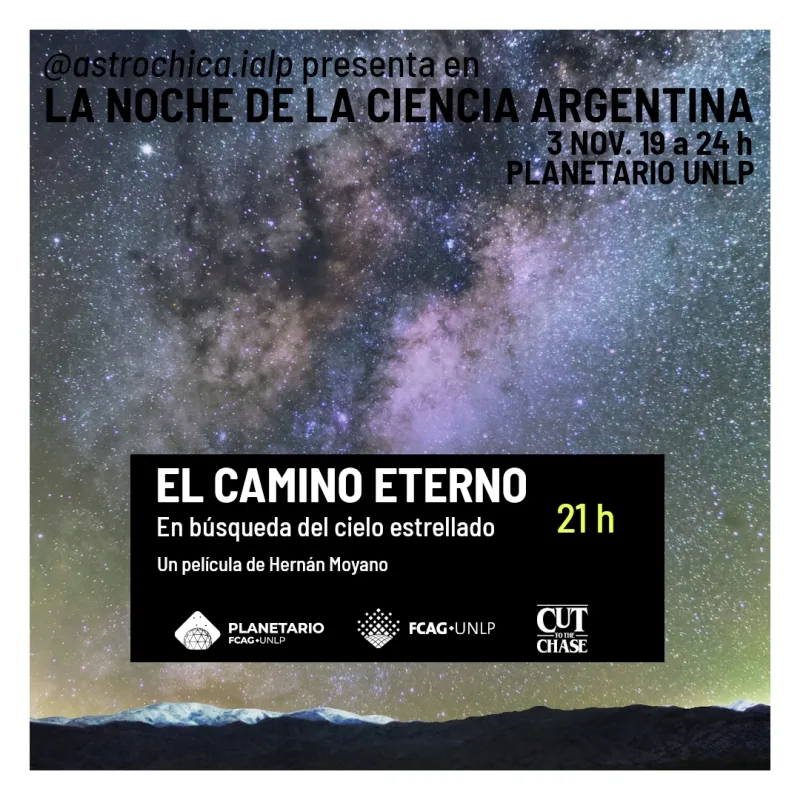
Other notable activities, organized jointly with other areas of the observatory, are the immersive projections under the dome of the Planetario UNLP of two audiovisual productions created by that institution: “La cuesta del viento, a la caza de un eclipse andino”, which shows the recording of the 2019 total solar eclipse in a small, peaceful town in San Juan, and “El camino eterno: en búsqueda del cielo estrellado”, where we follow the steps of an astrophotographer who, in search of the perfect photo of the starry sky, undertakes a journey through Argentina's astronomical observatories.
At the end of this last documentary, a group of astronomers who are participants in such sites will be subjected to a rapid-fire round of questions they must answer quickly and spontaneously: "What does an astronomer do during the day?" "Do you have a favorite star?" These and other questions will be selected from those sent to Astrochica's Instagram profile. Also, thanks to the Secretaría de Extensión of the astronomy faculty, the public will be able to learn the fascinating story of how and where planets are born, in a talk given by Lic. José Gomez, a researcher member of the IALP, and then they will be able to observe the majestic rings of the planet Saturn through the institution's giant and century-old telescope. Meanwhile, in the planetarium's hall, at the planetarium's interactive stand, you can discover in a playful way how the scientific instruments with which astronomers observe the universe work.
Also present at the exhibit with their respective proposals will be the Oficina Argentina de Gemini, under the Ministerio de Ciencia y Técnica, a participant in observations with the large twin telescopes located in Hawaii and Chile, and the Laboratorio MAGGIA, under the Universidad Nacional de La Plata and the Comisión de Investigaciones Científicas de la Provincia de Buenos Aires, dedicated to the study of space weather, geodesy, and geodynamics.
We look forward to seeing you!
Comisión de Extensión, Difusión y Redes Sociales del Instituto de Astrofísica de La Plata (IALP - CONICET/UNLP)
About Astrochica
“Astrochica” is a scientific culture outreach project aimed at making the rich astronomical activity carried out in our country visible to new digital generations. Astrochica is a young astronomer from the Instituto de Astrofísica de La Plata (IALP), under CONICET and the Universidad Nacional de La Plata, whose passion for science outreach has led her to share her knowledge on social media with the help of her colleagues. We invite you to follow her journey through the cosmos at @astrochica.ialp.
About the event La Noche de la Ciencia Argentina 2023.
The first Noche de la Ciencia Argentina is conceived as an instance of articulation of the national scientific and technological system to stimulate opportunities for access and participation in scientific culture throughout the country; an occasion for institutions to open their doors to the community and thus celebrate the country's knowledge, scientific discoveries, and technologies. The current context, strongly influenced by scientific advancement and the inclusion of new technologies in daily life, demands network work capable of promoting collective dialogues about current challenges and debates in science and society.
From the Ministerio de Ciencia, Tecnología e Innovación, through the Dirección de Museos, Exposiciones y Ferias and the Centro Cultural de la Ciencia, all institutions belonging to the scientific, technological, and innovation system are invited to participate in La Noche de la Ciencia Argentina.
Complete agenda of the event at the Planetario UNLP
November 3, 2023 from 19 to 24 h.
Planetario UNLP
Paseo del Bosque, La Plata
Province of Buenos Aires
STANDS
Hall at the Planetario UNLP
19:00 to 24:00 h
Astrochica: astronomer at some point in space-time.
Stand of the Instituto de Astrofísica de La Plata (IALP - CONICET/UNLP)
Come tour Astrochica's office! You can see the day-to-day life of our institute's outreach astronomer, rummage through her notebooks, papers, and her computer! She and her researcher friends will be available to answer all your questions. And we will have live and direct transmission of the incredible night sky of the Complejo Astronómico El Leoncito (CASLEO) where the largest telescope on Argentine soil is located.
Science at your fingertips
Interactive stand of the Planetario UNLP (FCAG - UNLP).
Feel the science! Discover how scientific instruments work, what you can learn with them, and play with the universe.
Argentina at the Gemini Observatory
Stand of the Oficina Gemini Argentina (OGA - Ministerio de Ciencia, Tecnología e Innovación de la Nación MINCyT)
Argentina has been participating for more than 20 years in the international astronomical observatory Gemini, using two of the world's largest telescopes and state-of-the-art technology. In this exhibit, you will be able to see what the observatory is like, where the telescopes are located, what the instruments for observing are like, and some of the most important images and results obtained. Furthermore, Dr. Verónica Firpo, an Argentine astronomer who currently works at the Gemini South Observatory (Chile), will connect live from the observatory's control room and show us how an 8-meter diameter telescope is operated.
Space Climatology: How Does It Affect Us?
Stand of the MAGGIA Laboratory (Space Meteorology, Terrestrial Atmosphere, Geodesy, Geodynamics, Instrumental Design and Astrometry - UNLP/CIC).
Solar activity influences the functioning of our daily lives, therefore, any irregularity that occurs between the sun and our atmosphere affects us directly. Modern man uses a technological infrastructure in space and on the Earth's surface, which will be affected by severe events occurring in interplanetary space. We will talk about how geomagnetic storms are generated, leading to the formation of the northern and southern auroras.
WORKSHOP
Application of satellites to the study of Earth and Terrestrial Atmosphere sciences.
20:00 to 24:00 h
Location: Hall or terrace of the UNLP Planetarium (depending on weather conditions)
MAGGIA Laboratory (Space Meteorology, Terrestrial Atmosphere, Geodesy, Geodynamics, Instrumental Design and Astrometry - UNLP/CIC).
We will explain how the satellite positioning system GPS works and what it is used for. We will talk about how we can study the natural processes that slowly or rapidly change the "shape" of the Earth, such as earthquakes, continental drift, glacier melting, etc. We will also show how we can monitor water vapor and the ionosphere.
TALK
"From Stardust to Planets: The fascinating story of how and where Planets are born" by Lic. José Gomez (IALP - CONICET/UNLP)
19:00 h
Location: UNLP Planetarium Dome
Extension Secretariat of the Faculty of Astronomical and Geophysical Sciences (FCAG - UNLP)
Planet formation is a fascinating cosmic journey that takes us from the dust of stars to the creation of habitable worlds. In this talk, we will explore the hidden processes in the emergence of planets in our universe. We begin in protoplanetary disks, gigantic disks of gas and dust around young stars. These disks are the kitchen of planets, containing the fundamental ingredients and conditions to obtain a planet. We will see how small dust particles clump together and collide, creating planetary cores. As these cores grow, they become planets. We will analyze the different stages of planetary formation and how factors such as location in the disk and composition affect their properties. Through this talk we will have an exciting journey through the cosmos, from the initial chaos to the creation of worlds that could harbor life, providing a deeper insight into our place in the universe.
GUIDED TOUR
An eye on the Universe: observations through the "Gran Ecuatorial Gautier" telescope from 1894
20:00 h
Location: Dawson Building, premises of the Gran Ecuatorial Gautier Telescope
Extension Secretariat of the Faculty of Astronomical and Geophysical Sciences (FCAG - UNLP)
"What are those domes seen in the Bosque platense?" "Is the sky observed from our Observatory?" "What is researched there?" A visit to the Museum of Astronomy and Geophysics is like a journey through time. Through old telescopes, objects and photos, an astronomer accompanies you, tells you their stories and their science. At the end of the tour, a giant telescope from 1894 will be pointing at one of the most fascinating objects in the sky: the planet Saturn. Its rings and natural satellites are seen there as if they were 300 times closer!
DISCUSSION PANEL
Ping Pong of questions.
22:00 h
Location: UNLP Planetarium Dome
Institute of Astrophysics of La Plata (IALP - CONICET/UNLP)
"What does an astronomer do during the day?" "Do they have a favorite star?" These and other questions must be answered quickly and spontaneously by a group of researchers of the stars from the institute. The questions will be selected from those sent by the public to the Instagram profile @astrochica.ialp, the account of the institute's scientific culture promotion project.
FULLDOME SHOWS
“La cuesta del viento, a la caza de un eclipse andino”
20:00 h (repeats at 22:30 h, duration 30 min)
Location: UNLP Planetarium Dome
UNLP Planetarium and Faculty of Arts (UNLP)
A group of astronomers travels from La Plata to San Juan to record the solar eclipse of July 2, 2019. Rodeo, a small peaceful town, begins to fill with characters attracted by this astronomical event of unparalleled magnitude: the Moon comes between us and the Sun and creates a false night for a few minutes in the middle of the day.
Fulldome documentary film produced by the UNLP Planetarium, under the Faculty of Astronomical and Geophysical Sciences, in association with the Department of Audiovisual Arts of the Faculty of Arts, belonging to the National University of La Plata (duration 30 minutes)
“El camino eterno: en búsqueda del cielo estrellado”.
21:00 h (duration 55 minutes)
Location: UNLP Planetarium Dome
UNLP Planetarium and Cut to the Chase.
An astrophotographer searches for the perfect photo of the starry sky, and to do so he must move away from urban lights and travel to where the large telescopes of Argentina's astronomical observatories are located. On his journey he discovers that he is embarked on a collective search that also involves researchers, engineers, computer scientists, mechanics and many more sky enthusiasts. Documentary film directed by Hernán Moyano and produced by the UNLP Planetarium.
Fulldome documentary film about astronomical observation sites in Argentina, directed by Hernán Moyano and produced by the UNLP Planetarium in association with the La Plata-based production company Cut to the Chase.
Sources and related links
Planetario La Plata http://planetario.unlp.edu.ar/
About the images
Credit: @astrochica