The "UFOs" that professional astronomers do observe. Or do they?
It is common to point out, among those of us who are skeptical of "weird things," read, paranormal phenomena, that there is a striking correlation: people who say they have seen "UFOs" are usually people who do not frequently observe the sky and who want to believe; while astronomers (amateurs and professionals) rarely observe "weird things."
However, it is not quite like that. Professional astronomers do observe phenomena that are not easy to explain. Here we will tell these cases which have a particularity: it is not about what they see, but about what they do NOT see.
A group of astronomers has created a project to investigate the case of several stars that appear in some photographs and do not appear in later ones. One of the astronomers in the group is Spanish: Beatriz Villaroel (IAC), who has published on the matter at least since 2016. The project's name is: “Vanishing & Appearing Sources during a Century of Observations” (VASCO), which in Spanish would be "Fuentes que aparecen y desaparecen durante un siglo de observaciones".
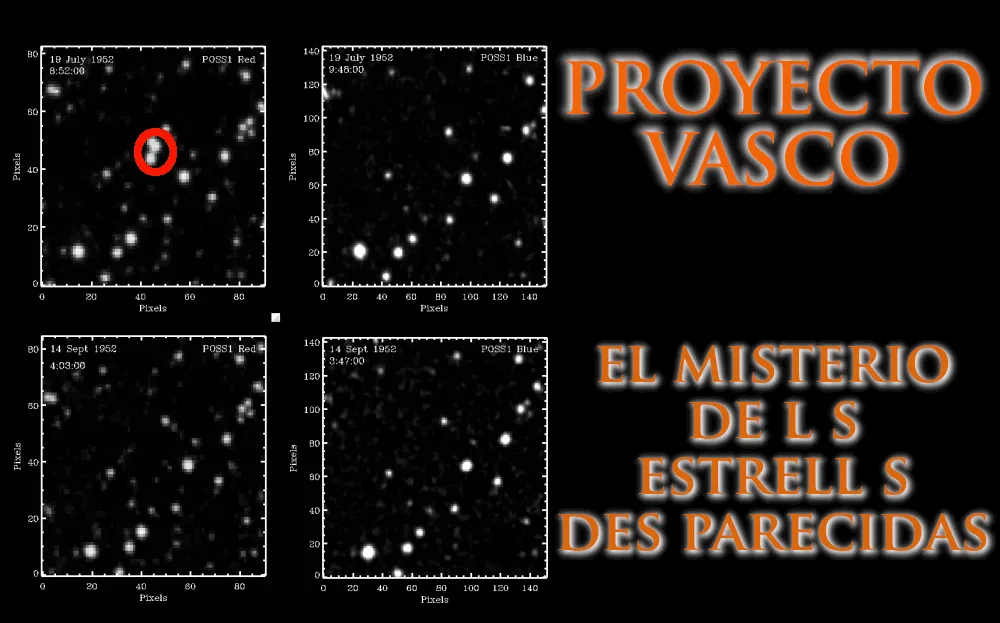
The mystery of the "disappeared stars" has been detected in some photographic plates from 1950 in which 9 point sources (which appear to be stars) are observed and in subsequent plates, taken within 30 minutes later, of a 10 arc-minute region of the sky, the sources are no longer there.
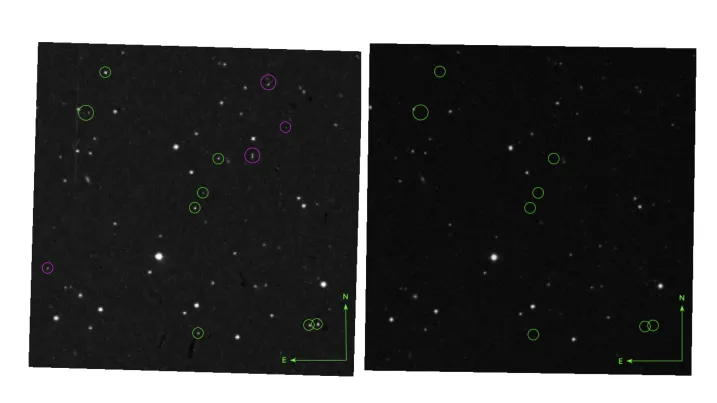
The famous nine: the circles in the left image mark the 9 sources detected in POSS-1, but not in POSS-2, on the right.
We have commented here, with a humorous tone included, on "Seinfeld astronomy," to refer to a phenomenon like this, linked to one of the possibilities: a "failed" supernova, that is, a massive star that collapses into a black hole without going through a considerable increase in brightness. Such a note published recently referred to objects observed in 2015.
However, as I indicated before, "disappeared" sources have been detected in April 1950 as part of the Palomar Sky Survey. The weirdest thing: the 9 sources are absent both in later and in earlier images...WTF?
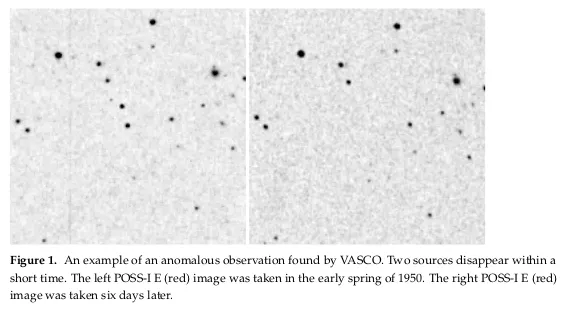
The matter is so weird, that among the possible explanations -elaborated by professional astronomers- is the SETI option, that is, some form of intelligent life. To my personal taste, that type of hypothesis should be left for when all others fail.
One of the options that have been evaluated is that the records are not astronomical, but the product of contamination. After dropping two nuclear bombs and testing several others, it is possible that some radioactive contaminants, used in Alamogordo, New Mexico in July 1945, such as the isotope Ce-141, reached the plates producing a false positive. The hypothesis is plausible, it would explain the absence of the objects before and after.
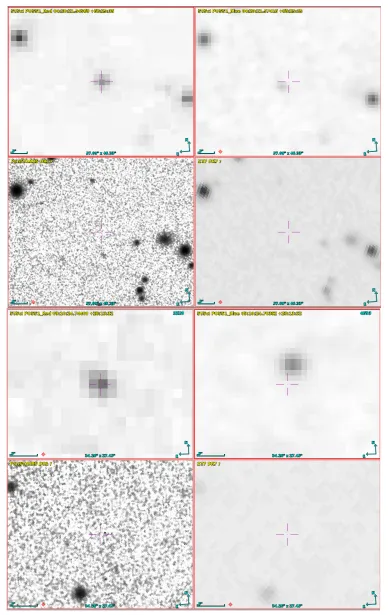
Examples of two sources seen in POSS I red and blue images, with a difference of ∼30 min, but not detected in more recent surveys.
In a work by Villaroel and others (2021) on those disappeared sources in plates from 1950, other...mundane scenarios are taken into account:
potassium contamination from the use of matches (perhaps by astronomers who smoke), known as the case "The potassium flare stars" that were detected in a French observatory and never again. The case of the unusual discovery of radio bursts that were caused by...microwave ovens is also pointed out. Moisture can leave traces on a photographic plate. An observer with hay fever (rhinitis) can produce aerosols that expose the plates. In some cases, it could even be...saliva.

Other possibilities: known natural transient phenomena such as GRBs and FRBs are a possibility, but their frequency is much lower than that of those 9 sources in 30 minutes. Asteroid fragments: in some cases it could be, but in others it is ruled out. Fireflies? Well, 9 at the same time, is unlikely. Geosynchronous satellites or space debris (bolides)? It is very common, but impossible for images obtained before 1957. Other natural possibilities could be outbursts from red dwarfs or brown dwarfs.
One of the latest works on this matter was published in October 2023, now: there are three sources detected in Palomar plates (they are called POSS I, Palomar Observatory Sky Survey) on July 19, 1952 and that do not appear in later plates. They have continued to be searched for with telescopes to date and after 70 years they are still not found.
A very interesting paper, one of the first by this researcher on the topic, dates from 2016 (Our Sky now and then). What they did in that work was to search for "disappeared" objects from the United States Naval Observatory (USNO) catalog that stores information on almost a billion objects down to magnitude 21. The records were detected during two epochs in POSS: 1950-1966; 1977-1999. Then they cross the data with the SDSS catalog to search for disappeared objects. They found 148 preliminary objects, but they evaluated the possibility of them being false positives and false negatives.
False positives are supposed objects in the early images that were not such, but defects (artifacts) like the ones I pointed out before. Using images from two previous epochs eliminates many of these scenarios because it is almost impossible for an "artifact," such as a cosmic ray, to have occurred in images from two different epochs in the same part of the sky. But other false positives could indeed occur. False negatives would be the (false) absence of the objects in the later catalog, due to perhaps the object being fainter than the survey's sensitivity. That is, the object did not disappear, but it is too faint. Of all the cases, one candidate survived this analysis, located at (ra,dec)=224.402387,18.417250 (J2000) or 14h 57m 36.57s +18d 25m 02.10s.
In another 2022 work they compared the POSS catalog against the Virtual Observatory archive. They identified more than 298 thousand sources, but filtered the results to discard known variables, asteroids and other cases and ended with a list of 5399 candidates.
It seems fundamental to me to know to what extent these "disappearances" from a photographic plate catalog also occur in digital catalogs. Several of the possible human contaminations of the plates could not occur in digital records, although it is true that there could be others, such as the lack of adequate cooling of a digital camera that produces false positives.
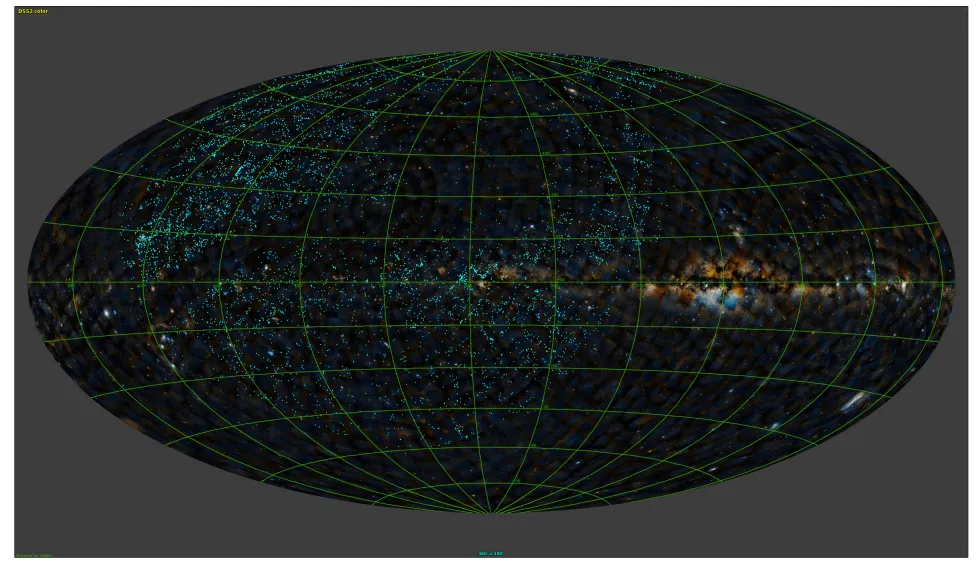
Spatial distribution in galactic coordinates of the 5399 candidate sources (blue dots). A color POSS-II image is shown in the background.
CONCLUSION
The VASCO project is a concrete example of when professional astronomers do find "something weird in the sky," which could be cataloged as a "UFO." However, it is not so rare for this to happen on photographic plates exposed to the elements and human handling. However, there is at least one example of a "disappearance" in 2015 in digital images. With more sensitive surveys, it is possible that several of the objects can be detected and investigated. Everything new to human knowledge is cataloged as "weird," until it is understood.
If they finally turned out to be little green men, it would be a great discovery. Or maybe not so much, if the disappearance of the stars is because they can't pay their light bill.☉
Sources and related links
- In 1952, A Group of Three “Stars” Vanished. Astronomers Still Can’t Find Them
https://www.universetoday.com/163820/in-1952-a-group-of-three-stars-vanished-astronomers-still-cant-find-them - Astronomía a lo Seinfeld
https://www.noticiasdelcosmos.com/2023/03/astronomia-lo-seinfeld.html - VASCO PROJECT
https://vascoproject.org/
The site has a section with all the work done. - The potassium flare stars
https://astroanecdotes.com/2015/06/08/the-potassium-flare-stars/ - Title: A Potassium-Flare Star.
Authors: Barbier, D. & Morguleff, N.
Journal: Astrophysical Journal, vol. 136, p.315-315
https://articles.adsabs.harvard.edu//full/1962ApJ...136..315B/0000315.000.html - The SVO archive of vanishing objects in POSS I red images.
http://svocats.cab.inta-csic.es/vanish-possi/index.php
About the images
Beatriz Villaroel et al.