Who came up with the idea of using this concept as a unit of measurement? What other names were proposed?
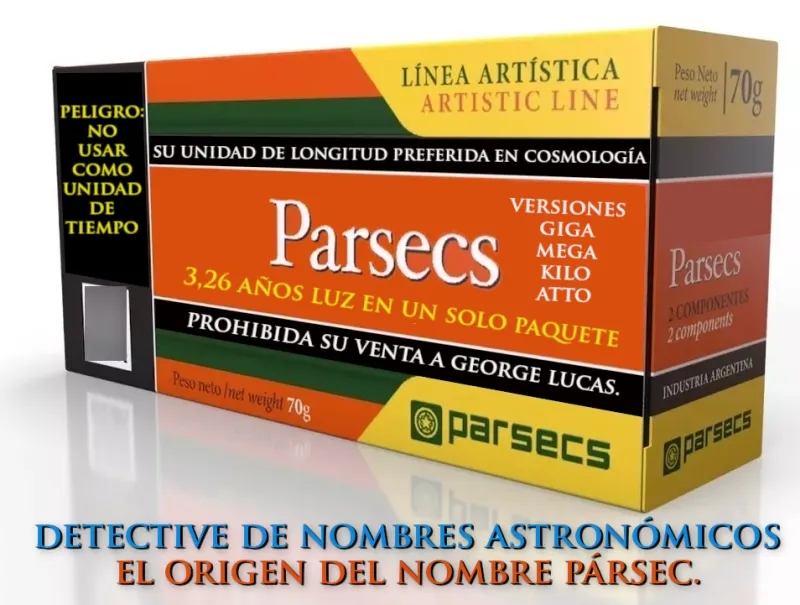
The detective of astronomical names (DNA) continues his tireless work, solving mysteries no one posed, answering questions never asked; an unprecedented and unusual task. In this episode, the Sherlock Holmes of astronomical names—also known as the Kent Brockman of astronomy—wanted to know the origin of the word Parsec.
According to the Biographical Encyclopedia of Astronomers, it would have been William Monck, an Irish astronomer (1839–1915) who suggested the use of the parsec as a unit of measurement for the first time in An Introduction to Stellar Astronomy (1899), where he would have written:
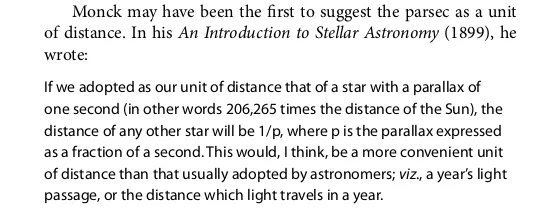
"If we adopt as our unit of distance that of a star with a parallax of one second (in other words, 206,265 times the distance to the Sun), the distance of any other star will be 1/p, where p is the parallax expressed as a fraction of a second. This would be a more convenient unit of distance—in my opinion—than that usually adopted by astronomers, namely, the passage of a light-year or the distance light travels in a year."
Regarding the name for that unit of measurement, the concern about this matter by astronomer Frank Watson Dyson is documented, who in 1913 wrote:
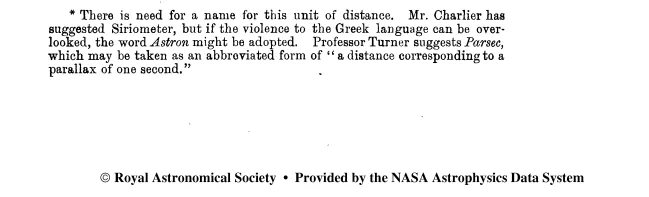
There is a need to name this unit of distance. Mr. Charlier has suggested Siriometer, but if the violence to the Greek language can be overlooked, the word Astron should be adopted. Professor Turner suggests Parsec, which should be taken as an abbreviation of 'a distance corresponding to a parallax of one second'.
The Turner he refers to is Herbert Hall Turner, British, like Dyson. Turner was a professor of astronomy at Oxford for decades. Beyond Dyson's comment referring to Turner, I did not find any document by the latter in which the word Parsec or any allusion to the subject appears. There is at least one paper on parallax, in which no name for a unit of distance measurement is mentioned. The English Wikipedia lists Turner as the one who coined the term, with reference to Dyson's published work as the only source.
It is at least curious that, at the distance given from Earth, equivalent to 3.26 light-years, there is no astronomical object, since the nearest star to the Sun lies at just over 4 light-years, less than 1 parsec. Therefore, if we take Earth as the point of origin, the parsec is a distance to nothingness. It would be ideal for measuring the seasons of the series Seinfeld, our DNA once commented while taking a sip of his 3.26th beer of the night.
THE PARSEC IN STAR WARS
A supposed error in the use of the word Parsec in the original Star Wars is known. It is a statement by Han Solo when talking about the Millennium Falcon: "It's the ship that made the Kessel Run in less than twelve parsecs," the character says (though in English in the original, of course). In some Spanish dubs they translated it as "para-seconds"... wtf!
Astronomers like Carl Sagan and Neil deGrasse Tyson have pointed out that it was a mistake to use a unit of length as if it were a measure of time. However, on the YouTube channel Odisea del Cosmos, run by Harold from Peru, they explain that it would not be a mistake. I leave the link with the video below. The summary is this:
According to the YouTuber, all ships when jumping to hyperspace would do so at the same speed. If some are ultimately faster than others, it is because they make shorter trips, calculating the shortest-length routes between two points. That would be the distinctive capability of the Millennium Falcon: to calculate better than other ships the shortest path, which, if traveled at the same speed as any other vehicle, will also be the fastest. Hence the phrase makes sense, although originally it did not seem to. This same idea is the one deployed in the script of the movie Han Solo. That is, it would never have been a mistake, according to believers in The Force. Likewise, the jump to hyperspace is exactly the same as a leap of faith.

ATTOPARSEC
On the (very, very nerdy) Jargon website, the "Cool Jargon of the Day" features the term attoparsec, a combination with the prefix atto, used to indicate a factor of 10^-18. An attoparsec is a trillionth of a parsec: ~ 3.1 cm; ~1.22 inches. What is it for? For the same thing as the exa-millimeter: For measuring the sense of humor.
I raise my glass to toast William Monck and Herbert Hall Turner for the idea of the parsec. I will toast to them for 12 attoparsecs...☉
Sources and related links
The Distribution in Space of the Stars in Carrington's Circumpolar Catalogue
F. W. Dyson, LL.D., https://academic.oup.com/mnras/article/73/5/334/972786?login=false
Biographical Encyclopedia of Astronomers: Monck, William Henry Stanley (1839-1915, Ireland), p. 798.
Wikipedia Parsec https://en.wikipedia.org/wiki/Parsec
Monck, William Henry Stanley https://www.dib.ie/biography/monck-william-henry-stanley-a5883
Monck, WHS (1899). An Introduction to Stellar Astronomy: with illustrations. London:
Hutchinson and Co., p. 51.
The expanding Universe: 100 years later https://bigthink.com/starts-with-a-bang/expanding-universe-100-years-later/
George Lucas was right about parsecs https://www.youtube.com/watch?v=JpDKs3Z00UU
Solo's Greatest Accomplishment Was Correcting One of the Most Infamous Star Wars Plot Holes https://www.esquire.com/entertainment/movies/a20967903/solo-star-wars-kessel-distance-plot-hole/
Cool Jargon of the Day http://jargon.net/jargonfile/a/attoparsec.html
About the images
Screenshots of the cited papers.