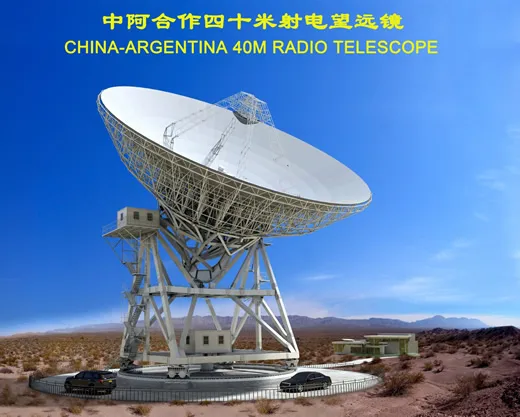
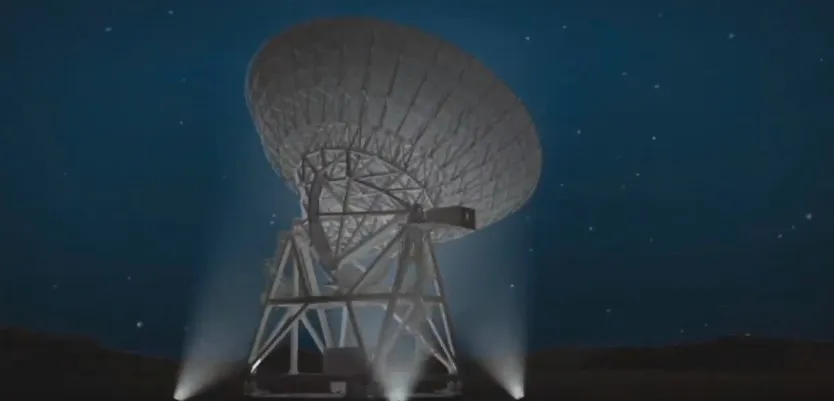
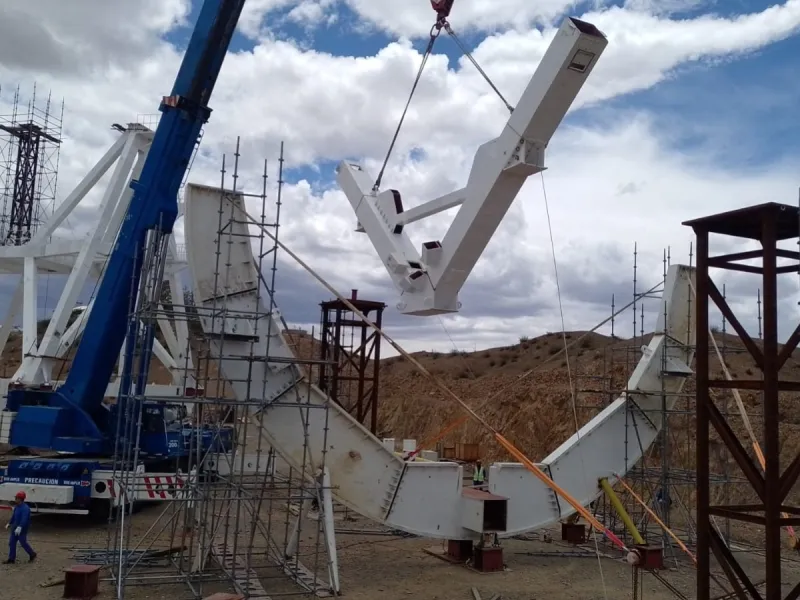
A 200-ton capacity crane is assembling the support-guide pieces that go under the main reflector and will allow its movement. The first tests are expected to be carried out by the end of 2025, and for it to be operational in the year 2026.
The Chinese-Argentine Radio Telescope Project (CART) is the result of collaboration between four key institutions: the Consejo Nacional de Investigaciones Científicas y Técnicas (CONICET), the Universidad Nacional de San Juan (UNSJ), the Government of San Juan, and the National Astronomical Observatories of the Chinese Academy of Sciences (CAS-NAOC). This strategic alliance aims to build a state-of-the-art radio telescope that will put San Juan on the map as an international-class astronomical hub.
Guillermo Perlo, a CONICET fellow at the Félix Aguilar Astronomical Observatory, commented that the final stage of assembly of the Radio Telescope in Barreal, Calingasta has already begun. Specifically, Perlo commented that the main reflector is finished, but is still at the base. The main structure is also almost fully assembled.
At this moment, a 200-ton capacity crane is assembling the support-guide pieces that go under the main reflector and will allow its movement.
Perlo has almost exclusive dedication to CART in supervising electrical/electronic aspects as an on-site technician, and commented that, in the immediate future, when the assembly of the main reflector's support-guide is completed, the main reflector will be lifted with a special 700-ton capacity crane and raised to place it on the main structure. This task is planned to be completed in March-April.
Furthermore, the arrival of the shipment with the supply of electrical and electronic control devices is awaited; once on site, their installation will proceed. In this regard, the main receiver is also already in special fabrication, and the placement of receivers for different bands is under study.
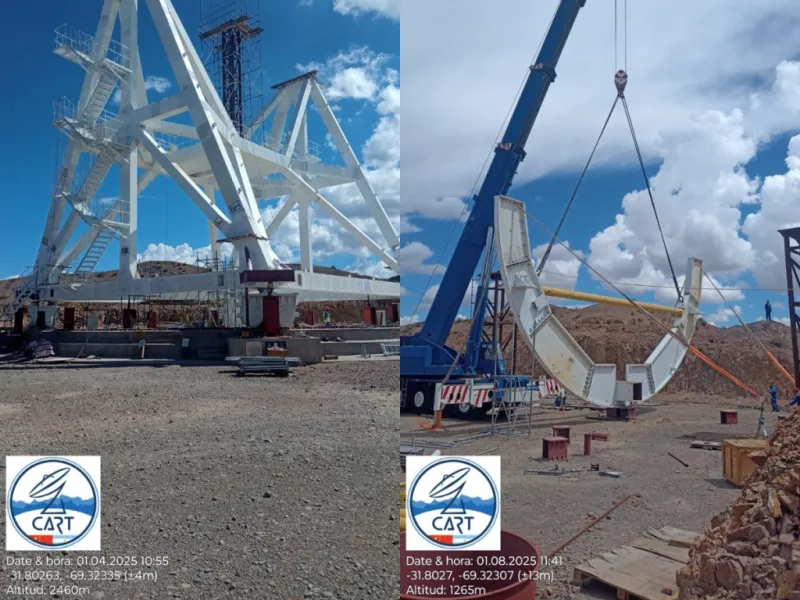
It is expected, barring significant delays, to carry out the first tests by the end of 2025, and for it to be operational in the year 2026.
The Project reported that the architecture of the future residence buildings, which will be built next to the current CESCO residence, is also under development, as is the control building that will be built next to the Radio Telescope.
The Radio Telescope
A Radio Telescope consists of four fundamental parts: antenna, positioning system, receiver, and data acquisition/processing system. The antenna positioning system directs it to the position to be observed and the main reflector or dish of the antenna collects the signal coming from that area. The radio astronomical receiver is responsible for taking the energy supplied by the antenna and conditioning it to appropriate levels and frequencies for recording. Data acquisition and processing is performed by a dedicated computing system.
The installation of CART in Argentina will contribute to improving the global coverage of the radio telescope network and, consequently, the determination of astro-geodetic parameters in our hemisphere and, especially, in Argentina.
Sources and related links
Final stage of assembly of the Radio Telescope begins https://www.unsj.edu.ar/home/noticias_detalles/8861/1
About the images
Credit: UNSJ