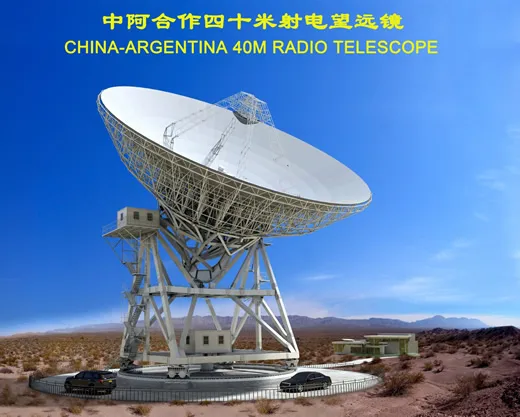
An ambitious project between Argentina and China for the construction of a large radio telescope in San Juan.
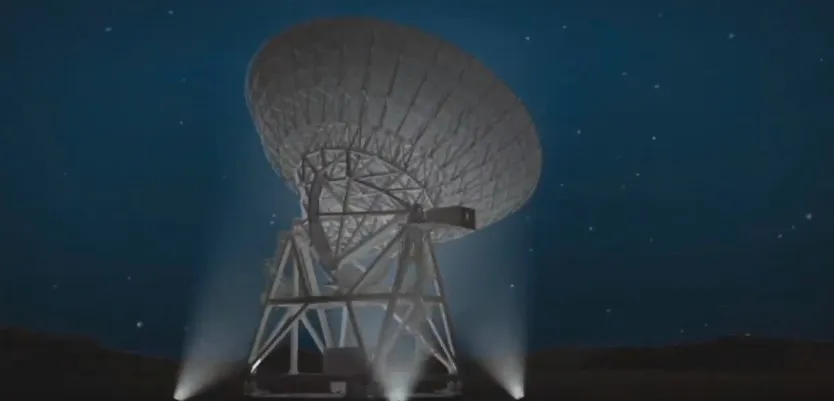
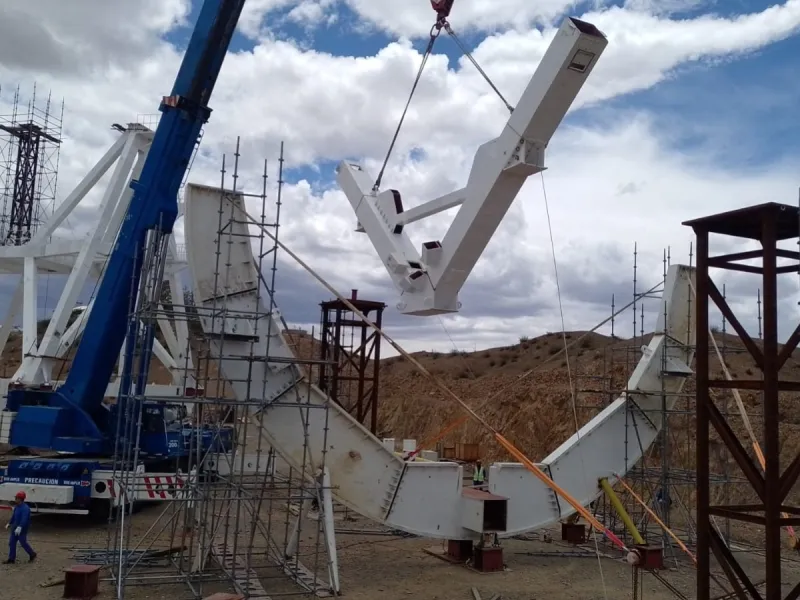
While the LLAMA (Large Latin American Millimeter Array) 12-meter project is being developed in northern Argentina, an agreement with China for the construction of a 40-meter instrument began in 2014. The change of government halted all projects with China, but it later continued and in 2017 the cornerstone was laid at the “Dr. Carlos Ulrico Cesco” High Altitude Station.
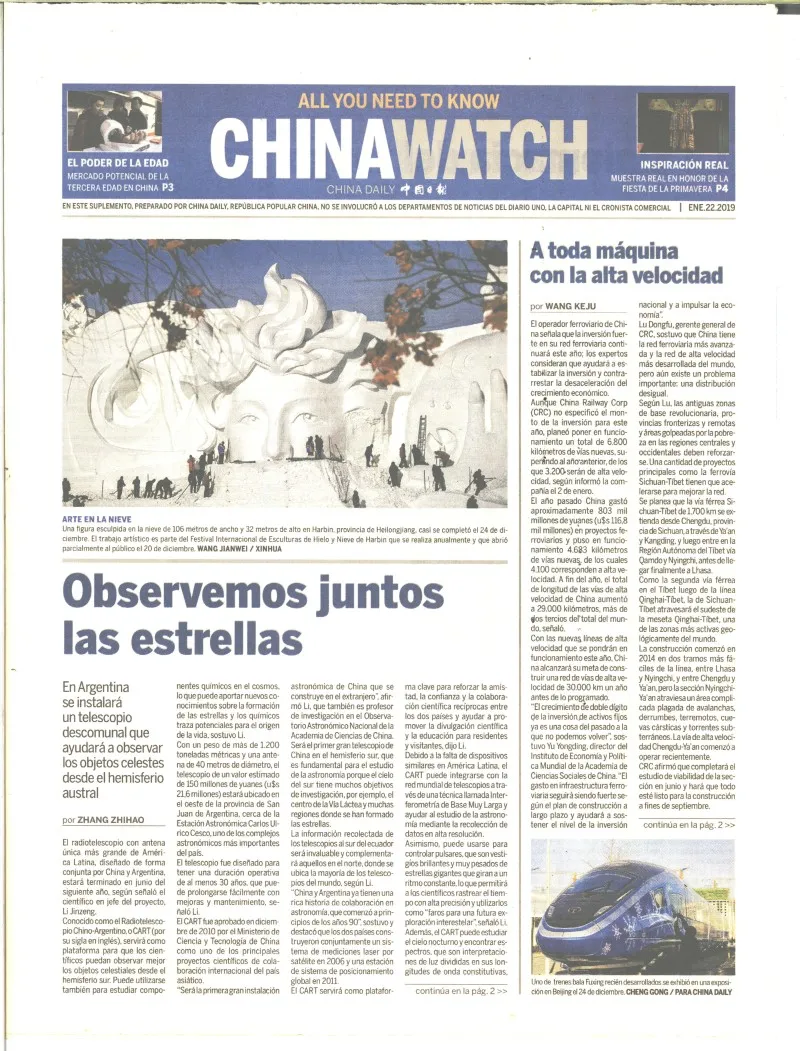
In the China Watch supplement distributed this week with the newspaper El Cronista, it is stated:
The largest single-dish radio telescope in Latin America, jointly designed by China and Argentina, will be completed in June of next year, according to the project's chief scientist, Li Jinzeng. Known as the Chinese-Argentine Radio Telescope, or CART (for its acronym in English), it will serve as a platform for scientists to better observe celestial objects from the southern hemisphere. It can also be used to study chemical components in the cosmos, which can provide new insights into the formation of stars and potential trace chemicals for the origin of life, Li said. Weighing more than 1,200 metric tons and with a 40-meter diameter antenna, the telescope with an estimated value of 150 million yuan (US$21.6 million) will be located in the west of Argentina's San Juan province, near the Carlos Ulrico Cesco Astronomical Station, one of the country's most important astronomical complexes. The telescope was designed to have an operational lifespan of at least 30 years, which can easily be extended with upgrades and maintenance, Li said.
CART was approved in December 2010 by China's Ministry of Science and Technology as one of the Asian country's major international scientific collaboration projects.
`It will be the first major astronomical facility of China built abroad,` said Li, who is also a research professor at the National Astronomical Observatories of the Chinese Academy of Sciences.
It will be China's first large telescope in the southern hemisphere, which is crucial for the study of astronomy because the southern sky has many research targets, for example, the center of the Milky Way and many regions where stars have formed. The information collected from telescopes south of the equator will be invaluable and will complement those in the north, where most of the world's telescopes are located, according to Li.
`China and Argentina already have a rich history of collaboration in astronomy, which began in the early 1990s,` he said and highlighted that the two countries jointly built a satellite laser ranging system in 2006 and a global positioning system station in 2011. CART will serve as a key platform to strengthen the friendship, trust and reciprocal scientific collaboration between the two countries and help promote scientific outreach and education for residents and visitors, Li said. Due to the lack of similar devices in Latin America, CART can be integrated with the global network of telescopes through a technique called Very Long Baseline Interferometry and help the study of astronomy by collecting high-resolution data. Likewise, it can be used to detect pulsars, which are bright and very heavy remnants of giant stars that spin at a constant rate, which will allow scientists to track time with high precision and use them as `beacons for future interstellar exploration,` Li said.
Sources and related links
China Watch: Let's watch the stars, by Zhang Zhihao.
Only a part of that article was extracted and the image, reduced, is published here with the sole purpose of documenting the reference.
CHINESE-ARGENTINA RADIO TELESCOPE (CART): NEW VEHICLE AND PROGRESS OF WORKS https://exactas.unsj.edu.ar/2018/01/06/chinese-argentina-radio-telescope-cart-vehiculo-obras/
CART (China-Argentina Radio Telescope)
https://www.argentina.gob.ar/ciencia/sact/cart
Radio telescope: only the concrete base will cost about 4 million dollars https://www.tiempodesanjuan.com/sanjuan/2018/5/2/radiotelescopio-solo-la-base-de-hormigon-costara-unos-millones-de-dolares-214340.html
The China-Argentina Radio Telescope was approved by MinCyT of Argentina http://english.nao.cas.cn/ns/NAOC_News/201408/t20140812_125744.html
First step for the assembly of the largest radio telescope in South America https://sisanjuan.gob.ar/noticias-planificacion-e-infraestructura/item/9513-primer-paso-para-el-montaje-del-radiotelescopio-mas-grande-de-sudamerica
CART Report: PDF https://exactas.unsj.edu.ar/wp-content/uploads/2017/03/Informe_Radiotelescopio_CART.pdf
Sirgas PDF infographic http://www.sirgas.org/fileadmin/docs/Boletines/Bol17/Podesta_et_al_Proyecto_CART.pdf
About the images
Initial image: screenshot from Marcelo Segura's video.
Videos
CART China Argentina Radio Telescope: Video by Marcelo Segura https://www.youtube.com/watch?v=ZayqPdpZcAg
Progress in the installation of the Radio Telescope- CART Project- 1: UNSJ interview with Marcelo Segura https://www.youtube.com/watch?v=EY_ow0W8TLI