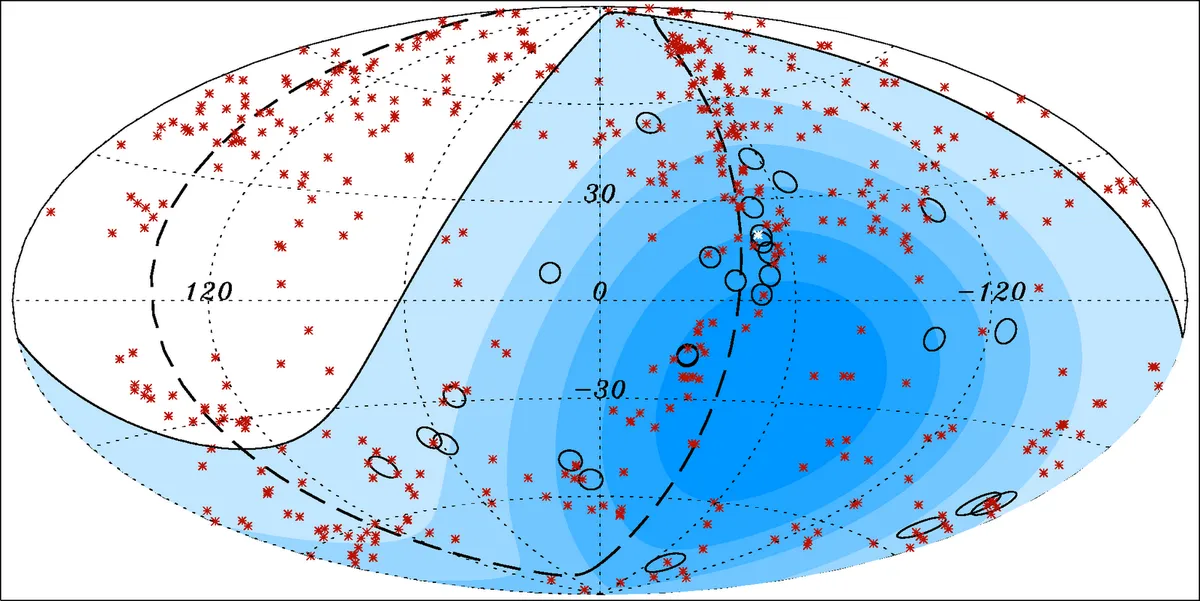
The relationship with Cen A has been established before with data from the Pierre Auger Observatory. This work deepens that relationship.
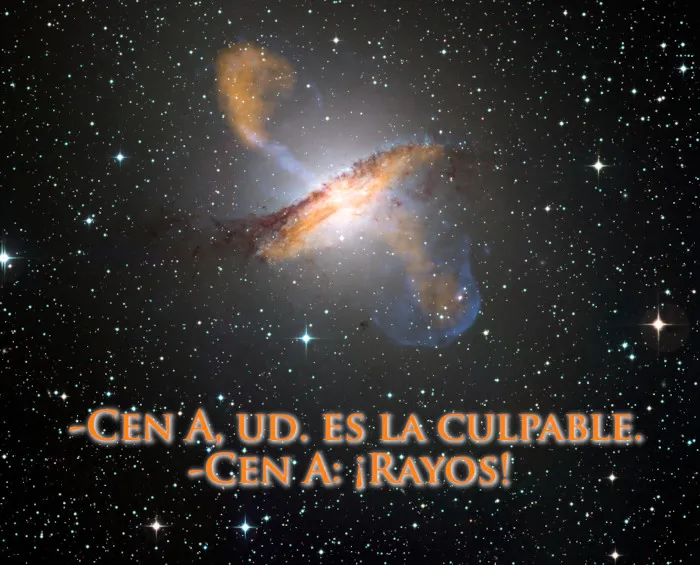
Argentine researchers Silvia Mollerach and Esteban Roulet (Centro Atómico Bariloche, CNEA, CONICET) published a work in which they discuss the possibility that a majority fraction of cosmic rays is due to a single nearby source, considering in particular the radio galaxy Centaurus A.
BRIEF INTRODUCTION TO UHECRs (ULTRA-HIGH-ENERGY COSMIC RAYS)
What follows is an excerpt from a text by astronomer Ana Laura Müller (See source, below):
Cosmic rays are mainly charged particles that possess very high energies, from approximately 10^-3 GeV to 1011 GeV^2. The flux of cosmic rays, that is, the amount of energy per unit area, time and solid angle in that energy range, is known as the cosmic ray spectrum. The lower-energy particles, that is, those with up to 30 GeV, are of solar origin.
Observing the spectrum of these particles, it is easy to notice that it is linear in sections, each with a different slope. The first of these slope changes occurs at energies on the order of 10^5-6 GeV, while the second occurs at energies of 10^8 GeV. The general shape of the cosmic ray spectrum is very similar to that of a human leg, which is why the first slope change is called the knee and the second the ankle.
We astrophysicists largely agree that cosmic rays in the range from 30 GeV to the knee are of galactic origin. On the other hand, the ankle is believed to represent the transition to the extragalactic regime, because particles with such high energies produced in the Milky Way could not remain in it, but would quickly escape and we would not detect them. At energies on the order of 10^11 GeV, the spectrum cuts off abruptly. The cause of this is thought to be the GZK effect, which causes the particles to lose energy through the interaction of cosmic rays with intergalactic radiation fields. Consequently, what were originally ultra-high-energy cosmic rays reach us as less energetic particles because they lost energy on the journey they traveled to Earth. In the case of protons, the most important interactions occur through interactions with the cosmic microwave background.
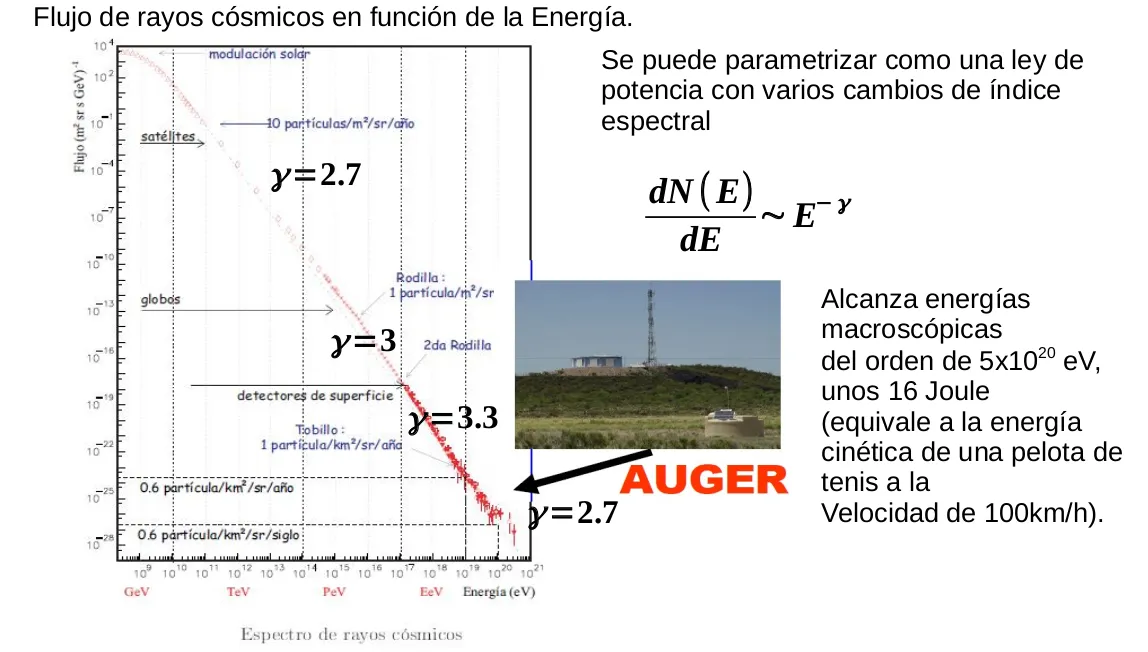
Fig. 1: cosmic ray flux as a function of energy. Credit: Patricia Hansen.
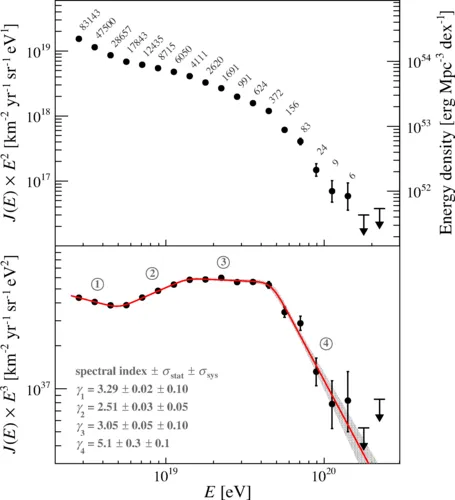
Fig. 2: Cosmic ray flux, where it is easier to notice the "leg", with its knee and ankle. Credit: Pierre Auger Observatory/Astrobites.
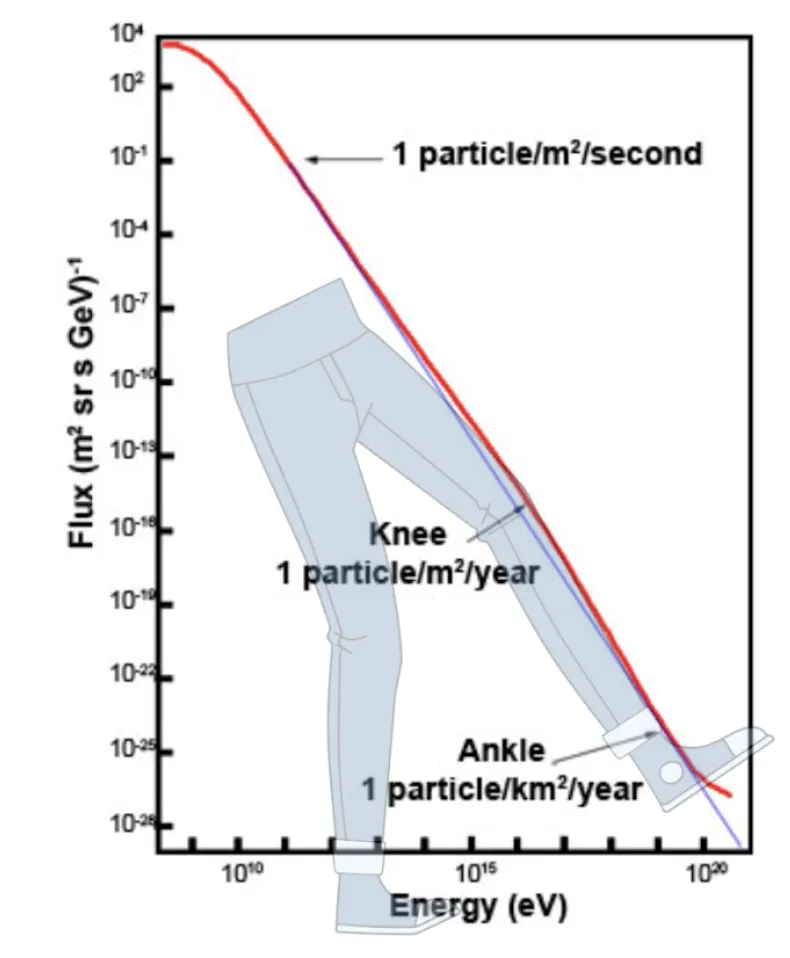
Fig. 3: Graph of the cosmic ray flux "leg", with its knee and ankle, according to Astrobites.
With this in mind, the authors performed models that match data obtained at the Pierre Auger Observatory in Mendoza. To that model they added more realistic conditions. The result does not rule out the contribution of other sources, but suggests that the main source is one: in particular, for heavy elements, which are less scattered by magnetic fields, a hotspot appears in Cen A.
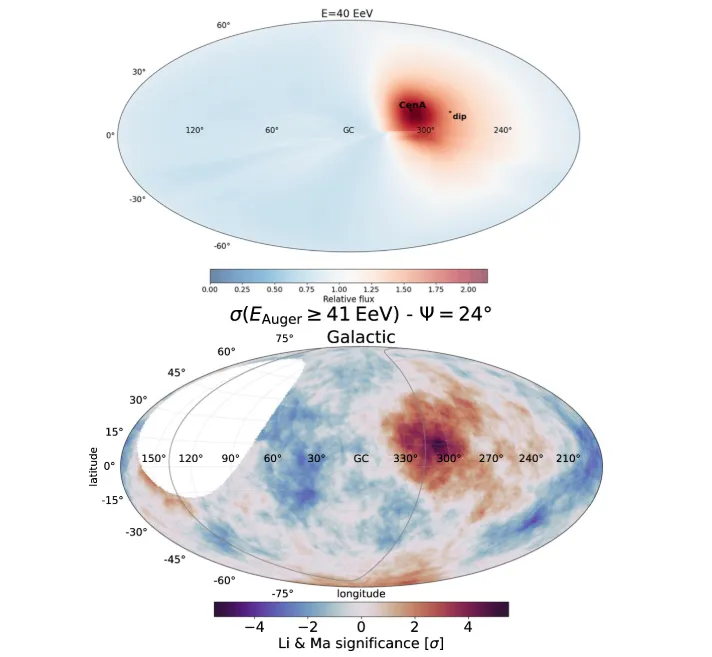
Figure 3: The distribution of UHECRs above 40 EeV, assuming all are produced by Cen A (top panel) and the hotspot observed from Pierre Auger (bottom panel), in galactic coordinates. In both cases, red indicates a higher flux of cosmic rays.
ENERGY
The electronvolt (symbol eV) is a unit of energy representing the change in energy experienced by an electron when moving, when the potential difference of the electric field is 1 volt. EeV means Exa eV (10^18) and GeV means Giga eV (10^9).
Cen A (NGC 5128) is a lenticular galaxy 14 million light-years away. Besides being a radio galaxy, it is a starburst galaxy. It is located in Centaurus, which is logical, considering it emits cosmic rays like crazy...☉
Sources and related links
- No horsing around: Centaurus A could be a nearby cosmic ray factory
https://astrobites.org/2025/02/06/cena-cosmic-rays/ - Case for Centaurus A as the main source of ultrahigh-energy cosmic rays
Silvia Mollerach, Esteban Roulet
https://arxiv.org/abs/2406.19199 - LOS EFECTOS GRAVITATORIOS CUANTICOS EN LOS RAYOS COSMICOS DE ENERGIAS ULTRAALTAS
Jorge Alfaro Solís
http://www.fis.puc.cl/~jalfaro/fiz1111/charla/rcae3.pdf - Cosmic Rays: where and how to find them
http://tux.iar.unlp.edu.ar/divulgacion/art-difu-46.htm
Ana Laura Müller - Class 15 - Pierre Auger Observatory - 08/03/21)
https://laconga.redclara.net/courses2021/astroparticulas-cosmologia/rayos-cosmicos-auger/clase01/clase01.html
Patricia Hansen - Pierre Auger Observatory
https://visitantes.auger.org.ar/
About the images
By ESO/WFI (Optical); MPIfR/ESO/APEX/A.Weiss et al. (Submillimetre); NASA/CXC/CfA/R.Kraft et al. (X-ray) - http://www.eso.org/public/images/eso0903a/, CC BY 4.0, https://commons.wikimedia.org/w/index.php?curid=5821706
Pierre Auger Collaboration/P. Hansen